
Sodium-ion (Na-ion) batteries are emerging as an alternative to lithium for storage. For off-grid solar, the main comparison is with LiFePO4. Here’s how they stack up and when each makes sense.
What Is Sodium-Ion?
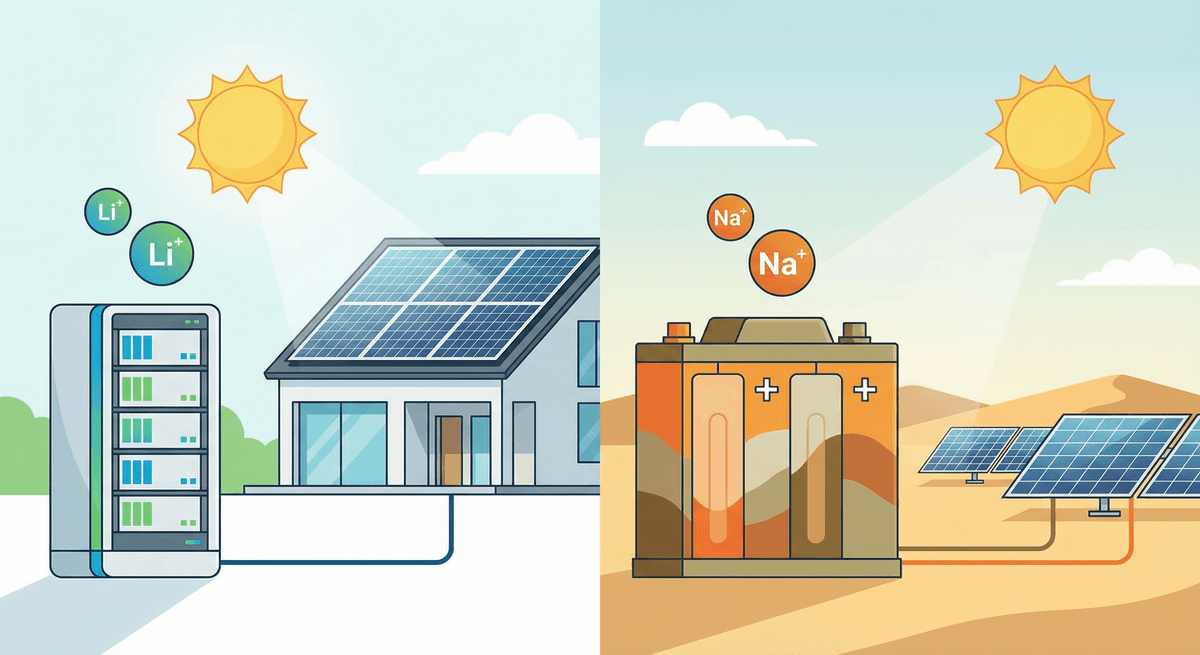
Sodium-ion cells use sodium instead of lithium. Advantages in theory: abundant raw materials, lower cost potential, and good safety. Trade-offs: slightly lower energy density and a less mature supply chain than LiFePO4.
LiFePO4 vs Sodium-Ion: Quick Comparison
| Factor | LiFePO4 | Sodium-ion (typical) |
|---|---|---|
| Energy density | Good | Slightly lower |
| Cycle life | 3,000–6,000+ | Improving; often similar |
| Cost (per kWh) | Moderate | Potentially lower |
| Safety | Very good | Very good |
| Availability | Widely available | Growing, region-dependent |
Where Sodium-Ion Fits in 2025
- Cost: If Na-ion is cheaper per kWh where you are, it can be attractive for large, fixed installations where weight isn’t critical.
- Sustainability: Sodium is abundant; some buyers prefer it for supply-chain or environmental reasons.
- Maturity: LiFePO4 is proven in off-grid solar; sodium-ion is newer. Check warranties, datasheets, and reviews before committing.
When to Choose LiFePO4
- You need maximum energy per weight (RV, boat, portable).
- You want the most proven chemistry for off-grid today.
- You need wide product availability and installer familiarity.
When to Consider Sodium-Ion
- Large, stationary off-grid or hybrid systems.
- Price is the main driver and Na-ion is clearly cheaper per kWh in your market.
- You’re comfortable with newer technology and have verified specs and support.
For most off-grid users in 2025, LiFePO4 remains the default; sodium-ion is worth watching and comparing where available. Use the WattSizing calculator to size your bank; it supports LiFePO4 and can be used with sodium-ion by entering equivalent usable capacity and DoD.


