
Peak sun hours are one of the most important numbers in off-grid solar sizing. They tell you how many “full sun” hours your location gets per day so you can size your panels correctly. This guide explains what they are and how to use them.
What Are Peak Sun Hours?
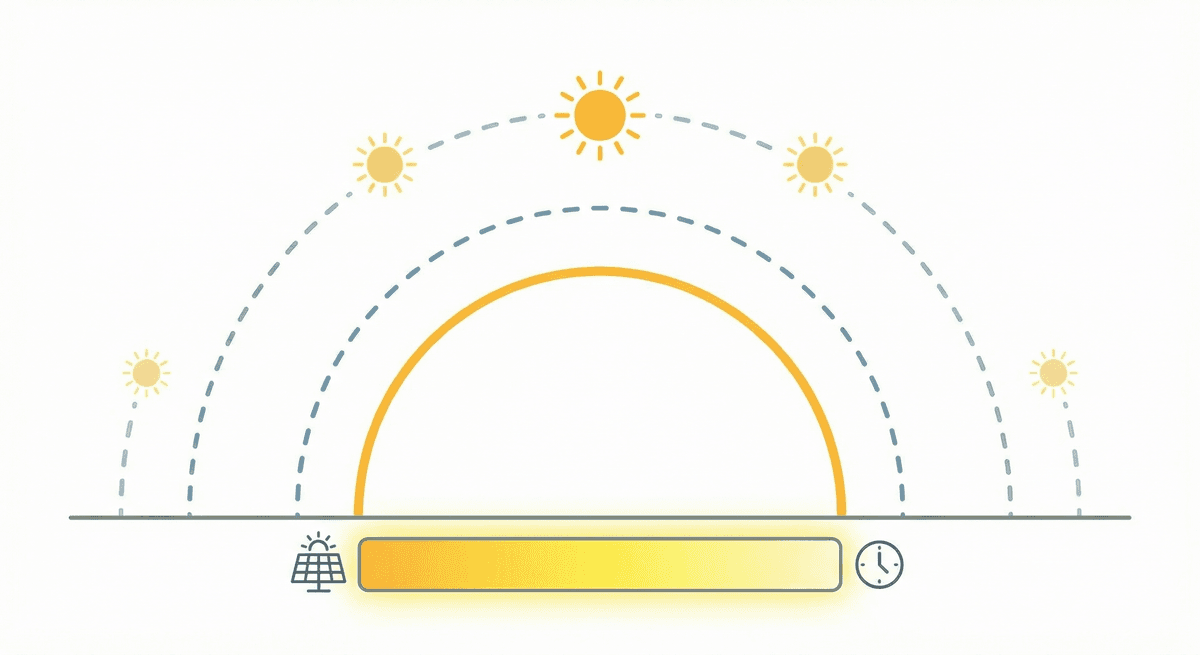
Peak sun hours (also called sun hours or solar insolation) are the number of hours per day when sunlight is equivalent to 1,000 watts per square metre (full sun). Real sunlight is weaker in the morning and evening and stronger at midday. So “4 peak sun hours” means the total energy you get that day is the same as 4 hours of full, direct sun.
They are not sunrise to sunset. A place might have 12 hours of daylight but only 4–5 peak sun hours because early and late light is weaker.
Why They Matter for Sizing
The solar panel formula is:
Array size (W) = Daily use (Wh) ÷ Peak sun hours ÷ Efficiency
So if you use 2,000 Wh/day and have 4 peak sun hours at 75% efficiency:
- Array = 2,000 ÷ 4 ÷ 0.75 = 667 W of panels
If you used 6 peak sun hours by mistake, you’d undersize (only 444 W) and run short in winter. Using conservative (low) peak sun hours for your worst month keeps you safe.
How Peak Sun Hours Vary
- Location: Sunnier regions (e.g. many parts of Australia, southwest USA) have more peak sun hours; cloudy or high-latitude areas have fewer.
- Season: Winter has fewer peak sun hours and shorter days; summer has more. For year-round off-grid, size using winter or your worst month so you don’t run short.
- Tilt and orientation: Values in tables are often for an “optimal” tilt. Flat panels or poor angle can reduce effective sun hours; our winter and low-sun sizing guide goes deeper.
Where to Get Numbers
- Online tools and maps: Search “peak sun hours [your city/country]” or “solar insolation map.” Many solar calculators and government energy sites publish average daily sun hours by month.
- Use the worst month: If December is 3.5 and July is 6, size with 3.5 (or a bit less) for reliability.
Summary
- Peak sun hours = equivalent full-sun hours per day (1,000 W/m²).
- Use them in: Array (W) = Daily use (Wh) ÷ Peak sun hours ÷ Efficiency.
- Use a conservative value (e.g. worst month) so your off-grid array and battery stay sufficient year-round. Enter your location and daily use in the WattSizing calculator to get recommended panel and battery size.


