
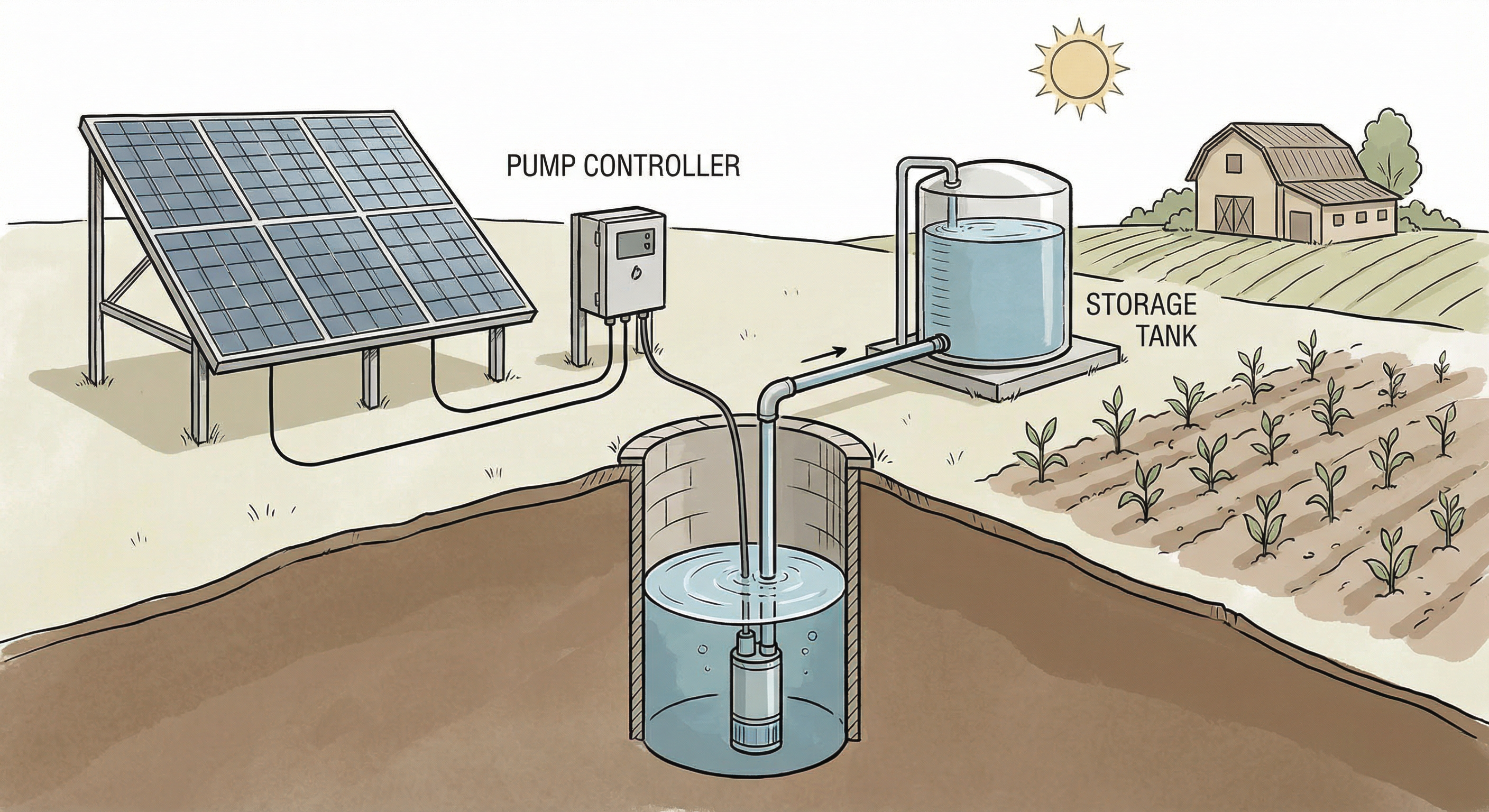
Water is life. For off-grid properties, getting water out of the ground is often the #1 priority, even before lights.
Grid-tied homes use 240V AC well pumps that surge to 4000W+ on startup. Running one of these on a small off-grid inverter is a recipe for disaster.
Here is how to pump water efficiently with solar.
1. The Two Main Approaches
A. Direct-Drive DC Solar Pumps (The "Simpler" Way)
These pumps run directly off solar panels. No batteries required.
- How it works: When the sun shines, the pump spins. When a cloud passes, it slows down. When the sun sets, it stops.
- Storage: You store water, not electricity. You pump water into a large cistern or tank on a hill (gravity feed) during the day to use at night.
- Pros: Extremely efficient, very reliable (no batteries to fail), simple.
- Cons: No water pressure at night unless you have a gravity tank.
B. AC Pumps with Batteries (The "Standard" Way)
You use a standard 120V/240V well pump powered by your main solar inverter and battery bank.
- How it works: The inverter powers the pump just like a grid outlet.
- Pros: High pressure (40-60psi) on demand, 24/7. Works at night.
- Cons: Requires a massive inverter (to handle the surge) and a large battery bank. Inefficient.
Recommendation: For livestock, irrigation, or filling a cistern, use Direct-Drive DC. For household pressure, use a small DC pressure pump or a Soft-Start AC pump.
2. Sizing a Solar Pump
To pick the right pump, you need two numbers:
- Total Dynamic Head (TDH): The vertical distance (in feet or meters) from the water level in the well to the top of your storage tank + friction loss in the pipe.
- Example: Well water is at 100ft. Tank is 50ft up a hill. TDH = 150ft.
- Flow Rate (GPM): Gallons Per Minute needed.
- Example: Filling a 1000-gallon tank in 5 hours of sun = 200 gallons/hour = ~3.3 GPM.
3. Selecting Panels for a DC Pump
Most DC solar pumps (like Grundfos or RPS) have a specific voltage range (e.g., 30V - 300V).
- Oversize the Array: If a pump is rated for 100W, use 200W of panels. This ensures it starts earlier in the morning and runs through clouds.
- Series Wiring: Higher voltage is better for pushing water up high heads. Wire panels in series to increase voltage.
4. Pressure Tanks vs. Cisterns
- Pressure Tank: The small blue tank in your basement. It holds 20-80 gallons under pressure. The pump cycles on/off frequently. Bad for solar pumps.
- Cistern (Storage Tank): A large (500+ gallon) non-pressurized tank. The solar pump fills this slowly all day. A separate, small 12V/24V "booster pump" (like an RV pump) then pressurizes the water from the cistern to your faucet. This is the most efficient off-grid design.
5. Winter Protection
- Freeze Protection: Solar pumps don't generate heat. If the pipe above ground freezes, the pump can burn out pushing against ice.
- Weep Hole: Drill a small 1/8" hole in the drop pipe below the frost line. This allows water in the pipe to drain back down when the pump stops, preventing freezing.
Conclusion
Moving water is heavy work.
- Best Efficiency: DC Submersible Pump -> Cistern -> Gravity Feed.
- Best Comfort: DC Submersible Pump -> Cistern -> DC Booster Pump -> Pressure Tank.
Avoid running a standard 1.5HP AC well pump on a small solar system. It will kill your inverter.
For more on sizing loads, see How to Calculate Your Energy Consumption.


