
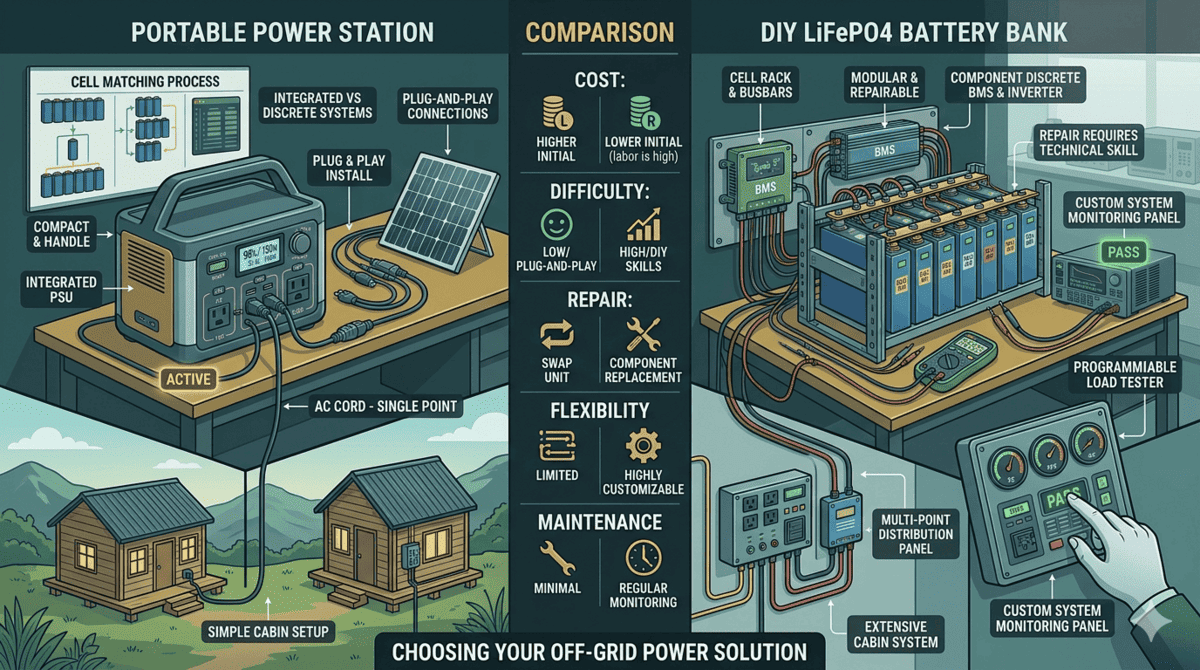
For a weekend cabin, a portable power station (2–4 kWh usable) wins on setup and mobility. For 6–15+ kWh and years of growth, a DIY LiFePO4 bank usually beats on $/Wh, expandability, and repair—if you will wire BMS, fuses, and enclosure.
Bottom line: boxed units often land ~$400–$1,100 per usable kWh at small sizes; a planned DIY rack at 8–12 kWh commonly falls ~$180–$340/kWh before labor. Match the architecture to camping shuttle vs fixed cabin, not nameplate Wh alone. Tiered dollars: solar generator vs DIY cost.
Scope: what you are buying
Portable power station — sealed pack, inverter, charger, and app in one case; plug loads and solar, little wiring.
DIY LiFePO4 bank — cells or rack modules, BMS, inverter or hybrid, fuses, and monitor you assemble per a DIY wiring guide. You own the bus and the parts list.
$/Wh: where each path wins
Use usable kWh (depth-of-discharge and BMS reserve), not marketing Wh. Illustrative 2026 upfront bands:
| Usable kWh | Portable (typical $/kWh) | DIY (typical $/kWh) |
|---|---|---|
| ~1 | $400–$900/kWh | $900–$1,500/kWh — DIY rarely wins |
| ~3 | $500–$1,170/kWh | $900–$1,470/kWh — similar; DIY wins on growth |
| ~8 | Stack units → $600–$900+/kWh | $250–$340/kWh with rack + inverter |
| ~12 | Few single boxes; stacking costly | $180–$280/kWh — see Grade A vs B LiFePO4 |
Add integration cost for DIY: enclosure, fuses, cable, shunt, and time. Cells-only math can look cheaper than a portable until you pass ~5 kWh usable.
Expandability
Portables grow by buying a larger unit, brand expansion packs, or a second box (separate inverters; sync limits vary). You depend on firmware, connectors, and SKUs staying available—outgrowing 3 kWh often means sell and replace, not bolt on 5 kWh.
DIY grows by parallel rack modules, upsized inverter when watts rise, and more solar MPPT capacity. Add 5 kWh this year, another 5 next year; swap one failed module without trashing the system—if bus, BMS, and fusing follow a proper DIY off-grid wiring guide.
Repair after warranty
| Issue | Portable | DIY |
|---|---|---|
| Bad pack | Whole-unit RMA or replace | Swap module or cell group |
| Inverter | New station | New inverter only |
| Parts | Scarce third-party | Cells, BMS, fuses from many vendors |
Portables suit never open the case. DIY suits a 10–15 year cabin asset if you will torque terminals and test capacity. Use reputable cells—Grade A vs B LiFePO4 matters for safety and longevity.
Cabin vs camping
Camping / RV / tailgate — portable: grab-and-go AC, fast solar plug-in, ~0.3–1.5 kWh/day (phones, lights, laptop, small fridge). DIY rarely pays unless you already run a mobile battery box.
Weekend cabin (few days/week) — portable works under ~2–4 kWh/day if surge fits (check fridge and pump LRA). DIY starts to win with freezer + pump + 2-day autonomy without stacking boxes.
Full-time off-grid cabin — DIY or installer LiFePO4 at 8–20 kWh, fixed solar, generator input. Portables become backup, not the main bus.
Worked example: weekend runtime
Loads: lights 0.2 + devices 0.3 + pump 0.2 + fridge 0.8 + router 0.1 = 1.6 kWh/day
Target: 2 days without sun → 3.2 kWh; size ~1.2× for BMS/DoD → ~3.8–4 kWh usable
Surge: fridge ~600–1,200 W; small pump ~300–800 W
Option A — portable 4 kWh usable ($2,000–$2,800):
- No sun: 4 ÷ 1.6 ≈ 2.5 days
- Add 1 kWh/day heater block: 4 ÷ 2.6 ≈ 1.5 days — feels tight fast
- ~$500–$700/kWh usable in this band
Option B — DIY 5 kWh usable ($2,300–$3,200 parts):
- No sun: 5 ÷ 1.6 ≈ 3.1 days; with heater 5 ÷ 2.6 ≈ 1.9 days
- ~$460–$640/kWh usable; +5 kWh next year without new inverter if headroom allows
Log your site in the WattSizing Calculator with real kWh/day and peak W.
What most guides skip
- Integration cost belongs in DIY totals—not cell price alone (solar generator vs DIY cost).
- Surge beats Wh on the label — a 4 kWh box that trips on pump or freezer LRA feels broken.
- Cold climates — both paths need LiFePO4 cold-charge limits; DIY needs BMS and sometimes heat.
Checklist
- Estimate kWh/day and surge W (meter one weekend).
- Decide mobility vs fixed install.
- Compare 24-month cost including expansion and repairs.
- Confirm warranty / spare module path.
- Match maintenance style — app-only vs wrench.
FAQs
Is DIY always cheaper than a portable power station?
No. Below ~2–3 kWh usable, DIY often costs more per kWh than a sale portable. DIY usually wins from ~5–8 kWh up when inverter and enclosure are shared.
How do I compare $/Wh fairly?
Use usable kWh and full DIY stack cost—inverter, BMS, fuses, enclosure—not cells alone.
Can I expand a portable like a DIY rack?
Only via same-brand expansion batteries or another unit—not generic kWh.
Which repairs better after warranty?
DIY — swap cells, BMS, or inverter. Portables are usually replace-only.
Are portables OK for continuous cabin use?
Many allow regular use within ventilation and load limits in the manual. Full-time primary cabins more often use fixed LiFePO4 with proper overcurrent protection.
When is portable clearly right?
Grab-and-go, 1–3 day trips, under ~2 kWh/day — camping, RV, tailgate. Multi-day autonomy and growing loads usually outgrow one box.
CTA
Model cabin or camp loads in the WattSizing Calculator, then compare both architectures on the same kWh/day, autonomy days, and surge watts.


