
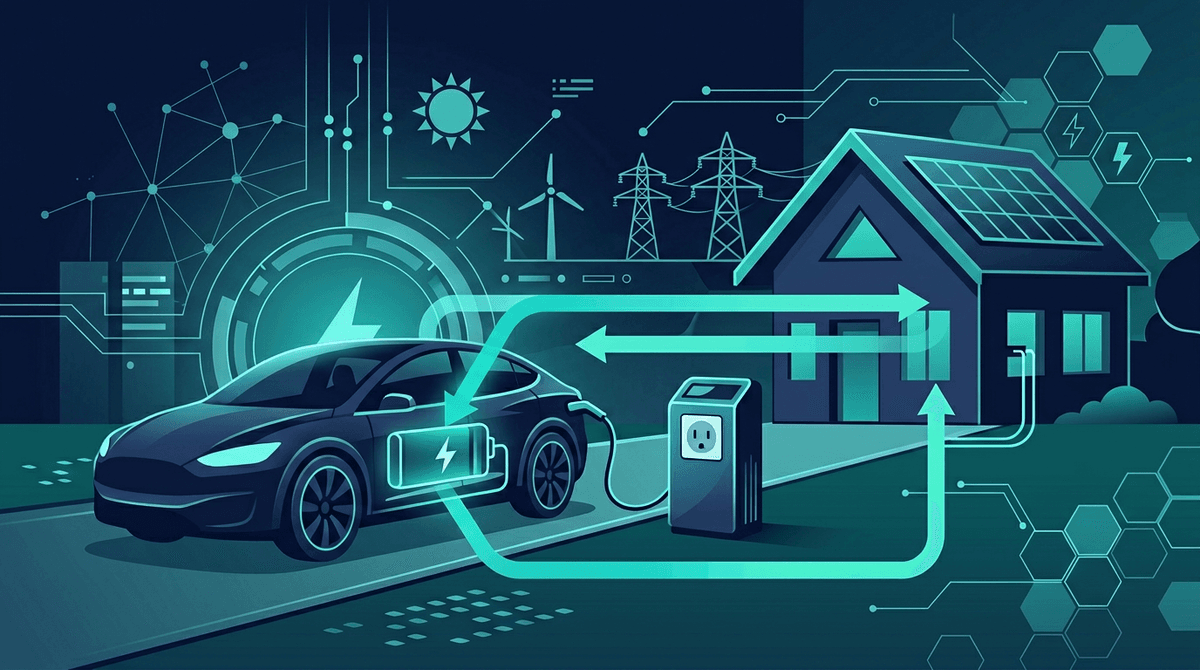
If you only remember three numbers as you shop, they are kW of export (how big a “generator” the car is), kWh in the pack (how long you can run), and how much of the house the approved hardware can attach to. The rest of this page is the wiring between those three ideas—without pretending every EV can do everything.
Use the WattSizing Calculator when you are translating a list of devices into a daily or outage plan.
Related: refrigerator wattage and EV Charging 120V vs 240V Efficiency for charging-side planning.
What bidirectional charging means in everyday hardware
-
V2L (vehicle to load): the EV exports outboard AC to a few outlets. Think “big portable power with wheels.” Wires often run to a few appliances or a transfer switch setup for partial home backup, depending on your kit. Export power is frequently in the 1.4–3.6 kW class for the portable-cord style systems people discuss most often, with some higher export paths when manufacturers publish larger inverter ratings for specific product stacks.
-
V2H (vehicle to home): a permitted, installed path to energize a home (or a critical subpanel) in a way your utility and local code will recognize when required. The headline is still kW and duration, but the safety story (transfer gear, earthing, anti-islanding) is the expensive part. Treat V2H as an electrical system project first and a “EV feature” second.
-
V2G (vehicle to grid): sending energy to the distribution grid (sometimes for market programs). For homeowners, the interesting question is whether your interconnection and tariff even allow it—and whether the revenue story beats wear-and-cycle anxiety. The U.S. Department of Energy summarizes managed and bidirectional charging as an emerging stack that can include building backup, microgrid, and—where allowed—grid services; see the FEMP note on managed charging and bidirectional EVs for a policy-correct overview.
WattSizing’s angle is not “pick a brand,” but: map your loads in watts, then see what each mode can carry.
A watts-first mental model (breakers and export caps)
Your house does not care that the battery is under the hood. It only asks:
- How many continuous watts? (heat pump, resistance heat, and large well pumps are common limiters)
- How many starting watts? (compressor motors, some pumps, older refrigerators)
- For how long? (kWh)
If an EV can export 2.0 kW continuous through a V2L adapter, a 1,800 W resistive load is close to the cap; add a fan and a router and you are near tripping. If the path supports 6–10 kW (some integrated V2H systems advertise range-style numbers, always read the manual for your configuration), the same home can run more simultaneously—but not “whole-home unlimited” without matching service equipment and a licensed design.
Quick conversion reminders
kW × 1h = kWh- If you must budget in amps at 240 V:
W = V × A(power factor and inverter limits still apply; this is a first-pass pencil check) - Inverter losses matter: a 1.0 kW house load is not a 1.0 kW car-side loss; budget 10–20% as a first-pass “conversion tax” for rough planning only, then tighten with your equipment’s stated efficiency if available.
This is the same skill set you use in electricity bill from kWh.
When an EV beats a fixed home battery—and when it does not
Where EV packs win on paper
-
kWh per dollar of storage (nominal): a long-range EV is often a dozens of kWh object you already own. A typical residential home battery is commonly discussed as a ~10–15 kWh class device for many installs—handy, but not the same order of duration for multi-day backup.
-
Flexibility: you can take the kWh to another address (drive away). Fixed batteries cannot.
Where fixed batteries still win in practice
-
Automatic backup path: many home battery + gateway installs are designed for seamless transfer with permitted controls; EV export depends on the presence of a compatible wall unit, the car’s own rules, and whether you are home to deploy V2L gear.
-
Chemistry and control tuned for building duty: stationary BMS, thermal management, and warranty framing are not identical to an automotive pack cycling under driving loads.
-
Wiring clarity: a battery on the wall has one job. An EV that leaves for work is not a guaranteed outage asset if you are not on planning assumptions that reflect reality.
If you are comparing options at the cell level, start with the chemistry overview in flexible vs rigid solar panels—the EV pack is a different product class, but the energy accounting is the same: usable kWh × inverter efficiency = useful AC energy.
Outage math template (illustrative)
Assume an export path of 2.0 kW useful continuous AC (round numbers for intuition only):
-
2.0 kW × 4 hours = 8.0 kWhfrom the inverter and wiring, independent of the car’s total kWh; you still must respect car-side minimum state of charge and any manufacturer cutoffs. -
If a refrigerator + freezer + a few small loads average 400 W together (duty cycles matter; see how to estimate appliance duty cycle), the average is
0.4 kW→ about0.4 × 24 = 9.6 kWhper day if that average holds—a reminder that kWh of storage and kWh of daily need are different conversations. -
If you add a 1,200 W space heater, you are often past a 2.0 kW export on paper once margins and inrush are counted.
None of the above is a promise about your car; it is a load-list discipline.
Buying checklist: questions that keep projects honest
- What is the continuous export, not the headline adjective?
- Is your goal “keep fridge+lights+internet” or “run central AC”? Those are not the same hardware paths.
- Who will stamp the V2H plan? (AHJ, utility, and qualified electrician—not a forum thread)
- If you are grid-tied, will any proposed export conflict with your interconnection agreement if it touches the grid? The DOE discussion above explicitly flags the need to align with the serving utility; treat this as a real gate.
- If you are off-grid, is the EV the sole plan? Many off-grid homes still pair solar + fixed storage for daily cycling and keep the car as a bonus or emergency layer.
FAQs
Is V2L the same as a portable power station on wheels?
Conceptually similar in shape (AC outlet energy from a pack), but the safety, grounding, and legal path to energize a building differ. A portable power station in the yard is a consumer device. A house is an electrical system.
Why do I see different kW numbers for the “same” vehicle?
Export paths differ by region, model year, charging hardware, and software enablement—and marketing rounds aggressively. Your manual beats a headline.
Can any EV backfeed my home without a transfer system?
Do not improvise where code requires a transfer or listed equipment. The goal in codes is to protect people working on the lines and to prevent your export from backfeeding an outage unsafely.
Does bidirectional export reduce battery life?
Cycling a pack for home energy is still cycling—whether the wear story matters depends on how often you do it, depth of discharge, temperature, and manufacturer guidance. V2G economics can be interesting; treat cycle counts as a real line item, not a footnote.
Where does WattSizing’s calculator fit?
Use the WattSizing Calculator to convert appliances into a coherent W / Wh / kWh story, then compare that story to the kW and kWh the EV path can make available. If the numbers do not connect, the problem is usually missing duty-cycle realism, not “more gadgets.”
I only need “keep the fridge and a few USB things.” Is V2L overkill?
Often, no—a modest, clearly bounded load list is the natural fit for a 1–2 kW-class export, as long as you stay disciplined about not also starting large motors at the same time. Write the list on paper with starting + running watts, then re-check the sum against your export cap.


