
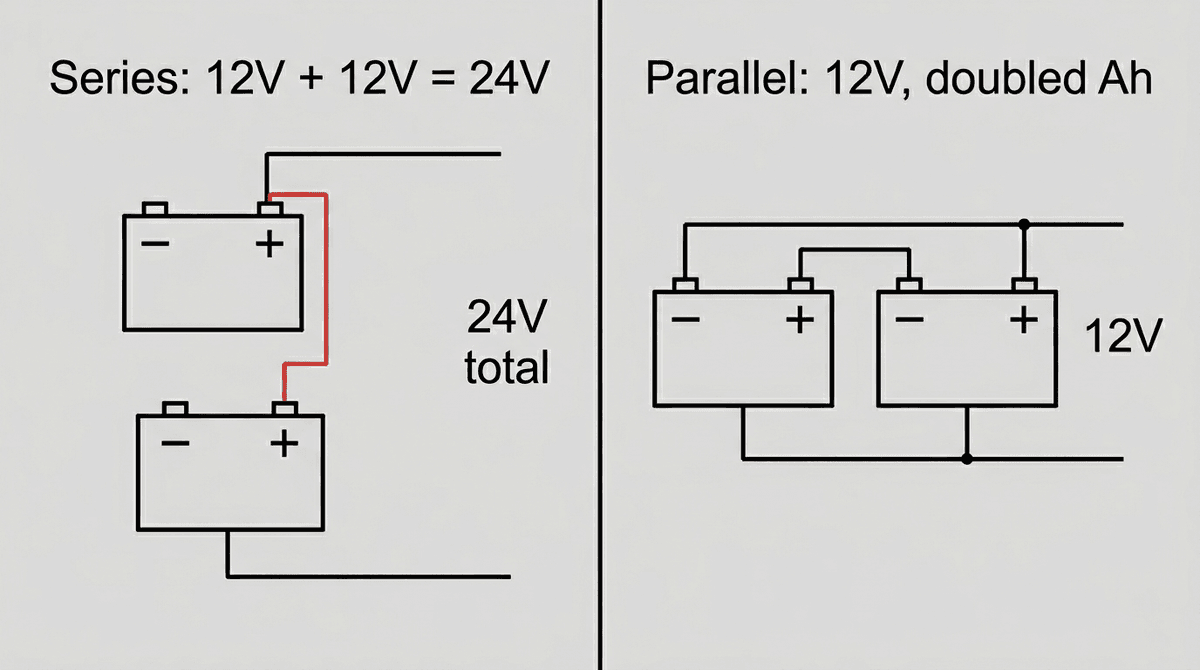
When designing an off-grid solar power system, one of the most fundamental decisions you will make is how to connect your battery bank. If you have two or more 12V batteries, you have two primary options: wiring them in series or wiring them in parallel.
Understanding the difference between series vs parallel battery connections is critical. Making the wrong choice can lead to inefficient charging, damaged equipment, or a system that simply cannot power your essential appliances. In this comprehensive guide, we will break down exactly how to connect two 12V batteries in series vs parallel, the advantages of each method, and which one is right for your specific solar setup.
If you are just starting out, be sure to check out our solar calculator to determine exactly how much battery capacity your system needs.
Understanding Battery Basics: Voltage and Capacity (Ah)
Before diving into the wiring methods, it’s essential to understand the two main metrics used to measure battery power:
- Voltage (V): Think of voltage as the "pressure" of the electricity. A standard deep-cycle solar battery is typically 12 volts.
- Amp-Hours (Ah): This measures the capacity or "volume" of energy the battery can store. A 100Ah battery can theoretically provide 1 amp of current for 100 hours, or 100 amps for 1 hour.
The way you connect your batteries will alter either the total voltage or the total amp-hour capacity of your battery bank.
Connecting Batteries in Series
Wiring batteries in series increases the total voltage of the battery bank while keeping the amp-hour capacity the same.
How to Wire Two 12V Batteries in Series
To connect two 12V, 100Ah batteries in series:
- Connect the Positive (+) terminal of Battery A to the Negative (-) terminal of Battery B using a heavy-duty battery cable.
- The remaining Negative (-) terminal on Battery A becomes the main negative connection for your system (going to your inverter or charge controller).
- The remaining Positive (+) terminal on Battery B becomes the main positive connection for your system.
The Result: You now have a 24V, 100Ah battery bank.
Advantages of Series Connections
- Lower Current (Amps): Because the voltage is doubled, the current (amps) required to produce the same amount of power (watts) is cut in half. (Watts = Volts x Amps).
- Thinner Cables: Lower current means you can use thinner, less expensive wiring between your battery bank and your inverter, reducing costs and making installation easier.
- Less Voltage Drop: Higher voltage systems suffer less voltage drop over long cable runs, making them more efficient.
- Better for Larger Systems: If you are running high-wattage appliances (like air conditioners or microwaves), a 24V or 48V series system is highly recommended.
Disadvantages of Series Connections
- Requires Compatible Equipment: Your inverter and solar charge controller must be rated for the higher voltage (e.g., 24V instead of 12V).
- If One Battery Fails, the Bank Fails: Because the power flows through both batteries sequentially, a dead cell in one battery will break the circuit or severely degrade the performance of the entire bank.
Connecting Batteries in Parallel
Wiring batteries in parallel increases the total amp-hour capacity of the battery bank while keeping the voltage the same.
How to Wire Two 12V Batteries in Parallel
To connect two 12V, 100Ah batteries in parallel:
- Connect the Positive (+) terminal of Battery A to the Positive (+) terminal of Battery B.
- Connect the Negative (-) terminal of Battery A to the Negative (-) terminal of Battery B.
- To ensure balanced charging and discharging, connect your main system positive cable to Battery A, and your main system negative cable to Battery B.
The Result: You now have a 12V, 200Ah battery bank.
Advantages of Parallel Connections
- Increased Runtime: By doubling the amp-hour capacity, you can run your 12V appliances for twice as long without needing to recharge.
- Standard 12V Equipment: Most RVs, vans, and small off-grid cabins use standard 12V appliances, inverters, and lights. A parallel system allows you to keep using this standard, affordable equipment.
- Redundancy: If one battery fails or develops a dead cell, the other battery will continue to provide 12V power to your system (though at a reduced total capacity).
Disadvantages of Parallel Connections
- Higher Current: Because the voltage remains at 12V, pulling high wattage requires very high amps.
- Thicker Cables Required: High current requires thick, expensive copper cables (like 4/0 AWG) to prevent overheating and fire hazards.
- Uneven Charging: If not wired perfectly (using the cross-corner method mentioned above), the batteries may charge and discharge unevenly, shortening their lifespan.
Series vs Parallel: A Quick Comparison
| Feature | Series Connection | Parallel Connection |
|---|---|---|
| Voltage | Adds up (12V + 12V = 24V) | Stays the same (12V) |
| Capacity (Ah) | Stays the same (100Ah) | Adds up (100Ah + 100Ah = 200Ah) |
| Total Energy (Wh) | 2400Wh | 2400Wh |
| Cable Size Needed | Thinner (Lower Amps) | Thicker (Higher Amps) |
| Best For | Large off-grid homes, high-wattage appliances | RVs, vans, small 12V setups |
| Redundancy | Low (One bad battery affects all) | High (One bad battery can be bypassed) |
Can You Connect Batteries in Series AND Parallel?
Yes! This is known as a Series-Parallel configuration, and it is the standard method for building large off-grid solar battery banks.
By combining both methods, you can increase both the voltage and the capacity. For example, if you have four 12V 100Ah batteries, you can wire two pairs in series (creating two 24V 100Ah strings), and then wire those two strings in parallel. The final result is a robust 24V, 200Ah battery bank.
Crucial Safety Rules for Wiring Batteries
Whether you choose series or parallel, you must follow these golden rules to prevent damage, fire, or explosions:
- Use Identical Batteries: Never mix old and new batteries, different brands, different capacities (Ah), or different chemistries (e.g., never mix AGM with Lithium). All batteries in a bank must be identical.
- Use the Right Cables: Always use appropriately sized cables for your system's maximum amperage. When wiring batteries together, the interconnecting cables must all be the exact same length and gauge to ensure balanced resistance.
- Use Fuses: Always install an appropriate fuse or DC circuit breaker on the main positive line as close to the battery bank as possible.
- Charge Fully Before Connecting: Before wiring multiple batteries together, charge each battery individually to 100% so they are perfectly balanced.
Conclusion: Which is Better for Your Solar System?
There is no single "best" way to connect batteries; it entirely depends on your energy needs.
- Choose Parallel if: You are building a small system for a van or RV, you only have a few low-wattage appliances, and you want to stick with standard 12V equipment.
- Choose Series if: You are building a larger system for an off-grid cabin or home, you plan to run high-draw appliances like AC units or microwaves, and you want to save money on thick copper wiring.
Ready to design your perfect off-grid system? Head over to our WattSizing Solar Calculator to find out exactly how many batteries and solar panels you need!
Frequently Asked Questions (FAQ)
Does wiring batteries in series increase capacity?
No. Wiring batteries in series increases the voltage, but the amp-hour (Ah) capacity remains the same as a single battery in the string. However, the total watt-hours (energy) of the battery bank does increase.
Can I mix 12V and 6V batteries?
It is highly discouraged to mix different voltages, capacities, or ages of batteries in the same bank. Doing so will lead to severe charging imbalances, drastically reducing the lifespan of all batteries involved.
What happens if I connect positive to positive and negative to positive?
This would create a dead short circuit, resulting in massive sparks, melted wires, and potentially a battery explosion. Always double-check your wiring diagrams before making any physical connections.


