
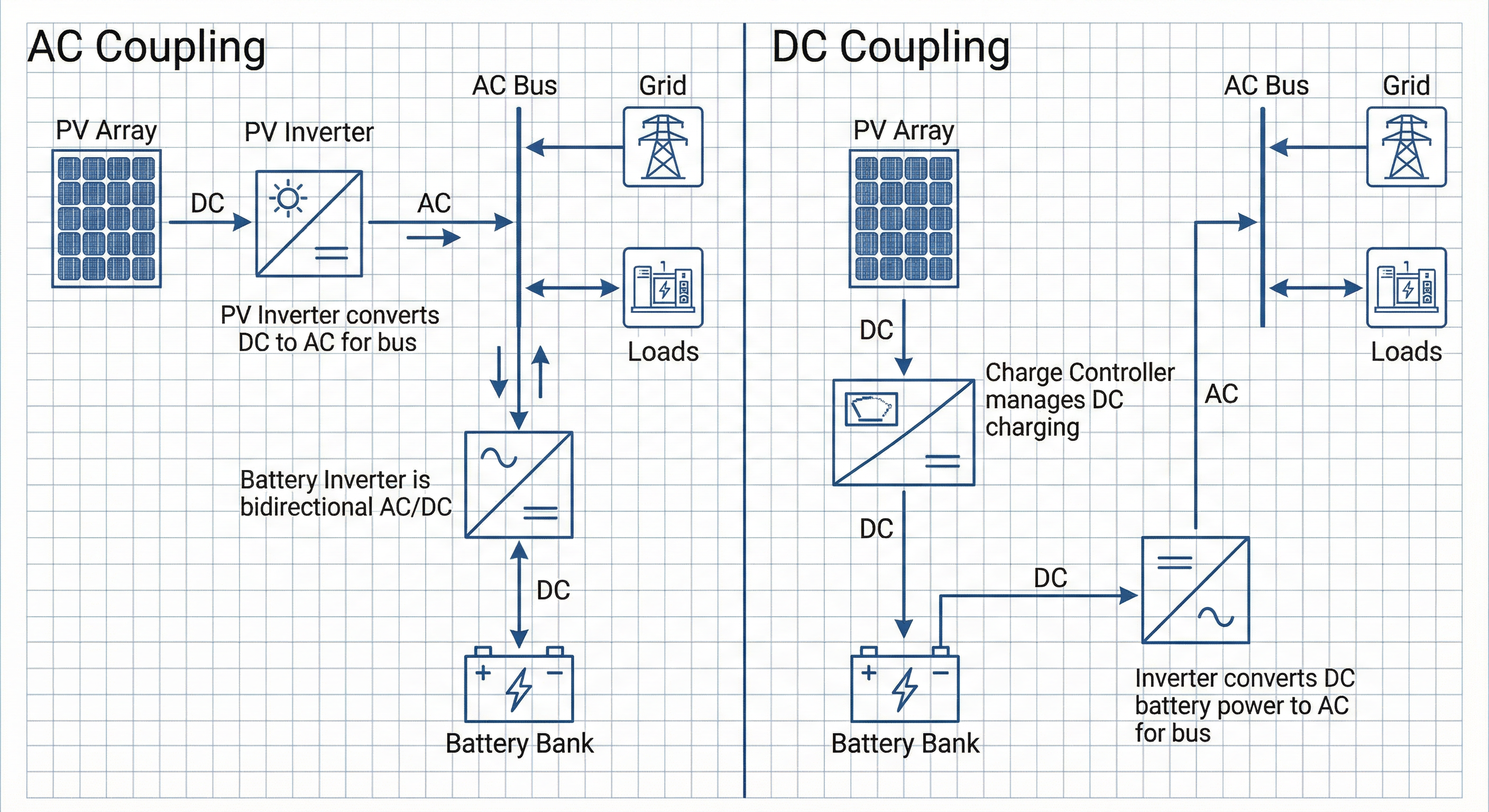
You have solar panels. Now you want batteries. How do you connect them? There are two architectures: AC Coupling and DC Coupling.
1. DC Coupling (The "Efficient" Way)
In a DC-coupled system, the solar panels connect directly to a Hybrid Inverter, which connects directly to the battery.
- Path: Solar (DC) -> Charge Controller (DC) -> Battery (DC).
- Conversion: No conversion! DC stays DC.
- Efficiency: Very High (~95-97%).
Pros
- Efficiency: Less energy lost in conversion.
- Cost: Usually cheaper for new installations because you buy one inverter that does everything.
- Black Start: Easier to restart the system if the battery goes completely dead.
Cons
- Retrofit Difficulty: If you already have a grid-tie inverter, you have to rip it out (or rewire everything) to install a hybrid DC inverter.
Best For: New installations, Off-Grid systems, RVs.
2. AC Coupling (The "Retrofit" Way)
In an AC-coupled system (like the Tesla Powerwall), the battery has its own built-in inverter.
- Path: Solar (DC) -> Grid Inverter (AC) -> Main Panel (AC) -> Battery Inverter (DC) -> Battery.
- Conversion: DC -> AC -> DC -> AC. (Three conversions!).
- Efficiency: Lower (~90%).
Pros
- Easy Retrofit: You don't touch your existing solar panels or inverter. You just wire the battery box into your main breaker panel.
- Placement: The battery can be far away from the solar panels.
Cons
- Efficiency Loss: You lose 5-10% of your energy in the multiple conversions.
- Complexity: Controlling the solar inverter during a blackout (Frequency Shift Power Control) can be tricky. The battery has to "trick" the solar inverter into turning off when the battery is full.
Best For: Adding batteries to an existing Grid-Tie home with microinverters (Enphase) or a String Inverter (SolarEdge).
The Verdict for 2026
- Building New? Go DC Coupled (Hybrid Inverter). It's cheaper and more efficient.
- Adding to Old System? Go AC Coupled (Tesla Powerwall, FranklinWH, Enphase IQ Battery). It's easier to install and doesn't void your old warranty.
Read more about hybrid systems in Hybrid Solar Systems: Grid-Tie with Battery Backup.


