
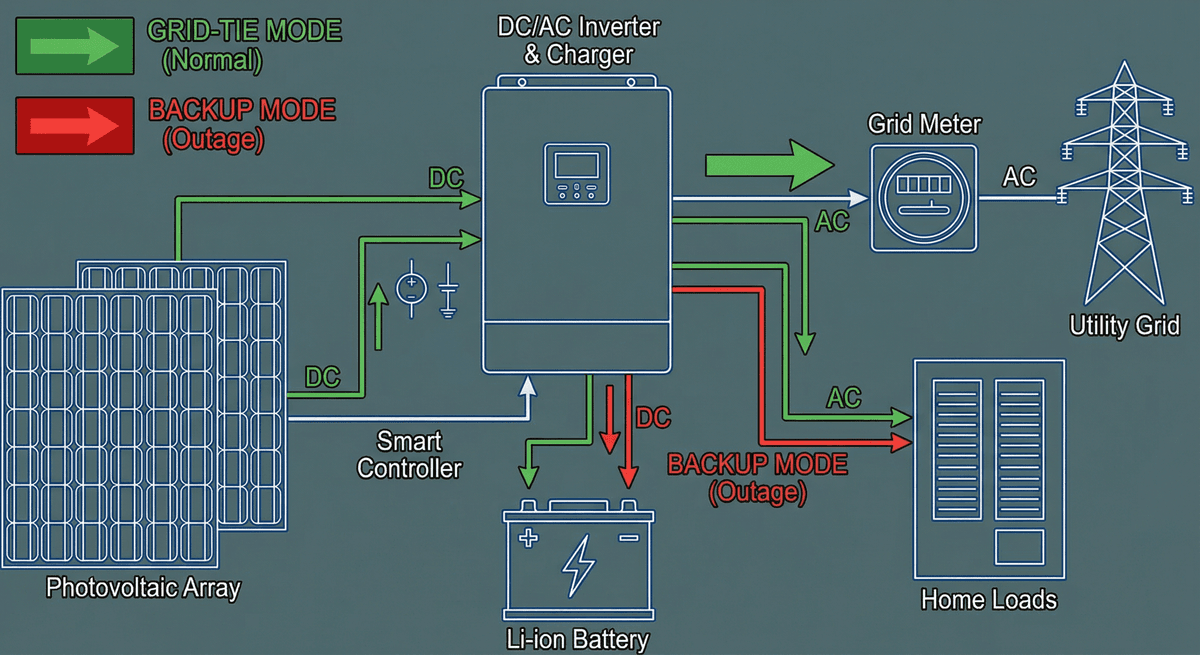
In the past, you had to choose:
- Grid-Tie: Saves money on bills, but goes dead when the grid goes down (safety requirement).
- Off-Grid: Total independence, but expensive batteries and no backup from the utility.
In 2026, the Hybrid Solar System is the standard. It does both.
What is a Hybrid Inverter?
A hybrid inverter (like Sol-Ark, Deye, or Growatt) has inputs for:
- Solar Panels (PV)
- Batteries
- Grid (AC Input)
- Generator (Gen Input)
- Home Loads (AC Output)
It manages the flow of power between all these sources automatically.
Modes of Operation
1. Self-Consumption Mode (Bill Reduction)
- Day: Solar powers the house first. Excess solar charges the battery.
- Evening: Battery powers the house.
- Night: If battery is empty, grid takes over.
- Goal: Minimize buying from the utility.
2. Backup Mode (UPS Function)
- Normal: Grid powers house, solar keeps battery 100% full.
- Blackout: Grid fails. Inverter instantly (~10ms) switches to "Island Mode." It disconnects from the grid (to protect linemen) and powers your "Critical Loads Panel" from the battery/solar.
- Goal: Security during outages.
3. Time-of-Use (TOU) Arbitrage
- Peak Rates (4pm-9pm): Electricity is expensive ($0.50/kWh). Inverter uses battery power.
- Off-Peak (Midnight): Electricity is cheap ($0.10/kWh). Inverter charges battery from grid (if solar wasn't enough).
- Goal: Save money on complex rate plans.
AC Coupling vs DC Coupling
- DC Coupled Hybrid: Solar panels plug directly into the hybrid inverter. Most efficient for charging batteries. Best for new installs.
- AC Coupled Hybrid: You keep your existing grid-tie inverter (e.g., Enphase microinverters). The hybrid inverter "tricks" them into thinking the grid is still on, so they keep producing power during a blackout. Best for retrofitting existing solar homes.
Sizing a Hybrid System
Unlike off-grid, you don't need to cover 100% of your usage.
- Battery: Size it for just your critical loads (fridge, lights, internet, well pump) for 12-24 hours.
- Inverter: Size it to handle the surge of your largest critical load.
Is it Worth It?
- Grid-Tie Cost: ~$15,000.
- Off-Grid Cost: ~$25,000.
- Hybrid Cost: ~$20,000.
For an extra $5k over a standard grid-tie system, you get blackout protection. In 2026, with grid instability rising, this is a no-brainer for most homeowners.
Read more about coupling methods in AC Coupling vs DC Coupling for Battery Storage.


