
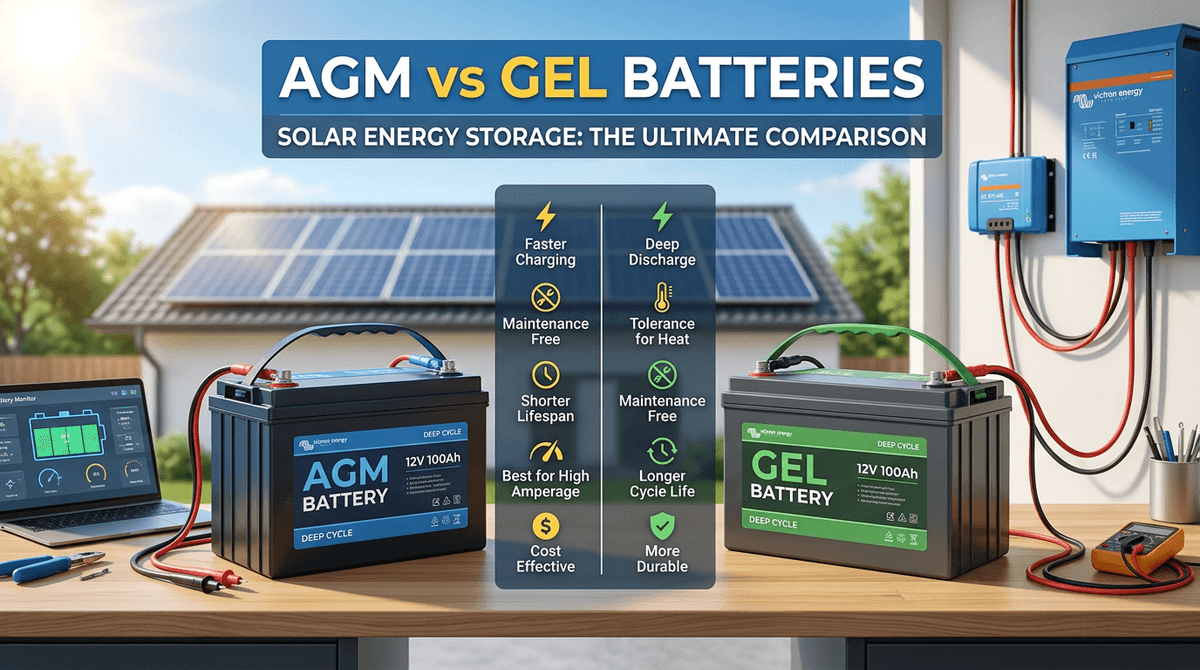
When building an off-grid solar system, choosing the right battery chemistry is one of the most important decisions you'll make. While Lithium Iron Phosphate (LiFePO4) is the modern gold standard, sealed lead-acid (SLA) batteries remain incredibly popular due to their lower upfront cost, proven reliability, and excellent cold-weather performance.
Within the SLA category, you have two main choices: Absorbent Glass Mat (AGM) and Gel Cell batteries.
Both are maintenance-free, spill-proof, and safe for indoor use, but they have very different internal structures, charging requirements, and ideal use cases. In this comprehensive guide, we will compare AGM vs Gel batteries head-to-head to help you decide which is best for your solar setup.
If you aren't sure how much battery capacity you need in the first place, try our free WattSizing Solar Calculator to perfectly size your system!
What is an AGM Battery?
AGM stands for Absorbent Glass Mat. Inside an AGM battery, the liquid electrolyte (sulfuric acid) is completely absorbed into a fine fiberglass mat sandwiched between the lead plates.
Because the acid is suspended in this mat rather than sloshing around freely, AGM batteries are completely sealed and spill-proof. You can mount them sideways or even upside down without leaking.
Pros of AGM Batteries for Solar
- High Current Output: Because the fiberglass mats provide very low internal resistance, AGM batteries can deliver massive bursts of power (high amps) very quickly. This makes them excellent for starting engines or running high-surge appliances like microwaves or air conditioners.
- Fast Charging: That same low internal resistance allows AGM batteries to accept a charge much faster than Gel or flooded lead-acid batteries. If you have a large solar array and limited sun hours, AGMs will soak up the power quickly.
- Cold Weather Performance: AGM batteries perform exceptionally well in freezing temperatures, making them a favorite for winter cabins and cold-climate RVs.
- Lower Cost: AGM batteries are generally cheaper to manufacture than Gel batteries, making them the most cost-effective sealed option on the market.
Cons of AGM Batteries
- Shorter Lifespan in Deep Cycling: While they are "deep cycle" batteries, repeatedly discharging an AGM below 50% will significantly shorten its lifespan compared to a Gel battery.
- Vulnerable to Overcharging: Like all sealed batteries, AGMs cannot be topped off with water. If you overcharge them and they vent gas, they are permanently damaged.
What is a Gel Battery?
A Gel battery is also a sealed lead-acid battery, but instead of using a fiberglass mat, silica dust is added to the sulfuric acid electrolyte. This turns the liquid acid into a thick, stiff gel (like petroleum jelly).
Like AGMs, Gel batteries are completely sealed, spill-proof, and maintenance-free.
Pros of Gel Batteries for Solar
- Superior Deep Cycle Lifespan: Gel batteries excel at slow, deep discharges. They can typically handle more charge/discharge cycles than an AGM battery, especially if they are regularly discharged below 50%.
- Excellent Heat Tolerance: The thick gel electrolyte is much better at dissipating heat than the fiberglass mats in an AGM. This makes Gel batteries the superior choice for hot climates or hot engine compartments.
- No Acid Stratification: Because the acid is immobilized in a gel, it cannot separate into layers of water and heavy acid (stratification), a common problem in flooded batteries that reduces capacity over time.
Cons of Gel Batteries
- Slow Charging Required: Gel batteries have higher internal resistance. If you try to charge them too fast with a massive solar array or alternator, the gel can develop bubbles or "burn" pockets, permanently ruining the battery. They require a very specific, slow charging profile.
- Lower Power Output: They cannot deliver high bursts of amps quickly. They are designed for slow, steady power draws (like running lights, a fridge, or a CPAP machine overnight).
- Strict Voltage Limits: Gel batteries are incredibly sensitive to high charging voltages. Most require a lower bulk/absorption voltage (around 14.1V - 14.4V) than AGMs. If your solar charge controller is set incorrectly, you will destroy the battery very quickly.
- Higher Cost: Gel batteries are generally more expensive than AGMs.
AGM vs Gel: Head-to-Head Comparison
| Feature | AGM Batteries | Gel Batteries |
|---|---|---|
| Electrolyte Type | Liquid absorbed in fiberglass | Thick silica gel |
| Best For | High bursts of power, fast charging | Slow, steady power draws, deep cycling |
| Charge Speed | Fast (Low internal resistance) | Slow (High internal resistance) |
| Deep Cycle Lifespan | Good (300-500 cycles at 50% DoD) | Excellent (500-1000 cycles at 50% DoD) |
| Temperature Tolerance | Excellent in Cold | Excellent in Heat |
| Sensitivity to Overcharging | High | Extremely High (Requires specific profile) |
| Cost | Lower | Higher |
The "Gel" Marketing Myth: A Warning
One of the biggest issues in the solar industry is deceptive marketing. Many cheap batteries sold on Amazon or eBay are labeled as "Gel" because the term sounds premium, but they are actually standard AGM batteries.
True Gel batteries are heavy, expensive, and relatively rare in modern small-scale solar setups. If you buy a battery labeled "Gel" but charge it using an AGM profile on your solar controller, and it doesn't die immediately, it was probably an AGM battery all along. Always buy from reputable brands (like Renogy, Battle Born, Victron, or Trojan) and check the spec sheets carefully.
Which is Better for Your Off-Grid System?
For 90% of off-grid solar users, AGM is the better choice.
Here is why:
- Solar is Unpredictable: You often need to charge your batteries as fast as possible when the sun comes out from behind the clouds. AGMs can accept that fast charge; Gel batteries cannot.
- High-Draw Appliances: Most modern RVs and cabins use inverters to run microwaves, coffee makers, or hair dryers. These require massive, fast bursts of amps that AGMs handle perfectly, but Gel batteries struggle with.
- Cost and Simplicity: AGMs are cheaper, easier to find, and less finicky about exact charging voltages.
When should you choose Gel? You should choose a true Gel battery if you live in a very hot climate (like the desert Southwest), you only have low-draw appliances (lights, fans, small 12V fridges), and you plan to discharge the battery deeply on a regular basis. They are fantastic for slow, steady, long-term power in hot environments.
The Elephant in the Room: Lithium (LiFePO4)
While this article compares AGM and Gel, it's impossible to talk about solar batteries without mentioning Lithium Iron Phosphate (LiFePO4).
If your budget allows, LiFePO4 is vastly superior to both AGM and Gel. Lithium batteries:
- Can be discharged to 100% without damage.
- Last 10x longer (3000-5000 cycles compared to 300-500).
- Weigh half as much.
- Charge faster than AGMs.
While Lithium costs more upfront, the cost-per-cycle over 10 years makes them significantly cheaper than replacing lead-acid batteries every 3-5 years.
Conclusion
Both AGM and Gel batteries are excellent, maintenance-free options for off-grid solar. If you need high power output, fast charging, and cold-weather reliability, go with AGM. If you need slow, steady power, deep cycling longevity, and heat tolerance, go with Gel.
Before you buy any batteries, make sure you know exactly how much capacity you need. Use our WattSizing Solar Calculator to perfectly match your battery bank to your solar array and daily energy usage!
Frequently Asked Questions (FAQ)
Can I mix AGM and Gel batteries in the same bank?
Absolutely not. Because they have completely different internal resistances and require different charging voltages, mixing them will cause your solar charge controller to overcharge one type while undercharging the other, destroying both very quickly.
Do AGM or Gel batteries need ventilation?
Both are sealed and "recombinant," meaning they absorb the gasses they produce during normal operation. They do not require the heavy ventilation that flooded lead-acid batteries do. However, if overcharged, they have safety valves that will vent explosive hydrogen gas. They should never be placed in a completely airtight box.
Can I use a standard car battery charger on a Gel battery?
No. Standard automotive chargers (and many older solar charge controllers) are designed for flooded or AGM batteries and output voltages that are too high for Gel batteries. Charging a Gel battery with a standard charger will cause the gel to bubble and permanently ruin the battery. You must use a charger with a specific "Gel" setting.


