
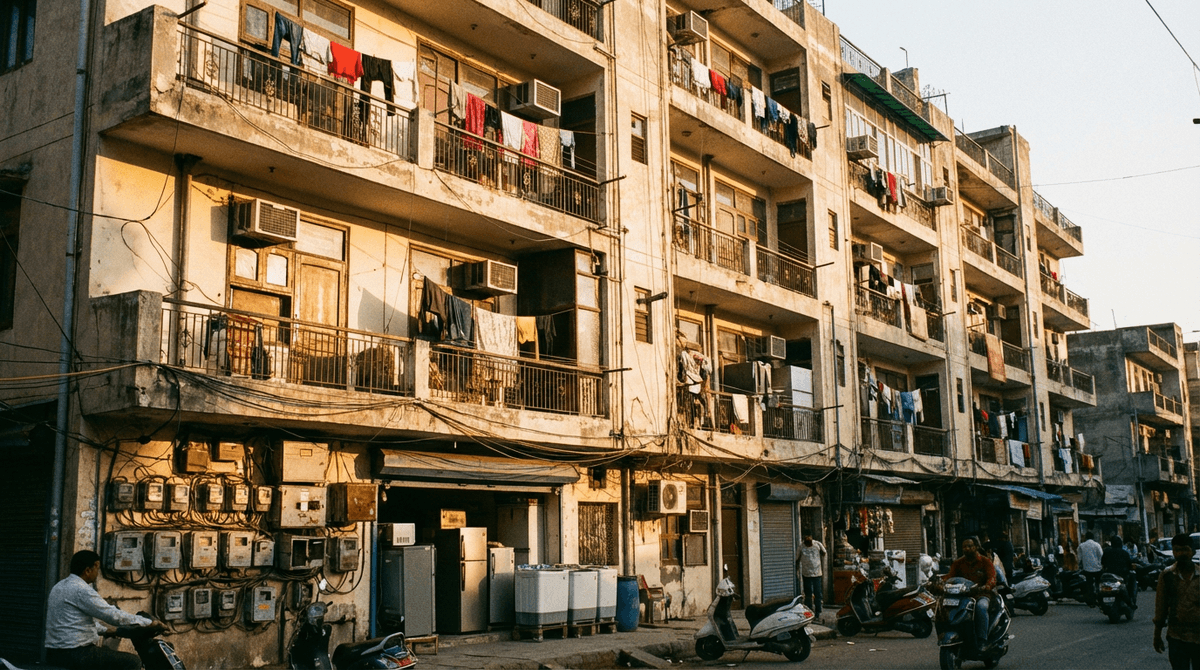
Average household electricity consumption India (per month kWh)
For typical urban flats and standalone houses, electricity billed at the meter often lands roughly in the about 120–550 kWh per month range for middle-class lifestyles—much lower without cooling, and often higher still during peak summer if multiple air conditioners run for long hours. These numbers are illustrative bandwidths, not a single national “truth”: family size, climate, appliance vintage, setpoints, and sanctioned load all shift the needle more than averages on the internet suggest.
Across India you will hear neighbours quote anything from “we touch 900 kWh in July” to under 120 kWh in the same billing period depending on footprint and cooling intensity. Treat every outside number skeptically unless it mirrors similar home size, climate zone, occupancy, and metering.
Tools while you benchmark: convert hours and watts to kWh in How to Calculate kWh From Watts and Hours, translate billed units into cost in How to Calculate Electricity Bill From kWh, and model loads in our WattSizing Calculator.
Monthly, daily and yearly equivalents (why search results mix wording)
Readers search “per month”, “per year”, and “per day” almost interchangeably. Use one consistent baseline first—your DISCOM bill’s billing-period kWh, which is metered energy over the days between readings—then derive the rest:
- Average kWh per day ≈ (period kWh) ÷ (days in billing period)
- Extrapolated kWh/month ≈ (kWh/day) × 30.4 (average days per calendar month—good enough for rough checks)
- Extrapolated kWh/year ≈ (rounded monthly) × 12
| If your daily average… | Rough monthly (~30.4 d) | Rough annual (×12 mo) |
|---|---|---|
| 4 kWh/day | ~120 kWh | ~1.4 MWh |
| 8 kWh/day | ~240 kWh | ~2.9 MWh |
| 12 kWh/day | ~365 kWh | ~4.4 MWh |
| 16 kWh/day | ~490 kWh | ~5.8 MWh |
| 22 kWh/day | ~670 kWh | ~8 MWh |
Why this matters: “Average household electricity consumption per day India” spikes in July–August cooling weeks and dips in mild months. Whenever you benchmark, compare whole billing periods, not snapshots from a prepaid app that shows yesterday only.
What “national average electricity usage” misses
India publishes economy-wide and per-capita electricity statistics intended for planners and policymakers. Household search intent, though, asks for something narrower: “How many billed kWh did a flat like mine consume last month?” Those are often different questions.
- Official series help you understand overall electrification momentum—but they rarely replace your meter history.
- Typical English-language articles collapse everything into one band (“200–250 kWh”) that will be wrong half the year if you cool aggressively.
- Reliable planning means six to twelve billing PDFs, not influencer estimates.
Official portals for context—not for guessing your slab:
- Ministry of Power, Government of India for policy/programme context.
- Central Electricity Authority (CEA) for sector dashboards and summaries.
- For metro-specific tariffs, bookmark your state electricity regulatory commission and distribution company (DISCOM) consumer portals.
Illustrative billed kWh/month by home archetype
Use the table below as orientation. Your goal is still to reconcile it with your own bill trend lines.
| Home profile | What usually dominates | Typical billed grid kWh/month (illustrative) |
|---|---|---|
| Small flat, LED lighting, few fans, no AC | Baseline “always-on” + kitchen | 60–180 |
| 2–3 BHK, fans + one inverter split AC in peak weeks | Cooling + fridge + water pump | 180–420 |
| 3–4 BHK, two or more inverter ACs, electric geyser habits | Cooling + water heating | 400–900+ |
| Large villa, pool pump, lift, heavy EV trickle | Everything at once | 900–2,500+ depending on estate services |
Illustrative split examples (not universal):
- Efficient urban flats that cool selectively can still log ~100–320 kWh/month through a full year.
- AC-forward homes in hot-humid or hot-dry zones can cross ~600–1,200+ kWh/month for the worst summer cycle while falling much lower in winter.
Delhi: why “average household electricity consumption Delhi kWh per month” is its own topic
Delhi combines intense summer cooling demand, winter space heating for many households, and urban premium tariffs that make each marginal kWh expensive at the top slabs. DISCOM consumers usually interact with BSES or Tata Power Delhi Distribution depending on area; NDMC serves parts of Lutyens’ Delhi. Regulated consumer education and tariff tables are published via Delhi Electricity Regulatory Commission (DERC).
Practical differences versus, say, coastal metros:
- Peak summer kWh can jump sharply if multiple rooms are cooled simultaneously.
- Winter bills can spike again if heaters substitute for other fuels.
- Foggy weeks (reduced solar if you have rooftop PV) do not lower grid import if your backup strategy is still grid-heavy.
If you are comparing Delhi vs Chennai or Delhi vs Bengaluru, match month and degree-days, not annual averages.
Maharashtra, Gujarat, south India: one-line climate reality
Hot-humid coasts punish old fixed-speed ACs; inverter splits with clean coils often shrink the same comfort target by double-digit percentage points in kWh. Interior Deccan summers are brutally hot but less mould-friendly than the coast; north Indian plains add winter heating kWh that many peninsular flats never see. Always narrate climate before bragging about a single “India average”.
DISCOM bills: slabs, fixed charges, and PPAC-style lines
Most Indian residential bills stack:
- Energy charges – usually slabbed by monthly kWh (crossing a slab changes the economics of the next unit).
- Fixed / demand / customer charges – often flat per month or tied to sanctioned load; shaving 20 kWh may barely move the total if this block is large.
- Pass-through adjustments – fuel, power purchase, regulatory charges; they move even when your routine does not.
- Duties and taxes – shown separately on good bills; essential for “why did my bill jump if units barely changed?”
Read the PDF breakdown, not a one-line SMS. If you want habit-based savings aligned to Indian DISCOM reality, start with How to Reduce Your Electricity Bill in India.
Diesel gensets, inverters, and rooftop solar: “missing” kWh
Grid kWh can understate total electrical energy at home when:
- Diesel generators carry critical loads during outages (costly kWh, never on the DISCOM bill).
- Solar + net metering exports mask how much on-site solar actually served loads (you must read import, export, and banking carefully).
- Dual-feed arrangements (common in some societies) split lift/common area from flat meters.
For off-grid or backup-centric thinking, cross-link your load list with Load List for Off-Grid Solar Sizing—the habit of listing watts × hours pays off even on-grid.
Worked examples (illustration only)
Example A – 420 kWh in 31 days
- kWh/day ≈ 420 ÷ 31 ≈ 13.5 kWh/day
- Extrapolate: 13.5 × 30.4 ≈ 410 kWh/month equivalent (close—because the period is already a month)
Example B – blended variable energy charge
420 kWh at an illustrative blended ₹7.5/kWh variable component:
420 × 7.5 = ₹3,150 before fixed charges, regulatory lines, and taxes.
Swap your own approved slab table from the DISCOM tariff order; never use blog math in a legal dispute.
Practical checklist (next 7 days)
- Download your last 12 bills; plot kWh vs billing days to get true kWh/day.
- Tag summer vs monsoon vs winter bills—spot the AC and heating signatures.
- Note sanctioned load changes; they can move fixed blocks independent of kWh.
- If you have solar, reconcile export with comfort—you may still be import-heavy at night.
- Model one worst-week day in the WattSizing Calculator (cooling + kitchen + pump).
FAQs
What is the average household electricity consumption in India per month in kWh?
There is no single credible number for every home. Medium-consumption urban homes without extreme cooling often land roughly between ~120 kWh and ~550 kWh in many cities across the year, while high-AC summers can push 600–1,200+ kWh for larger layouts. Your own meter history beats any internet average.
What is the average monthly electricity consumption for an Indian household in kWh per year?
Multiply a stable monthly kWh estimate by 12 for a rough annual total, or—better—sum twelve actual bills so seasonality is baked in. A home that shows 300 kWh in March can show 700+ kWh in June; averaging two months creates fake precision.
How do I estimate average household electricity consumption per day in India?
Take the kWh from your bill and divide by the number of days in that billing period. That daily average is the only number that honestly answers “per day” questions for your household.
Is Delhi higher or lower than other cities?
Delhi is not automatically “higher”; it is spiky: summer cooling and winter heating can both lift kWh, while shoulder months look tame. Compare same calendar months across cities.
My bill jumped but kWh barely changed—how?
Check fixed/demand charges, slab movement (one extra block of units can reprice a chunk of energy), and PPAC/regulatory lines. This is common and confusing if you only watch the headline “units”.
Do inverter ACs reduce kWh?
Usually yes versus old fixed-speed units when sized correctly, maintained, and not set to 18 °C with dirty coils. The savings show up as fewer kWh per cooling hour, not miracles.
Are “200 units” stories online realistic?
Sometimes—for specific flat sizes and climates. Treat them as anecdotes unless the author shows billing period length, season, and cooling strategy.
We are renters—what moves the needle fastest?
AC setpoints, fan-first cooling, sealing drafts, efficient fridge at replacement, and geyser discipline (timer/thermostat where applicable). You cannot always change wiring or sanctioned load.
Does rooftop solar mean we use less grid electricity?
Often grid import falls, but comfort kWh may stay high; read import/export separately. Banking/settlement rules vary by state policy—your installer and DISCOM portal matter more than generic articles.
Where do I verify official tariffs?
Your state regulator and DISCOM consumer portal for the currently approved tariff order—not reposted screenshots.
Is “power consumption” different from “electricity consumption”?
In everyday Indian English, people mix kW (power) and kWh (energy). Bills are in kWh; when you multiply device watts × hours, you estimate kWh—see How to Calculate kWh From Watts and Hours.
Should I compare my home to USA or EU averages?
Mostly no unless voltage, thermal construction, tariff structure, and appliance mix align. Benchmark against similar homes in your city first.
Sources
- Ministry of Power, India
- Central Electricity Authority (CEA)
- Delhi Electricity Regulatory Commission (DERC)
CTA
Stress-test worst-week cooling, kitchen peaks, and pumps in the WattSizing Calculator—then compare the story it tells with your actual DISCOM history.


