
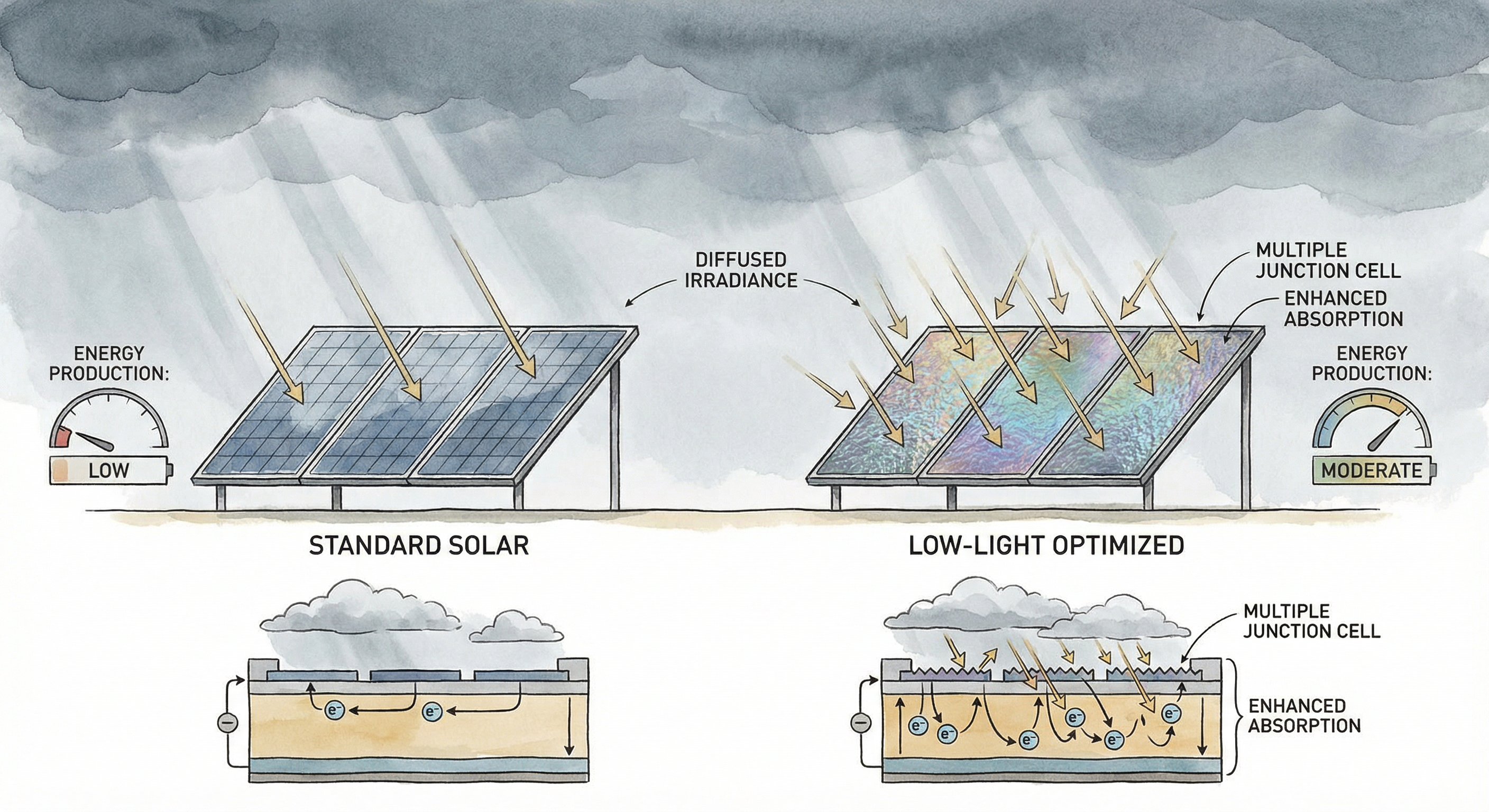
"I live in Seattle/London/Vancouver. Will solar work for me?"
The answer is yes, but you need to choose the right equipment. Solar panels do not need direct, blazing sunlight to generate power. They work on irradiance (light intensity), which still exists on cloudy days.
However, output drops significantly. A panel might produce 10-25% of its rated power under heavy cloud cover.
Here is how to maximize that 10-25%.
1. The Technology Factor
Monocrystalline (The Winner)
Modern Monocrystalline PERC or TOPCon panels are excellent in low light.
- Why: High efficiency means they capture more photons even when they are scarce.
- Performance: Expect ~15-20% output in heavy overcast.
Thin Film (The Specialist)
Thin Film (CIGS/CdTe) panels are famous for their "spectral response." They can absorb a wider range of light wavelengths (including some UV and infrared) that penetrate clouds better than visible light.
- Why: They don't rely as heavily on direct angles.
- Performance: Can sometimes outperform crystalline panels by 5-10% in purely diffuse light.
- Downside: Lower overall efficiency means you need a huge array to match the peak power of mono panels on sunny days.
Polycrystalline (The Loser)
Generally perform the worst in low light due to lower purity silicon. Avoid for cloudy climates.
2. Bypass Diodes
Shade from clouds is "soft shade," but shade from a tree branch is "hard shade."
- Standard Panels: Have 3 bypass diodes. If a leaf covers one cell, the diode bypasses that entire section (usually 1/3 of the panel) to save the rest.
- Half-Cut Cells: Modern panels are split in half. If the bottom half is shaded, the top half still runs at 100%. Highly recommended for cloudy/shaded areas.
3. MPPT is Mandatory
In low light, the voltage of the panel drops.
- PWM Controller: Will likely cut off charging completely because the panel voltage drops below the battery charging voltage (e.g., ~13V).
- MPPT Controller: Can step down even lower voltages (buck/boost) or simply harvest the tiny amount of current available much more effectively. MPPT can yield 20-30% more energy in cloudy weather.
4. System Design Tips
- Over-Paneling: Solar panels are cheap. If you need 500W of power in winter, install 1000W of panels. The extra capacity compensates for the 50% loss from clouds.
- Series Wiring: Wiring panels in series increases voltage. In low light, voltage drops. A series string keeps the total voltage high enough to "wake up" the MPPT controller earlier in the morning and keep it running later in the evening.
- Tilt Angle: In winter (cloudy season), tilting panels steeply (latitude + 15 degrees) helps them catch the low sun and shed snow/rain, which blocks light.
Conclusion
For cloudy climates in 2026:
- Panel: Monocrystalline Half-Cut Cell (PERC or TOPCon).
- Controller: MPPT.
- Strategy: Oversize the array by 20-50%.
Don't let the clouds stop you. Germany is a world leader in solar, and it's not exactly known for its tropical sun!
Learn more about panel efficiency in Solar Panel Efficiency in 2026: Mono vs Poly vs Thin Film.


