
As we move through 2026, solar technology continues to evolve at a rapid pace. The "standard" solar panel of five years ago is now considered obsolete, replaced by higher-efficiency modules that generate more power in less space.
When shopping for solar panels, you'll primarily encounter three main technologies: Monocrystalline (Mono), Polycrystalline (Poly), and Thin Film. Understanding the differences in efficiency, cost, and aesthetics is crucial for designing an effective solar array.
What is Solar Panel Efficiency?
Solar panel efficiency refers to the percentage of sunlight hitting the panel that gets converted into usable electricity. If a panel has 20% efficiency, it means 20% of the sun's energy hitting that surface area becomes power.
In 2026, average efficiencies have climbed:
- Standard panels: ~20-22%
- High-end panels: ~23-25%
- Lab records: Exceeding 30% (Perovskite tandems)
Higher efficiency means you need less roof space or ground area to generate the same amount of power.
Monocrystalline Solar Panels (Mono)
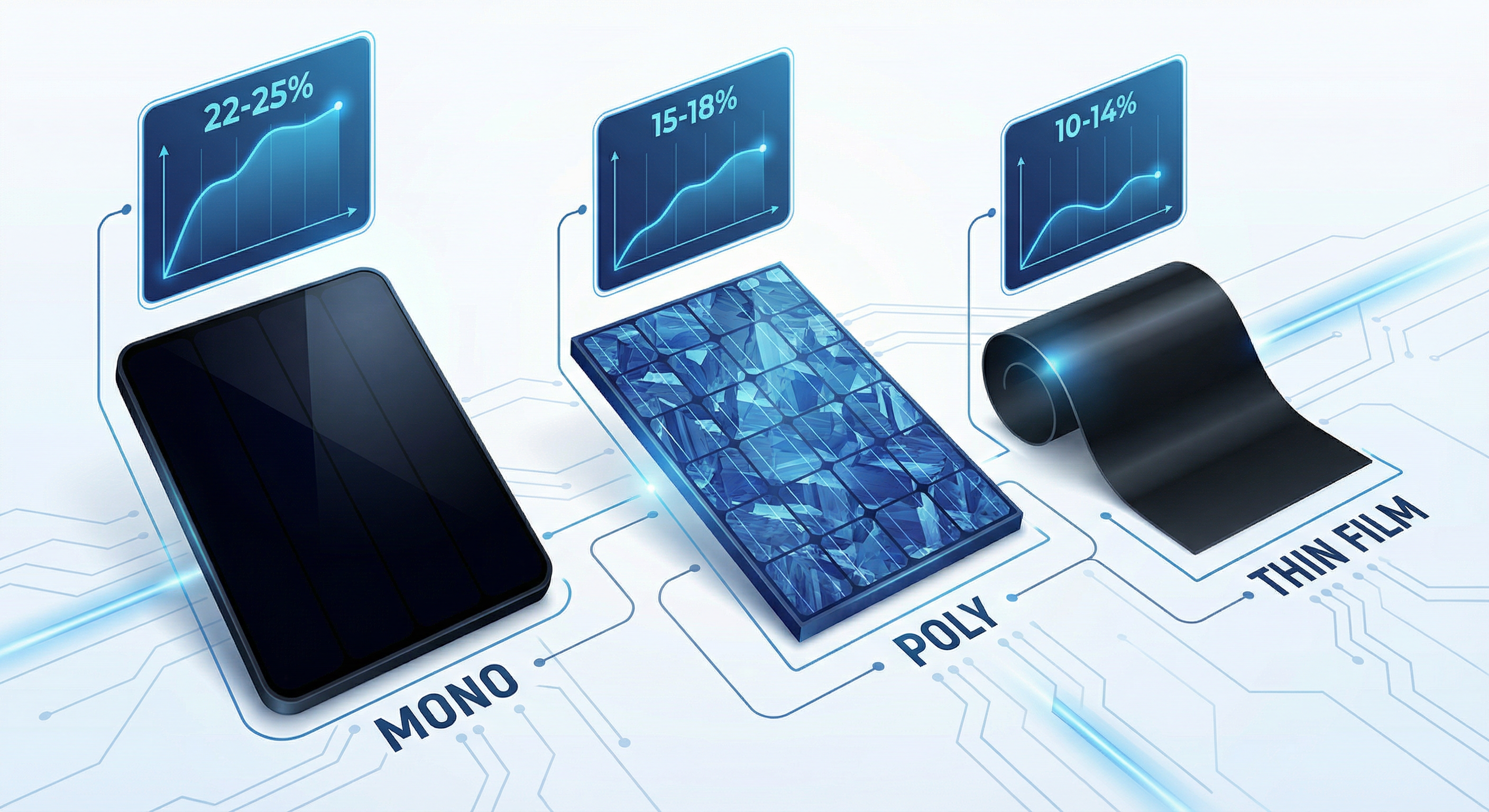
Monocrystalline panels are made from a single, continuous crystal structure of silicon. They are easily recognizable by their uniform dark black color and rounded edges on the cells.
Pros
- Highest Efficiency: In 2026, commercial mono panels routinely hit 22-24% efficiency. Premium models (like those using N-type or HJT technology) can reach 25%.
- Space Efficient: Because they are more efficient, you need fewer panels to reach your target wattage. Ideal for RVs, tiny homes, or small roofs.
- Longevity: Mono panels typically have the longest warranties (25-30 years) and lowest degradation rates.
- Aesthetics: The sleek black look is preferred for residential rooftops.
Cons
- Cost: They are the most expensive option upfront, though the gap has narrowed significantly.
- Temperature Sensitivity: While better than poly, efficiency still drops as temperatures rise (though less so than in the past).
Best For: Residential roofs, RVs, boats, and anywhere space is limited.
Polycrystalline Solar Panels (Poly)
Polycrystalline panels are made by melting many silicon fragments together. They have a distinctive blue, speckled appearance and square cells.
The Decline of Poly
By 2026, polycrystalline panels have largely fallen out of favor for residential installations in developed markets. The cost difference between mono and poly has shrunk so much that the efficiency penalty of poly is rarely worth the small savings.
Pros
- Lower Cost: Still the cheapest option per watt, making them attractive for massive utility-scale projects or budget DIY builds where space is unlimited.
- Eco-Friendly Production: The manufacturing process wastes less silicon than mono production.
Cons
- Lower Efficiency: Typically 15-18%. You need significantly more space to generate the same power as a mono array.
- Aesthetics: The blue, mottled look is often considered less attractive.
- Heat Tolerance: Generally perform worse in high heat compared to modern mono panels.
Best For: Large ground-mount arrays where space is abundant and budget is the primary constraint.
Thin Film Solar Panels
Thin film panels are made by depositing photovoltaic material onto a substrate like glass, plastic, or metal. Materials include Cadmium Telluride (CdTe) and CIGS (Copper Indium Gallium Selenide).
Pros
- Flexible & Lightweight: Can be made into flexible sheets, perfect for curved surfaces on RVs or boats.
- Low Light Performance: Often perform better in cloudy or shaded conditions than crystalline silicon. See our guide on Best Solar Panels for Cloudy Days.
- High Temperature Tolerance: They maintain efficiency better in extreme heat.
Cons
- Lowest Efficiency: Generally 13-16% for commercial flexible panels, though rigid commercial thin film (like First Solar) is higher.
- Durability Issues: Flexible panels often degrade faster (3-5 years) due to micro-cracking from flexing and lower weather resistance compared to glass-encased rigid panels.
- Large Footprint: Requires the most space for the same power output.
Best For: Curved surfaces (Airstreams, boats), portable camping setups, or specific commercial applications.
Emerging Tech: PERC, TOPCon, and HJT
In 2026, "Mono" isn't just one thing. You'll see terms like:
- PERC (Passivated Emitter and Rear Cell): The standard for years. Adds a reflective layer to the back of the cell to capture more light.
- TOPCon (Tunnel Oxide Passivated Contact): The successor to PERC. Slightly more expensive but higher efficiency and better low-light performance.
- HJT (Heterojunction): Combines crystalline silicon with thin film layers. Extremely high efficiency and excellent high-temperature performance, but expensive.
Which Should You Choose?
- Go Monocrystalline (TOPCon or PERC) if you want the best balance of performance, longevity, and value. This is the default choice for 95% of homeowners and DIYers in 2026.
- Go Polycrystalline only if you are building a massive ground array, have free land, and are on a strict budget.
- Go Thin Film (Flexible) only if you have a curved surface or weight restrictions that prohibit rigid glass panels.
Summary Table (2026 Estimates)
| Feature | Monocrystalline | Polycrystalline | Thin Film (Flexible) |
|---|---|---|---|
| Efficiency | 22% - 25% | 15% - 18% | 13% - 17% |
| Cost | $$$ | $ | $$ |
| Lifespan | 25+ Years | 20-25 Years | 5-10 Years (Flexible) |
| Space Req. | Low | High | High |
| Appearance | Black / Uniform | Blue / Speckled | Black / Uniform |
For more on how to read the technical specs of these panels, check out How to Read Solar Panel Specifications.


