
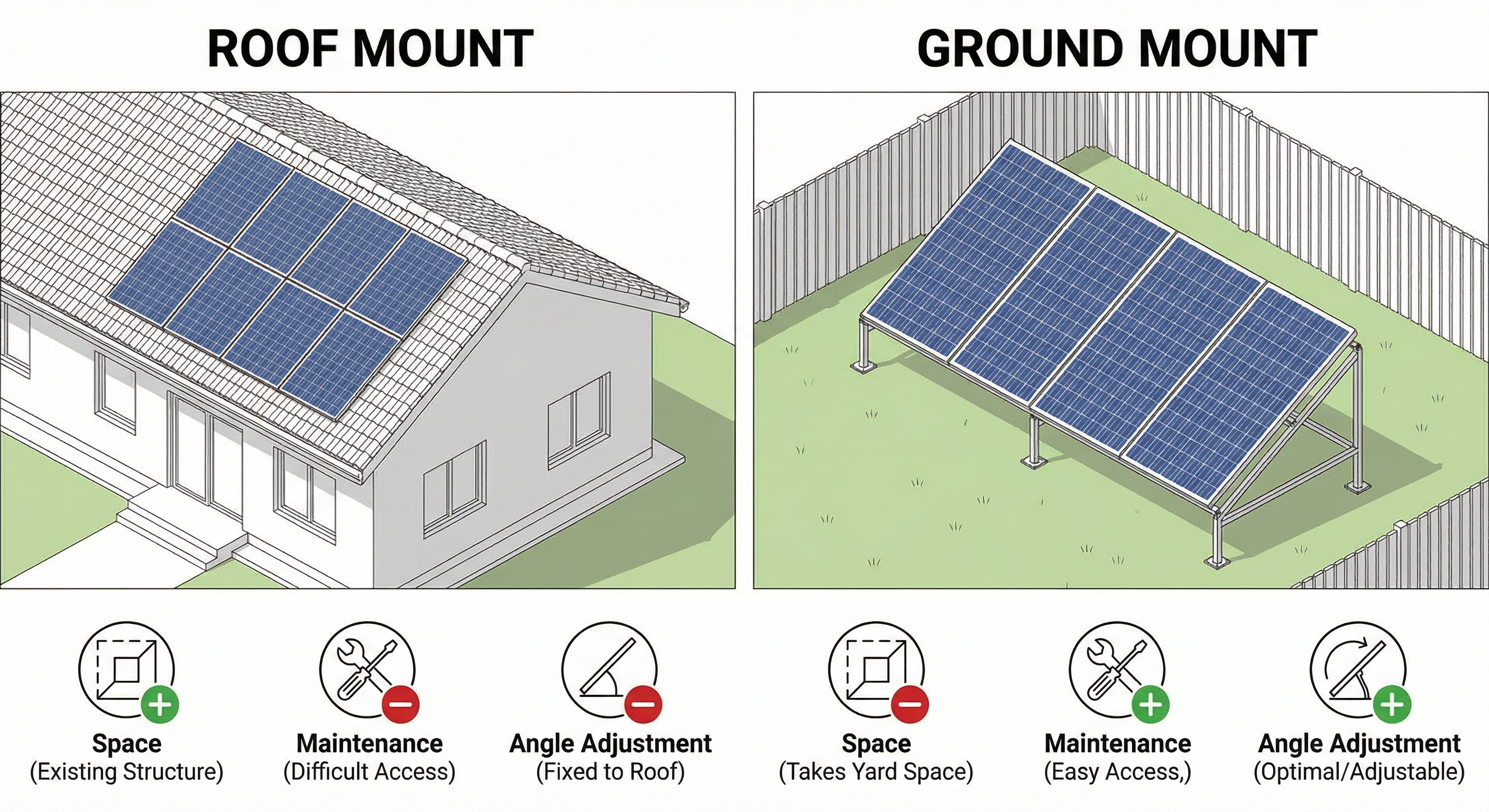
Once you have your panels, you need to put them somewhere. The two main options are Roof Mount (on your house/shed) or Ground Mount (on a rack in the yard).
For DIYers, this decision affects installation difficulty, maintenance, and cost.
1. Roof Mounts
The most common choice for residential grid-tie, but is it right for off-grid?
Pros
- Space Saving: Uses "dead space" on your roof. Great for small properties.
- Security: Harder for thieves to steal panels.
- Protection: Panels act as a shade for the roof, actually lowering attic temperatures.
Cons
- Difficult Install: Carrying 40lb glass panels up a ladder is dangerous and hard work.
- Holes in Roof: Every mounting foot is a potential leak point if not flashed correctly.
- Maintenance: Cleaning snow or dust requires climbing a ladder.
- Heat: Panels run hotter (less airflow underneath), reducing efficiency slightly.
- Orientation: You are stuck with your roof's angle and direction. If your roof faces East, you lose power.
DIY Difficulty: 8/10
Requires safety harness, ladder skills, and flashing knowledge.
2. Ground Mounts
A rack built from aluminum rails, galvanized steel pipe, or even pressure-treated wood (for small arrays).
Pros
- Perfect Orientation: You can point them exactly South (or North) and set the perfect tilt angle.
- Cooling: Excellent airflow keeps panels cool and efficient.
- Maintenance: Easy to brush off snow or wash off dust with a broom.
- Expandability: Easy to add more panels later.
- No Roof Holes: Zero risk of leaks in your house.
Cons
- Space: Takes up yard space.
- Wiring: Requires digging a trench to bury the cable from the array to the house.
- Cost: Racking hardware (concrete footings, steel pipe) is often more expensive than simple roof rails.
- Shading: More susceptible to shading from fences, bushes, or low structures.
DIY Difficulty: 5/10
Requires digging holes and mixing concrete, but no ladders. Safer.
3. Pole Mounts (Top-of-Pole)
A single large steel pole holds a rack of 4-12 panels.
Pros
- Tracking: Some pole mounts allow you to manually or automatically track the sun (single-axis or dual-axis), boosting output by 25-40%.
- Snow Shedding: High off the ground, so snow slides off easily.
Cons
- Expensive: Heavy steel pole and massive concrete footing required.
- Wind Load: High wind stress on the pole.
Recommendation
- Choose Roof Mount if: You have limited yard space, a good South-facing roof, and are comfortable with heights.
- Choose Ground Mount if: You have land, want easy maintenance (snow removal), or have a complicated roof (dormers/shade).
For DIYers, we strongly recommend Ground Mounts. The safety factor of staying on the ground and the ease of cleaning make it superior for off-grid living.
Learn about wiring your array in How to Wire Solar Panels: Series vs Parallel.


