
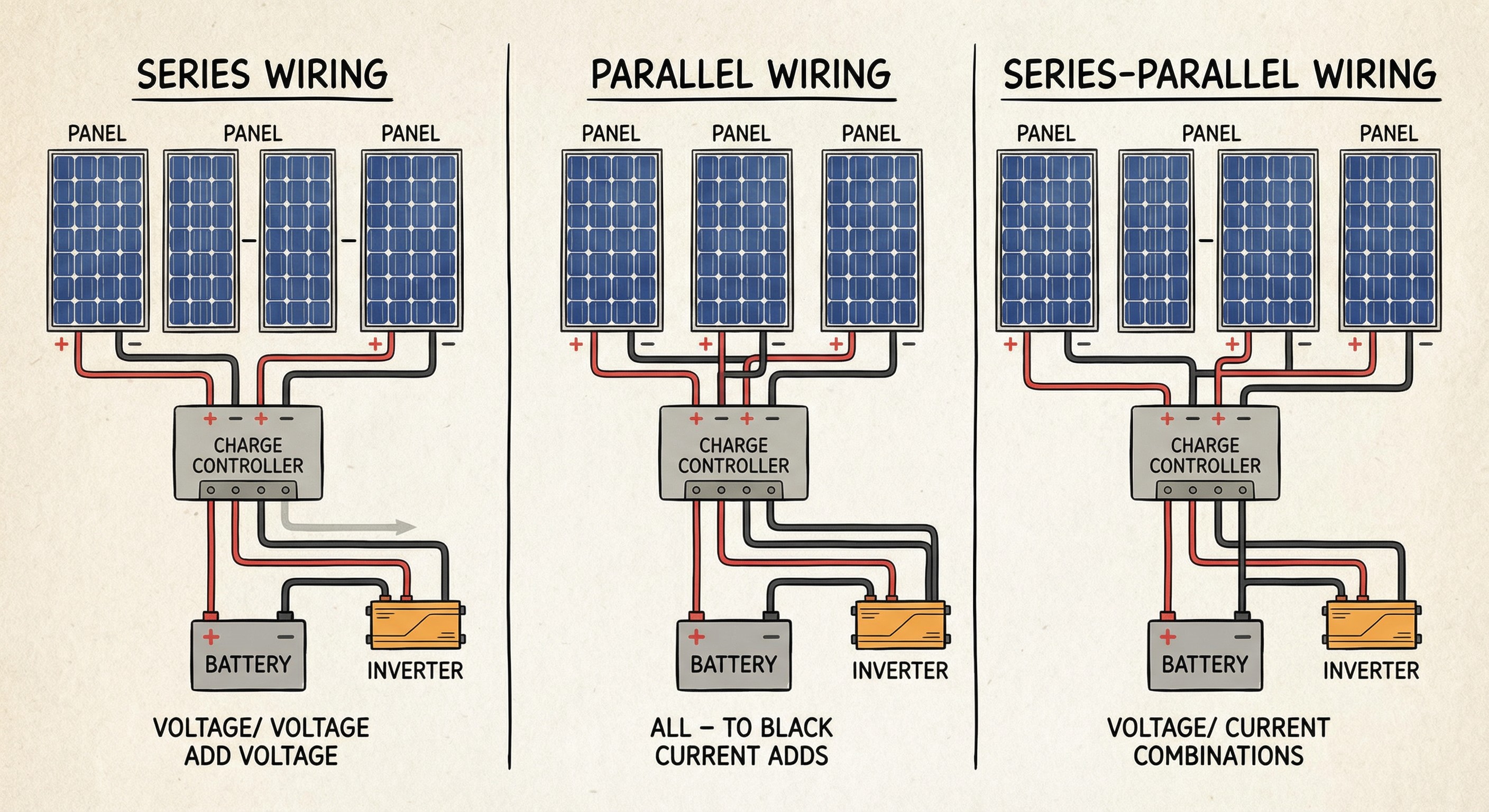
You have your solar panels. Now, how do you connect them? The way you wire your panels—Series, Parallel, or a mix of both—determines the voltage and amperage going into your charge controller. Getting this wrong can damage your equipment or severely limit your power production.
The Golden Rules
- Series Wiring: Adds Voltage, Amperage stays the same.
- Parallel Wiring: Adds Amperage, Voltage stays the same.
1. Series Wiring ("String")
Connect the Positive (+) of Panel A to the Negative (-) of Panel B. The remaining free ends (Negative of A, Positive of B) go to the charge controller.
- Effect: Voltage increases. Amps stay low.
- Example: Two 100W panels (20V, 5A each).
- Total Voltage: 20V + 20V = 40V.
- Total Amps: 5A.
- Total Power: 40V x 5A = 200W.
Pros of Series
- Thinner Wires: Since Amps stay low, you can use thinner, cheaper wire over long distances without voltage drop.
- MPPT Efficiency: MPPT controllers work better with higher voltage input.
- Low Light: Higher voltage means the system "wakes up" earlier in the morning and stays on later.
Cons of Series
- Shading: If one panel is shaded, the output of the entire string drops to match the shaded panel. It's like a kink in a garden hose.
Best For: Unshaded locations, long wire runs, MPPT controllers.
2. Parallel Wiring
Connect Positive (+) to Positive (+) and Negative (-) to Negative (-). You usually need a "Branch Connector" (Y-connector) to do this.
- Effect: Amperage increases. Voltage stays the same.
- Example: Two 100W panels (20V, 5A each).
- Total Voltage: 20V.
- Total Amps: 5A + 5A = 10A.
- Total Power: 20V x 10A = 200W.
Pros of Parallel
- Shade Tolerance: If one panel is shaded, the others continue to work at full power. The shaded panel doesn't drag down the rest.
- Safety: Keeps voltage lower (safer to touch, though still be careful).
Cons of Parallel
- Thick Wires: High amperage requires thick, expensive copper cables to prevent fire and voltage drop.
- Controller Limits: Most charge controllers have an Amperage limit (e.g., 40A). Parallel wiring hits this limit quickly.
Best For: Shaded locations (RVs, boats), PWM controllers, small arrays.
3. Series-Parallel (Hybrid)
This combines both methods. You create multiple strings of series panels, and then wire those strings in parallel.
- Example: Four 100W panels.
- String 1: Panel A + Panel B in Series (40V, 5A).
- String 2: Panel C + Panel D in Series (40V, 5A).
- Parallel Connection: Connect String 1 and String 2 in Parallel.
- Total Output: 40V, 10A (400W).
Pros of Hybrid
- Balance: You get the benefits of higher voltage (efficiency) while keeping amperage manageable.
- Redundancy: If one string is shaded, the other string still produces full power.
Best For: Large residential or off-grid arrays (6+ panels).
Important: Matching Panels
- Ideally: All panels should be the exact same brand and model.
- Series: Panels must have the same Amperage rating. If you mix a 5A panel and a 3A panel in series, the whole string runs at 3A.
- Parallel: Panels must have the same Voltage rating. If you mix a 24V panel and a 12V panel in parallel, the 24V panel will be dragged down, or current will flow backward (dangerous).
Fusing
- Series: Usually doesn't need fuses between panels (check local codes).
- Parallel: If you have 3 or more strings in parallel, you MUST install a fuse on each string to prevent fire if a short occurs.
Read more about fusing in Fusing and Breakers for Solar Systems.


