
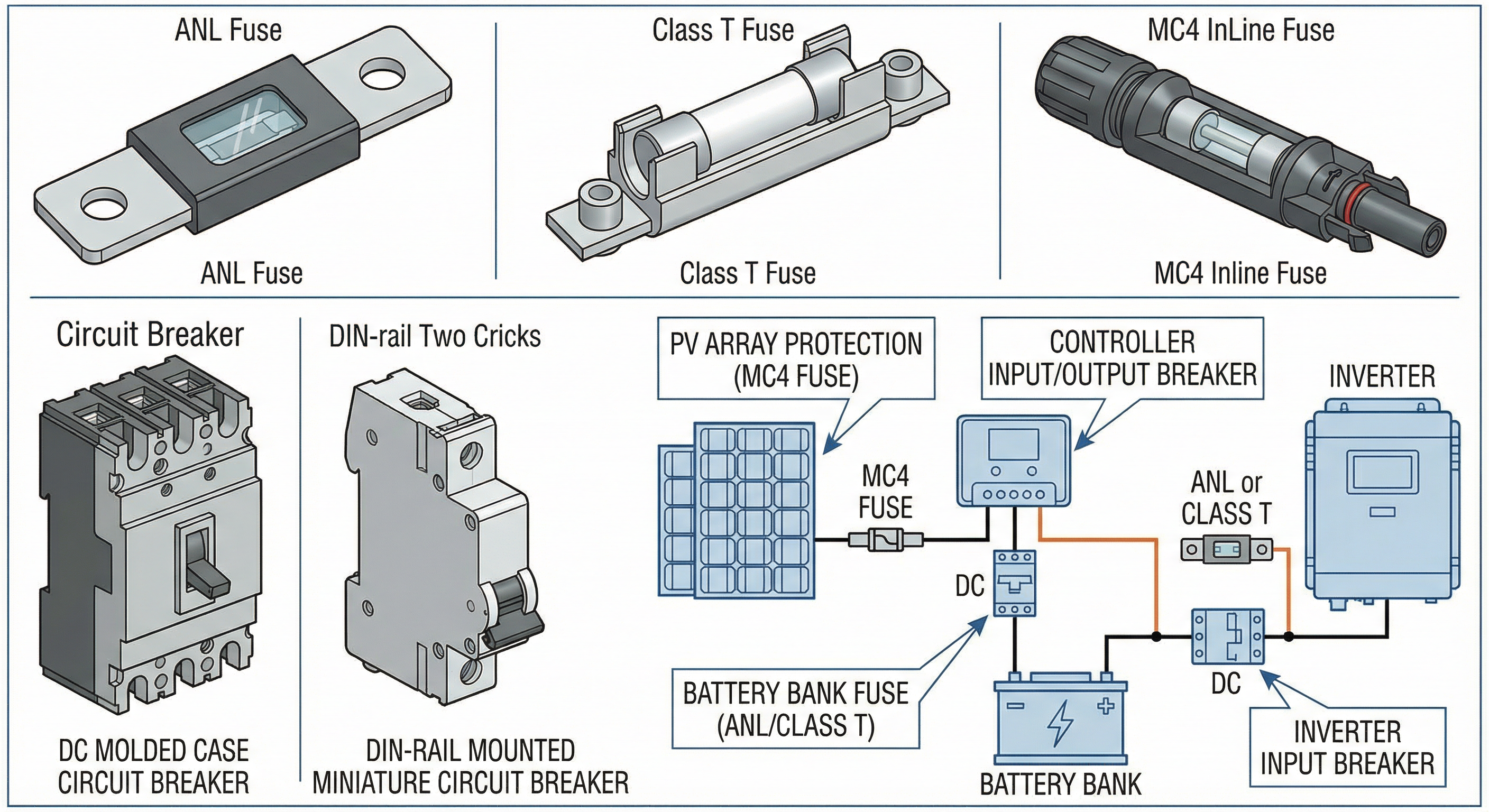
A fuse or circuit breaker has one job: to protect the wire. If too much current flows through a wire, it gets hot, melts the insulation, and starts a fire. The fuse is designed to "blow" (break the circuit) before the wire gets hot enough to burn.
Here is where you need them and how to size them.
The 3 Critical Locations
- Between Solar Panels and Charge Controller (PV Circuit).
- Between Charge Controller and Battery.
- Between Battery and Inverter.
(Optional: Between Battery and DC Fuse Block for small loads).
1. PV Circuit Protection (Panels -> Controller)
Do I need a fuse here?
- Series String: Usually NO, if the wire can handle the short circuit current (Isc) of the panel.
- Parallel Strings: YES, if you have 3 or more strings in parallel. If one string shorts, the other two can dump their current into the shorted one, causing a fire.
Sizing
- Voltage: Must be rated higher than the array Voc (Open Circuit Voltage). Do not use standard 12V automotive fuses here! Use PV-rated fuses (e.g., 1000VDC).
- Amperage: Panel Isc x 1.56.
- Example: Panel Isc = 10A.
- Fuse = 10A x 1.56 = 15.6A -> 15A or 20A Fuse.
Recommendation: Use a PV Combiner Box or inline MC4 fuses.
2. Controller to Battery Protection
This protects the wire if the battery shorts out or the controller malfunctions.
Sizing
- Amperage: Match the Charge Controller's rating.
- 60A MPPT Controller -> 60A or 80A Breaker.
- Wire size must be rated to handle 60A+.
Recommendation: Use a high-quality DC Circuit Breaker (like MidNite Solar or Blue Sea). This also acts as a convenient On/Off switch for maintenance.
3. Battery to Inverter Protection (The Big One)
This is the most dangerous circuit because the battery can dump thousands of amps instantly in a short.
Sizing
- Amperage: Inverter Continuous Watts / Battery Voltage x 1.25 (Safety Factor).
- Example: 2000W Inverter / 12V Battery = 166 Amps.
- 166A x 1.25 = 208 Amps.
- Fuse Size: 200A or 250A Class T Fuse.
Important: Class T Fuses
For Lithium batteries, you MUST use a Class T Fuse. Why? Lithium batteries have extremely low resistance and can release massive current (20,000A+) in a short. Standard ANL or Breakers might arc and weld shut, failing to break the circuit. Class T fuses are fast-acting and designed to stop this arc.
Summary Table
| Location | Device Type | Sizing Rule |
|---|---|---|
| PV Array | MC4 Fuse / PV Breaker | Isc x 1.56 |
| Controller -> Battery | DC Breaker | Controller Rating x 1.25 |
| Battery -> Inverter | Class T Fuse | (Watts / Volts) x 1.25 |
Breakers vs. Fuses
- Breakers: Resettable. Good for circuits you turn on/off frequently (like PV input).
- Fuses: One-time use. Cheaper, simpler, and often safer for very high currents (like the main battery fuse).
Conclusion
Never skimp on fuses. A $20 fuse protects your $5,000 system and your life. Always size the wire to handle more current than the fuse rating.
Learn more about wiring configurations in How to Wire Solar Panels: Series vs Parallel.


