
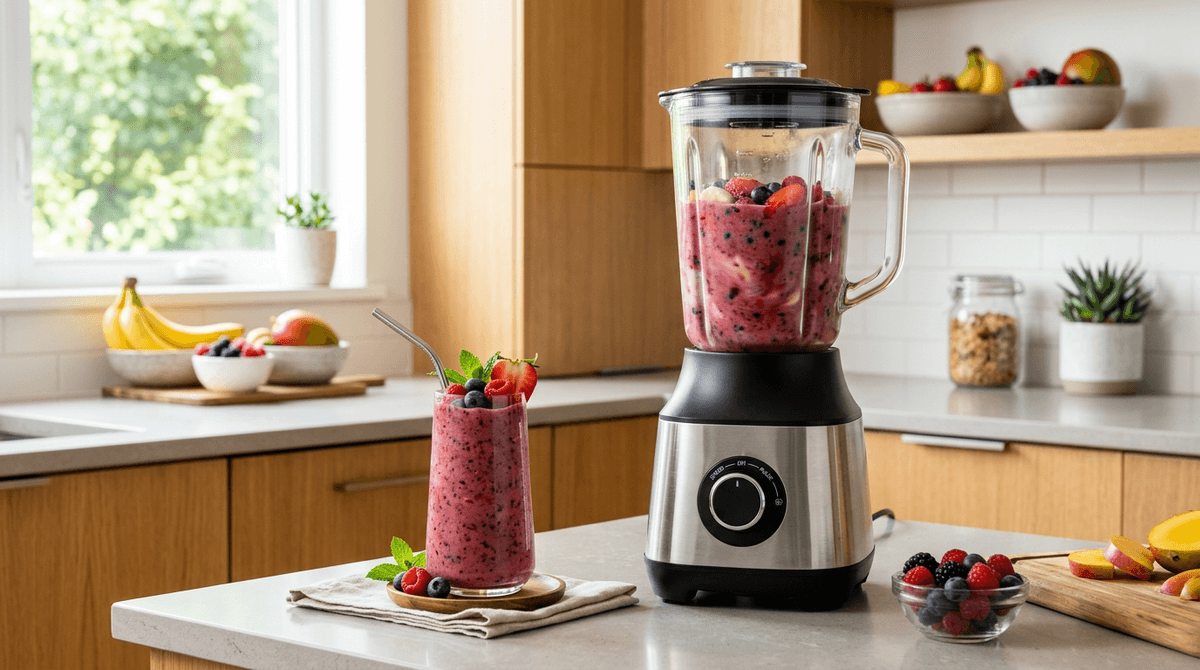
Most blenders use about 300 to 1,200 watts while blending. High-power “professional” countertop blenders can push higher, while small personal blenders typically use less.
For full system planning, use the WattSizing Calculator.
Quick Answer
Most blenders use about 300 to 1,200 running watts. Many personal blenders land around 200 to 600 W, while high-power countertop models are often 1,000 to 1,800 W at full load.
Detailed Explanation
Blenders are motor appliances, so power draw can jump based on:
- What you’re blending: ice, frozen fruit, nut butter, and thick mixtures increase load.
- Speed and pulse use: max speed and long blends pull more energy than quick pulses.
- Jar size and blade design: larger jars and aggressive blade designs can demand more torque.
For inverter sizing, allow headroom for a brief startup surge, especially on higher-powered models.
Watt Table
| Blender Type | Typical Running Watts | Typical Starting Watts |
|---|---|---|
| Personal / single-serve blender | 200 - 600 W | 300 - 900 W |
| Standard countertop blender | 300 - 1,000 W | 450 - 1,400 W |
| High-power countertop blender | 1,000 - 1,800 W | 1,300 - 2,500 W |
| Immersion blender | 200 - 800 W | 300 - 1,100 W |
Calculation Example
Example: A blender draws 700 W and you blend for 3 minutes/day total.
- Run time in hours: 3 / 60 = 0.05 h
- kWh/day = (700 x 0.05) / 1000 = 0.04 kWh/day
- At $0.16/kWh, monthly cost is about $0.19
If you’re stacking kitchen loads, compare with How Many Watts Does a Microwave Use and How Many Watts Does an Electric Kettle Use.
Tips to Reduce Power Usage
- Use pulse mode to break up ice/frozen ingredients, then blend on a lower setting.
- Add liquid first to reduce motor strain on thick mixes.
- Blend in shorter bursts instead of long, continuous runs when possible.
- If on backup power, avoid running the blender at the same time as a kettle, toaster, or microwave.
FAQs
Do blenders have a big startup surge?
They can. Motor startup and heavy loads (like ice) can cause a brief spike above steady running watts.
Does a higher watt blender always use more electricity?
Not necessarily. High-watt models can finish tasks faster, and energy depends on both power and time.
Where do I find my blender’s wattage?
Check the label on the base, the manual, or the product listing. For best accuracy, measure with a plug-in power meter.
CTA
Ready to size your setup accurately? Use the WattSizing Calculator to estimate panel, battery, and inverter requirements from your real appliance loads.


