
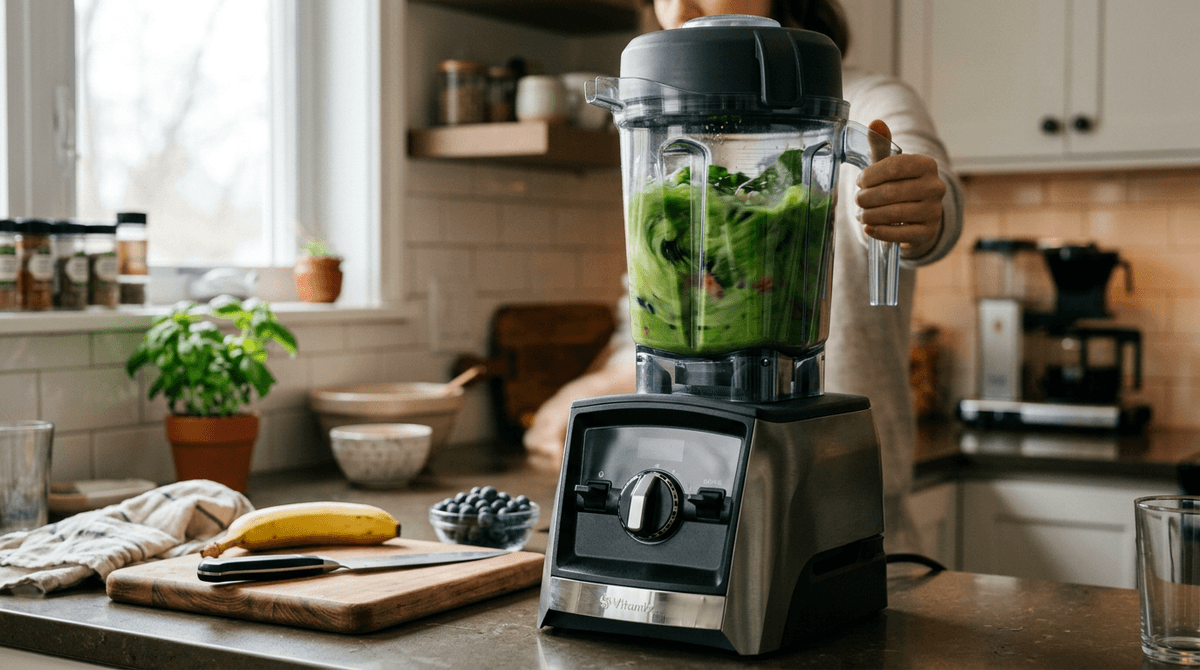
Most blenders are high-power but short-run appliances. In many homes, blender use works out to roughly 0.01 to 0.10 kWh/day depending on wattage and total blend minutes.
For full system planning, use the WattSizing Calculator.
Quick Answer
Most households use about 0.01 to 0.10 kWh/day on blending. Light smoothie use is usually near the low end; frequent thick blends (ice, frozen fruit, nut butter) can push daily kWh higher.
Detailed Explanation
Daily blender energy is mainly:
- Watts while blending: typically a few hundred watts to over 1,000 W on powerful models.
- Total minutes per day: many blends are 30–120 seconds, but multiple batches add up.
Because blenders are motor loads, they may draw briefly higher power at startup or when the mixture is very thick.
Watt Table
| Blender Type / Usage Pattern | Typical Running Watts | Typical Starting Watts | Typical Daily Energy |
|---|---|---|---|
| Personal blender (1–3 min/day) | 200 - 600 W | 300 - 900 W | 0.01 - 0.03 kWh/day |
| Standard countertop (2–6 min/day) | 300 - 1,000 W | 450 - 1,400 W | 0.02 - 0.10 kWh/day |
| High-power blender (3–8 min/day) | 1,000 - 1,800 W | 1,300 - 2,500 W | 0.05 - 0.24 kWh/day |
Calculation Example
Example: A blender averages 800 W while blending and you use it for 4 minutes/day total.
- Run time in hours: 4 / 60 = 0.07 h
- kWh/day = (800 x 0.07) / 1000 = 0.06 kWh/day
- At $0.16/kWh, monthly cost is about $0.29
For other daily kitchen loads, see How Many Watts Does a Microwave Use Per Day and How Many Watts Does an Electric Kettle Use Per Day.
Tips to Reduce Power Usage
- Blend in short bursts instead of long continuous runs.
- Add liquid first and avoid overfilling to reduce motor strain.
- Thaw frozen ingredients slightly when possible to shorten blend time.
- On backup power, stagger blender use with other high-watt kitchen appliances.
FAQs
Why is blender kWh/day usually low even if watts are high?
Because most blending happens for a few minutes per day, keeping total daily energy modest.
Does blending ice increase electricity use?
Usually, yes. Ice and thick mixtures raise motor load and can increase average watts and blend time.
Should I use rated watts or measured watts?
Use measured watts when possible for accuracy. Rated watts are fine for ballpark kWh/day estimates.
CTA
Ready to size your setup accurately? Use the WattSizing Calculator to estimate panel, battery, and inverter requirements from your real appliance loads.


