
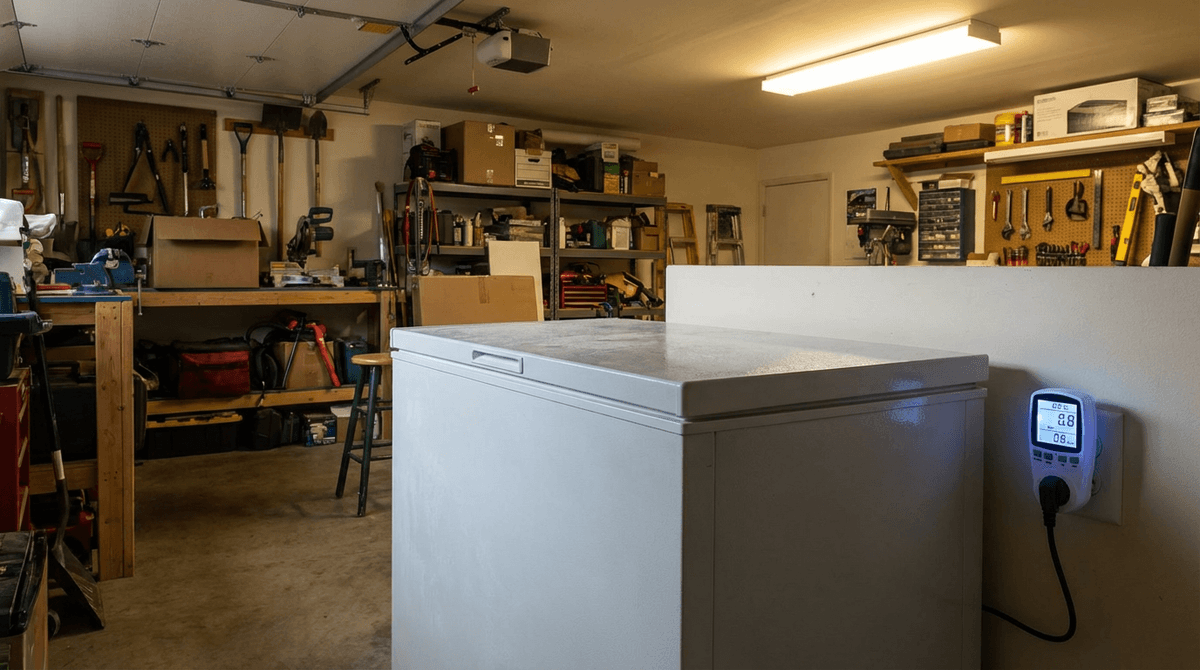
A chest freezer does not suddenly draw higher watts in peak-rate windows, but the same kWh can cost more when consumed during peak hours.
For full system planning, use the WattSizing Calculator.
Quick Answer
Typical running watts remain 80 to 250 W and startup 500 to 1,500 W. Peak-hour impact is primarily a billing issue tied to tariff timing.
Peak-Hour Cost Logic
If more compressor cycles happen in late afternoon heat, both consumption and price can rise together. That is why freezer placement and ventilation still matter under TOU billing.
Typical Planning Ranges
| Size | Running Watts | Starting Watts | Peak-Window Energy (4h) |
|---|---|---|---|
| Small | 70 - 130 W | 400 - 800 W | 0.2 - 0.5 kWh |
| Medium | 100 - 180 W | 600 - 1,100 W | 0.3 - 0.7 kWh |
| Large | 140 - 260 W | 900 - 1,600 W | 0.4 - 1.0 kWh |
Practical Example
If your freezer uses 0.7 kWh during peak and peak rate is $0.32/kWh:
- Peak-period cost = $0.22 for that window
You can compare TOU strategies with How to Calculate Appliance Running Cost.
FAQs
Can I shift freezer usage away from peak hours?
Not fully, but pre-cooling and reducing warm door-open events before peak can help.
Do peak hours change surge requirements?
No. Power-equipment sizing remains the same.
Is chest freezer still efficient under TOU?
Usually yes, especially compared to many continuously active large loads.
CTA
Ready to size your setup accurately? Use the WattSizing Calculator to estimate panel, battery, and inverter requirements from your real appliance loads.


