
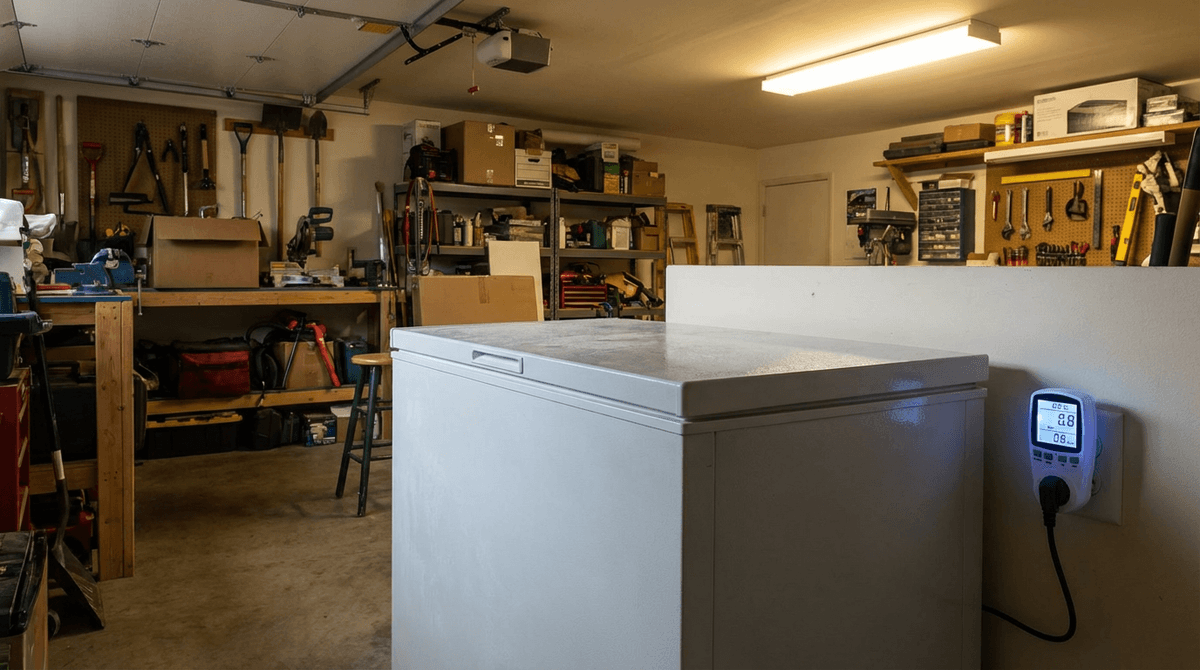
During rainy season, chest freezers usually stay near 80 to 250 running watts, while daily kWh depends on local temperature swings and ventilation.
For full system planning, use the WattSizing Calculator.
Quick Answer
Typical running draw remains 80 to 250 watts, startup 500 to 1,500 watts. Daily energy often lands between winter and summer values.
Rainy-Season Considerations
Cooler outdoor air can help efficiency, but humidity and poor airflow around the unit can offset gains. Keep clearance around side walls and condenser areas.
Typical Ranges
| Chest Freezer Size | Running Watts | Starting Watts | Typical Rainy-Season kWh/day |
|---|---|---|---|
| 5-7 cu ft | 70 - 130 W | 400 - 800 W | 1.1 - 1.9 |
| 8-12 cu ft | 100 - 180 W | 600 - 1,100 W | 1.6 - 2.8 |
| 13+ cu ft | 140 - 260 W | 900 - 1,600 W | 2.2 - 3.9 |
Practical Example
A medium freezer averaging 135 W uses:
- (135 x 24) / 1000 = 3.24 kWh/day
- At $0.15/kWh, around $0.49/day
For comparison, see How Many Watts Does a Refrigerator Use.
FAQs
Does humidity increase freezer watts directly?
Usually not directly, but moisture and airflow issues can increase compressor runtime.
Should I worry about surge in rainy season?
Yes. Startup surge sizing does not go away.
Is this enough for off-grid planning?
Use a conservative kWh/day assumption and include inverter surge headroom.
CTA
Ready to size your setup accurately? Use the WattSizing Calculator to estimate panel, battery, and inverter requirements from your real appliance loads.


