
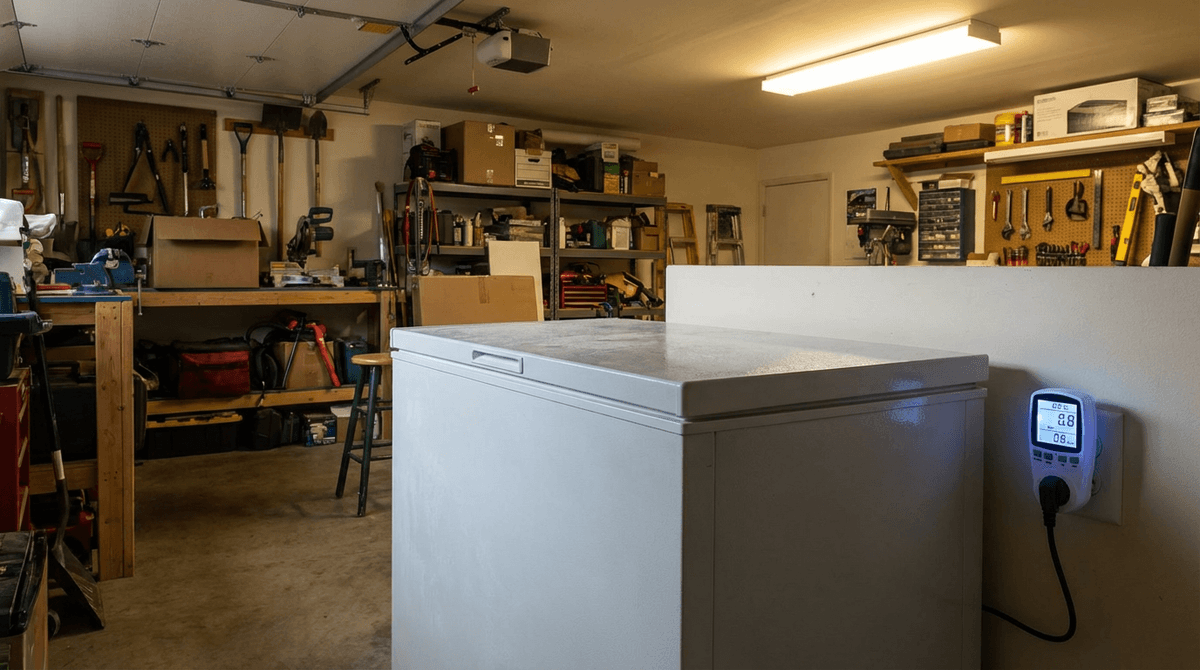
In winter, many chest freezers use slightly less daily energy because ambient temperature is lower, though running watts and startup surge stay in similar bands.
For full system planning, use the WattSizing Calculator.
Quick Answer
Expect around 80 to 250 running watts and 500 to 1,500 starting watts. Winter often trims daily kWh by roughly 5% to 20% versus hot-season operation.
Winter Behavior
Compressor systems are less stressed in cooler surroundings, so duty cycle may drop. But very cold spaces can create control issues on some units, so stable placement is still important.
Typical Winter Ranges
| Chest Freezer Size | Running Watts | Starting Watts | Typical Winter kWh/day |
|---|---|---|---|
| 5-7 cu ft | 70 - 130 W | 400 - 800 W | 1.0 - 1.8 |
| 8-12 cu ft | 100 - 180 W | 600 - 1,100 W | 1.5 - 2.6 |
| 13+ cu ft | 140 - 260 W | 900 - 1,600 W | 2.0 - 3.6 |
Practical Example
If a freezer averages 120 W over a winter day:
- kWh/day = (120 x 24) / 1000 = 2.88
- At $0.14/kWh, daily cost is about $0.40
Related baseline guide: How Many Watts Does a Chest Freezer Use Per Day.
FAQs
Are winter running watts lower on the label?
No. Nameplate power usually does not change; runtime does.
Does defrosting still help in winter?
Yes. Ice buildup hurts efficiency in any season.
Is backup sizing different in winter?
Daily energy may be lower, but inverter/generator should still cover startup surge.
CTA
Ready to size your setup accurately? Use the WattSizing Calculator to estimate panel, battery, and inverter requirements from your real appliance loads.


