
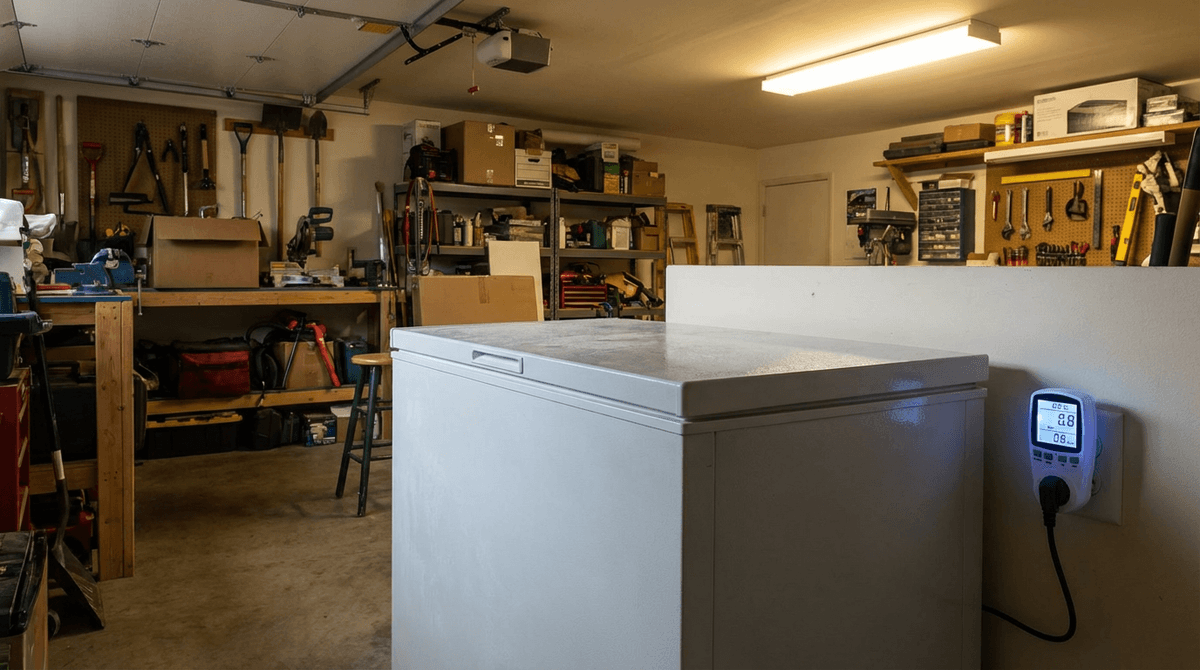
A chest (deep) freezer differs from an upright in a way that actually shows up on the bill: a top lid holds a pool of cold, dense air in the well when you open it, so you usually lose less cold per look inside than you do with a full-height swing door that dumps a column of air onto the floor. That often reduces kWh for a given stockpile volume, but the electrical shape is the same: low average power, a spiky compressor start for inverters and small generators, and a daily kWh line that still swells in a hot garage.
Model loads in the WattSizing Calculator. For the one-second vs hourly split in backup gear, read Generator running watts vs starting watts. If you will run a kitchen fridge on the same backup path, treat two cold appliances as one planning problem: How many watts does a refrigerator use? and overlap, not a lone freezer in a spreadsheet cell.
1) Three numbers: on-cycle W, start window, kWh per day
| What you need | What it answers |
|---|---|
| Running watts when the compressor (and any fan) is on | Can the inverter hold steady load after a good start? |
| Start / inrush (often under a few seconds; softer on some inverter compressors) | Will a small solar generator or power station trip when the motor leaves a dead stop? |
| kWh per 24 h (Energy Guide, utility data, or a plug-in meter over 48 h) | How many Wh in the battery and solar budget? |
A label that the freezer averages 120 W is not proof that a 1,200 W peak class inverter will start your unit without a measured margin.
2) Why chest freezers often win on kWh (no mysticism)
- Lid geometry keeps more cold in the well; you get fewer long recoveries if you are not in and out all day.
- Thick insulation on current models holds duty cycle down in a reasonable room. A ~70 °F (21 °C) kitchen is not a ~100 °F (38 °C) garage in July.
- Upright units can reheat the cavity faster on frequent door use. A chest is still a kWh machine—not “free” because the lid is horizontal.
3) Volume bands (rough only: nameplate and measurement win)
| Capacity (typical retail) | On-cycle “running” feel | Surge to plan (classic 120 V hardware) | kWh / day in mild ambient (ballpark) |
|---|---|---|---|
| Small (≈3–7 cu ft) | ~80–180 W | ~500–1,000 W | ~0.3–0.8 |
| Mid (≈7–12 cu ft) | ~120–250 W | ~700–1,300 W | ~0.5–1.0 |
| Large (≈15+ cu ft) | ~200–400 W | ~1,000–1,800+ | ~0.8–1.6+ |
Older units, dirty coils, and tight rear clearance can add a large kWh tax with little change in how the nameplate looks. Measure the install you actually run.
4) Setpoint, defrost, and surprise loads
- 0 °F (−18 °C) (or the manufacturer’s recommendation) is the usual long-term storage target for quality; colder setpoints cost kWh for margin you may not need.
- Manual-defrost chests skip scheduled defrost heater energy but need frost maintenance. Some frost-free or self-defrosting designs (where sold) can still hide a hundreds-of-watt heater event for many minutes on a schedule—easy to miss if you only watch “compressor W” for a short sample.
5) Hot garage: the same label, a different life
A hot ambient stretches compressor on-time. kWh tracks minutes per hour the system runs, not a single W in a table. Shade, a clear air path to the condenser, and moving the box out of a sun-baked shed often matter more than debating 5 vs 7 cu ft on a sticker.
6) Generators: the two-thermostat overlap
A plausible worst case for an extension-cord plan is freezer surge + kitchen fridge surge + a little router and lights. Running vs starting is where you add watts—not where you reassure yourself with “it only runs 150 W.”
Staggering (start one load, wait until it is running steadily, then add the other) cuts coincident surge. It does not remove the fact that two independent thermostats can still demand a start on the same long outage day.
7) Off-grid: inverter peak and battery kWh are two checks
- Size inverter continuous for ~running and documented surge (plus cable drop and BMS current on 12 V runs) for start. See Inverter sizing for off-grid solar.
- Waveform matters: Pure sine vs modified sine is not optional trivia for compressor motors and control boards.
If you have 8 h of effective on-time in a 24 h day at ~200 W, that is the kWh from watts and hours line item; daily off-grid use in Wh ties that to usable battery capacity under lithium vs lead depth-of-discharge rules.
12/24 V native compressor freezers (where people use them) can skip AC double conversion; DC fusing and length-correct cable then become the gating specs, not a marketing badge.
8) Outage tips: mass, lid discipline, insulation
- A full freezer (food plus jugs of frozen water) stretches safe time with no grid.
- One planned lid open per day beats browsing with the top open in a blackout.
- A quilt or moving blanket over the shell in an emergency can buy hours; it is not a substitute for normal ventilation in everyday use.
FAQs
Can a 1,000 W inverter run my chest freezer?
Sometimes for running; a weak default for lock-rotor if the inverter’s surge spec is tight to the brochure and you have not logged a max W for your unit. A 2,000 W class pure sine is a common first stop in off-grid refrigeration (see pure vs modified) so control boards and motors are not a gamble.
Is a chest always lower kWh than an upright?
Often in like-for-like ambients and use—not always. Leaky gaskets and frequent openings override door geometry in a hurry.
Is a 2,000 W generator “safe” for chest freezer + kitchen fridge?
Often with staggering; shaky if both compressors try to start in the same instant and your set is 2,000 W running with tight headroom. A 3,000 W running-class inverter generator is a dull, reliable class for fridge + freezer + a little baseload.
What is a “DC chest freezer” in off-grid talk?
A 12 V or 24 V compressor product that avoids AC; the tradeoff moves to BMS current, fuse class, and cable length—same work, different failure modes than a W on a solar box.
My freezer is in a 100 °F garage. Does your kWh table still apply?
No. When the condenser cannot reject heat to a tolerable ambient, kWh jumps. A mild-weather label does not replace a July bake in a shed with no shade.
How do I measure surge and kWh at home without a lab?
A reputable plug-in energy meter (or 48 h of interval data on a dedicated circuit). Record the highest W the unit hits and total kWh; for a 48 h test, divide kWh by 2 for per-day kWh.
Manual defrost vs auto / frost-free chest: which uses less kWh?
Manual-defrost lines often skip defrost heater kWh; you pay in frost chores and airflow if ice builds in the wrong place. Compare two units on a meter, not brochure buzzwords alone.
Why did my solar “power station” still trip on the chest freezer?
Inverter surge < compressor start or battery sag under inrush on the DC side—average W in the marketing copy did not match the second the compressor cared about.
Recap: size for start and honest overlap on generators and inverters; size kWh and Wh for sun and batteries. When the inputs are yours, the WattSizing Calculator stops being a stranger’s guesswork.


