
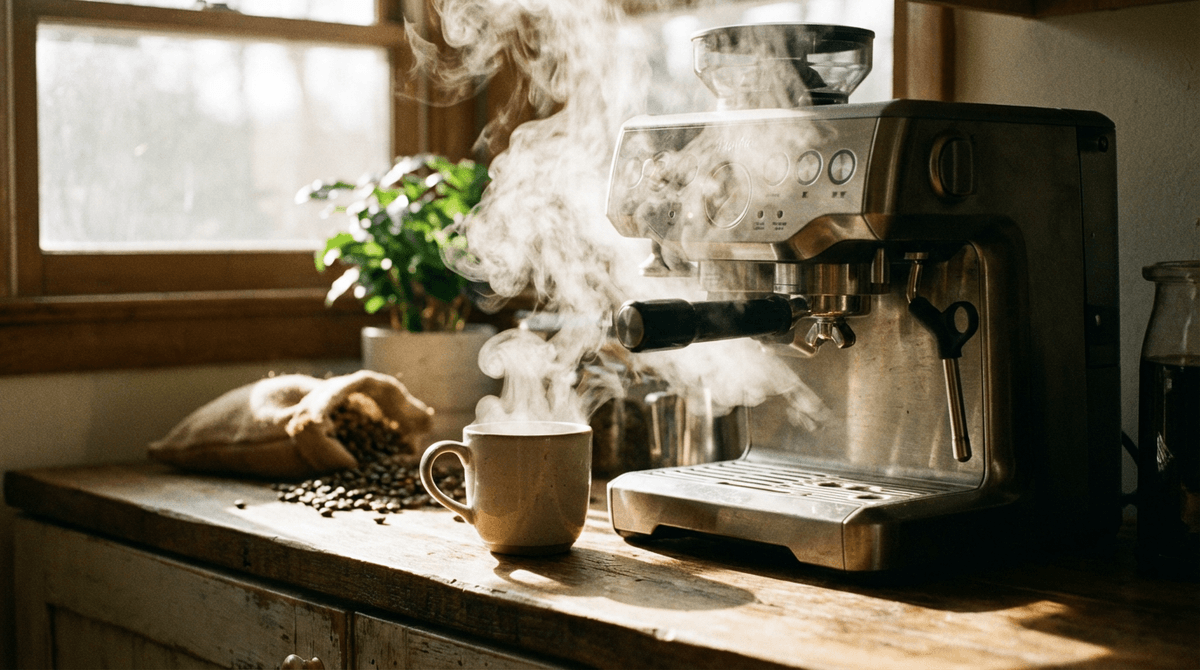
Most coffee makers draw high watts while heating water, but brewing is usually short. Daily use often lands around 0.10 to 1.20 kWh/day, mainly depending on brew frequency and how long a warming plate stays on.
For full system planning, use the WattSizing Calculator.
Quick Answer
Many homes use about 0.10 to 1.20 kWh/day on coffee making. A quick brew with no keep-warm is usually near the low end, while frequent brewing plus hours of warming-plate time can push daily kWh higher.
Detailed Explanation
Coffee maker daily consumption is typically split into two parts:
- Brewing (heating water): high watts for a few minutes.
- Keep-warm / standby: lower watts, but it may run for hours.
That’s why two households with the same coffee maker can have very different kWh/day: one brews once and turns it off, the other brews twice and leaves the warming plate on all morning.
Watt Table
| Coffee Maker Type / Usage Pattern | Typical Running Watts | Typical Starting Watts | Typical Daily Energy |
|---|---|---|---|
| Drip coffee maker (1 brew/day, no keep-warm) | 600 - 1,200 W | 700 - 1,300 W | 0.08 - 0.25 kWh/day |
| Drip + warming plate (1 brew + 1–3 hr keep-warm) | 600 - 1,200 W (brew), 50 - 200 W (warm) | 700 - 1,300 W | 0.20 - 0.80 kWh/day |
| Single-serve (2–6 cups/day) | 900 - 1,500 W | 1,000 - 1,700 W | 0.15 - 0.60 kWh/day |
| Espresso + steam use (daily) | 800 - 1,800 W | 900 - 2,200 W | 0.25 - 1.20 kWh/day |
Calculation Example
Example: A drip coffee maker draws 1,100 W while brewing for 9 minutes/day total, then the warming plate averages 120 W for 2 hours/day.
- Brewing time in hours: 9 / 60 = 0.15 h
- Brewing energy: (1,100 x 0.15) / 1000 = 0.17 kWh/day
- Keep-warm time in hours: 2.0 h
- Keep-warm energy: (120 x 2.0) / 1000 = 0.24 kWh/day
- Total = 0.17 + 0.24 = 0.41 kWh/day
- At $0.16/kWh, monthly cost is about $1.97
For other daily kitchen loads, see How Many Watts Does a Toaster Use Per Day and How Many Watts Does an Electric Kettle Use Per Day.
Tips to Reduce Power Usage
- Use an insulated thermal carafe (or disable keep-warm) instead of a warming plate.
- Brew once in a larger batch instead of several small cycles.
- Turn the machine fully off after brewing (some models have significant standby draw).
- If on backup power, stagger coffee maker use with other high-watt appliances.
FAQs
Why is coffee maker kWh/day sometimes higher than expected?
Usually because the warming plate or keep-warm feature runs for a long time, even though brew time is short.
Are single-serve machines more expensive per cup?
They can be, especially with frequent reheating cycles. The wattage is high, but the main factor is how many times per day it heats water.
Should I use a power meter to measure coffee maker energy?
Yes, if you want accuracy. It will capture both brew cycles and any keep-warm or standby energy.
CTA
Ready to size your setup accurately? Use the WattSizing Calculator to estimate panel, battery, and inverter requirements from your real appliance loads.


