
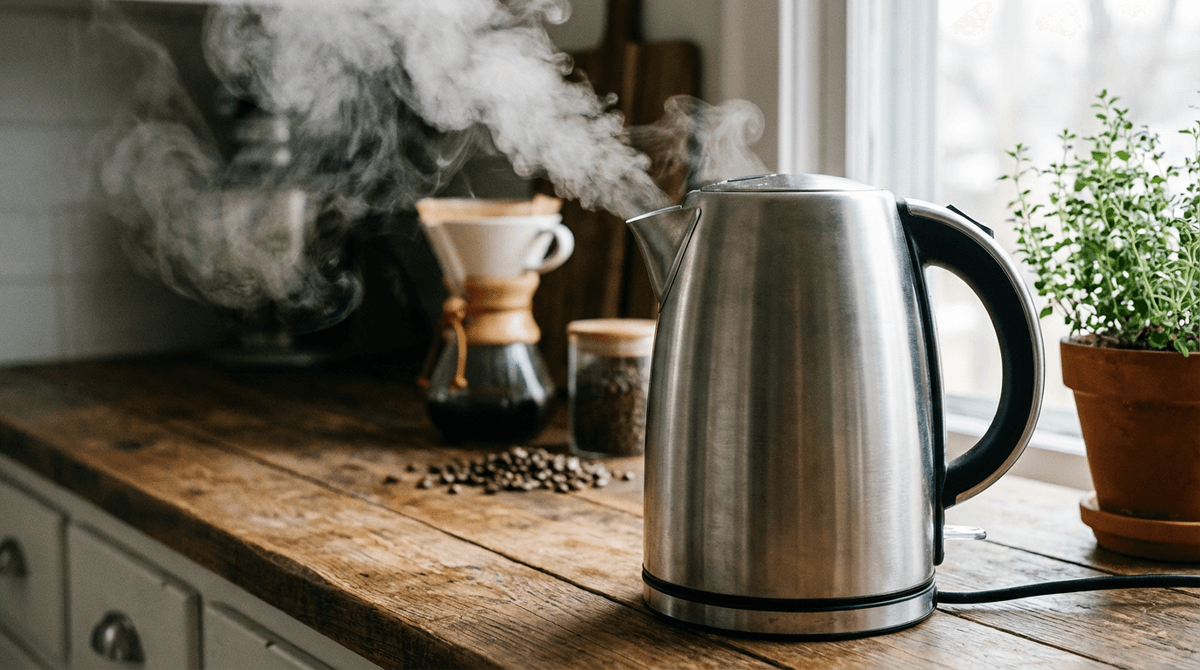
Most electric kettles draw about 1,200 to 1,800 watts while heating, and many homes land around 0.1 to 0.6 kWh/day depending on how often water is boiled.
For full system planning, use the WattSizing Calculator.
Quick Answer
Most electric kettles draw about 1,200 to 1,800 watts while heating, and many homes land around 0.1 to 0.6 kWh/day depending on how often water is boiled.
Detailed Explanation
Kettles are short-duration, high-power loads. Unlike refrigerators or air conditioners, they do not cycle all day; they run for a few minutes per boil session.
That means daily kWh depends more on boil frequency and fill volume than on nameplate watts alone. A household that boils water six times a day can use several times more energy than one that boils once.
Watt Table
| Kettle Type / Usage Pattern | Typical Running Watts | Typical Starting Watts | Typical Daily Energy |
|---|---|---|---|
| Compact kettle, light use (1-2 boils/day) | 700 - 1200 W | 800 - 1300 W | 0.05 - 0.20 kWh/day |
| Standard kettle, moderate use (2-4 boils/day) | 1200 - 1700 W | 1300 - 1900 W | 0.15 - 0.40 kWh/day |
| Fast-boil kettle, heavy use (4-6 boils/day) | 1500 - 2000 W | 1600 - 2200 W | 0.30 - 0.60 kWh/day |
| Office/shared kitchen use | 1500 - 2200 W | 1700 - 2400 W | 0.50 - 1.20 kWh/day |
Calculation Example
Example: A kettle draws 1,600 W and is used for 12 minutes/day total.
- Run time in hours: 12 / 60 = 0.20 h
- kWh/day = (1,600 x 0.20) / 1000 = 0.32 kWh/day
- At $0.16/kWh, monthly cost is about $1.54
For other kitchen daily-load references, see How Many Watts Does a Microwave Use Per Day and How Many Watts Does a Refrigerator Use Per Day.
Tips to Reduce Power Usage
- Heat only as much water as needed for the current cup or recipe.
- Use residual hot water in an insulated flask instead of multiple re-boils.
- Descale regularly to keep heating performance efficient.
- Stagger kettle use when running on backup systems with tight inverter limits.
FAQs
Why can kettle watts be high but kWh/day still low?
Because run time is usually short. High power for a few minutes often uses less daily energy than lower-power appliances running for hours.
Is auto shut-off important for energy savings?
Yes. It reduces accidental overboiling and avoids unnecessary heating cycles.
How do I estimate my own kettle kWh/day quickly?
Track total boiling minutes for a typical day, then use kWh/day = (watts x hours) / 1000.
CTA
Ready to size your setup accurately? Use the WattSizing Calculator to estimate panel, battery, and inverter requirements from your real appliance loads.


