
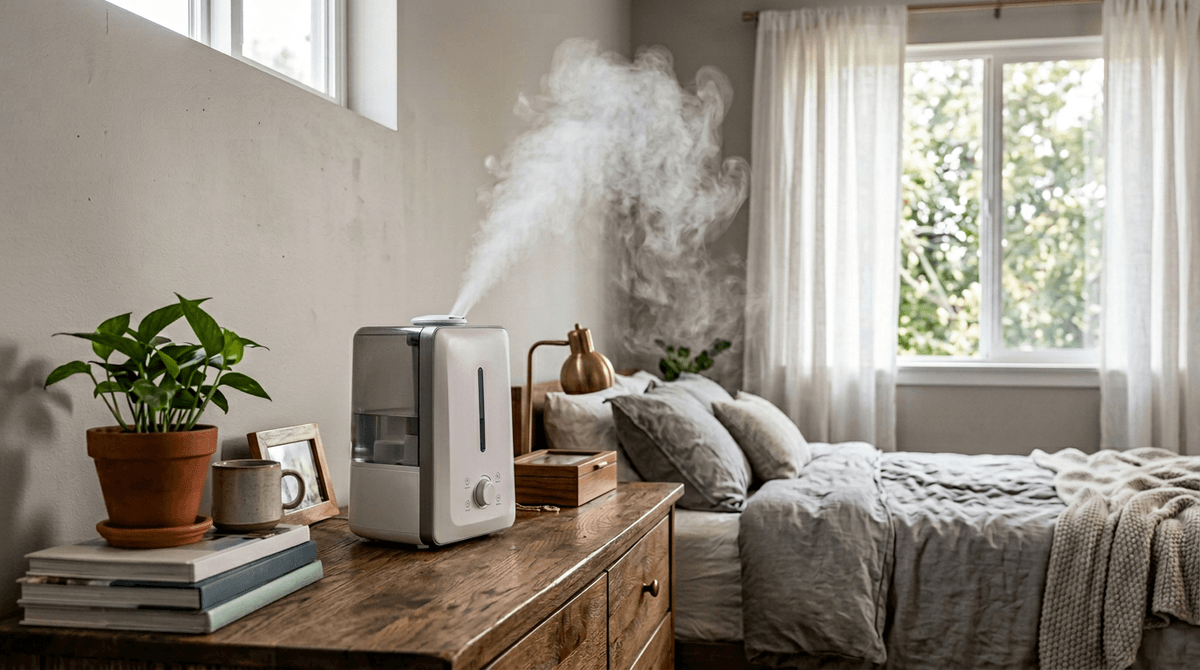
During the dead of winter, indoor heating systems dry out the air, causing chapped lips, bloody noses, and cracking wood furniture. A humidifier solves this by injecting moisture back into the room.
However, if you are relying on an off-grid solar setup or a small backup generator during a winter storm, choosing the right humidifier is absolutely critical. Some humidifiers use almost zero electricity, while others act like miniature space heaters, consuming massive amounts of power that will drain your battery bank flat before morning.
In this comprehensive guide, we will break down exactly how many watts different types of humidifiers use, explain the brutal difference between "Warm Mist" and "Ultrasonic" models, and show you how to size a battery backup to keep your bedroom comfortable all night long.
To model your specific humidifier alongside your other household loads, use our free WattSizing Off-Grid Calculator.
The Quick Answer: Humidifier Power Draw
Humidifiers plug into standard 120-Volt wall outlets. Their power consumption depends entirely on the technology they use to turn liquid water into airborne vapor.
- Ultrasonic / Cool Mist Humidifiers: These are incredibly energy-efficient. A standard bedroom unit uses just 20 to 40 watts while running at maximum output.
- Warm Mist / Steam Humidifiers: These use brute force to boil water. A standard warm mist unit draws between 200 and 400 watts.
- Whole-House Humidifiers: These massive console units use 600 to 1,000+ watts to generate enough moisture for a 2,500 square foot home.
Because humidifiers do not use heavy mechanical compressors, they do not have a startup surge. A 30W ultrasonic humidifier will pull exactly 30W the moment you turn it on.
Humidifier Wattage by Technology Type
If you are buying a humidifier for an RV, a tiny home, or a backup power situation, you must read the box carefully. The words "Warm Mist" mean you are buying a resistive heating element.
Here is a realistic look at what different types of humidifiers pull from your electrical panel or battery bank:
| Humidifier Technology | Room Size | Typical Running Watts | Daily Energy (Run 8 Hrs) |
|---|---|---|---|
| Ultrasonic (Cool Mist) | Bedroom (200 sq ft) | 20 - 40 W | 0.16 - 0.32 kWh |
| Evaporative (Cool Mist) | Bedroom (200 sq ft) | 30 - 60 W | 0.24 - 0.48 kWh |
| Warm Mist (Steam) | Bedroom (200 sq ft) | 200 - 400 W | 1.6 - 3.2 kWh |
| Large Console (Evaporative) | Whole House | 60 - 150 W | 0.48 - 1.2 kWh |
| Whole-House Steam | Whole House | 600 - 1,200 W | 4.8 - 9.6 kWh |
Deep Dive: How the Technology Changes the Wattage
1. Ultrasonic Humidifiers (The Off-Grid Winner)
Instead of boiling water, ultrasonic humidifiers use a tiny metal diaphragm vibrating at high frequency to shatter water droplets into a microscopic, cool fog. The only electricity required is for the tiny vibration plate and a microscopic fan to push the fog out. This is why they use less power than a lightbulb (often under 30W) and are the undisputed champion for off-grid living.
2. Evaporative Humidifiers (The Middle Ground)
These units use a wicking filter to soak up water from a tank. A fan then blows dry room air through the wet filter, causing the water to evaporate naturally. The only power consumed is by the fan motor (usually 30W to 60W). While efficient, you have to replace the gross, moldy wicking filters frequently.
3. Warm Mist Humidifiers (The Battery Killer)
These are literally electric kettles. They use a 300W resistive heating element to physically boil the water in the tank, pushing steam out the top. They are fantastic for killing bacteria and warming up a freezing bedroom, but they will absolutely devastate a small portable power station in hours.
Running a Humidifier on a Portable Power Station
During a winter blackout, you might want to run a humidifier next to your bed using a lithium portable power station (like a Jackery, Bluetti, or EcoFlow).
Because humidifiers have no startup surge, sizing your power station is a simple math equation:
Formula: (Running Watts × Hours Run) ÷ 0.85 (Inverter Inefficiency) = Required Battery Capacity in Wh
The Ultrasonic Scenario (Success)
You plug a 30W ultrasonic humidifier into your power station to sleep for 8 hours.
30W × 8 Hours = 240 Wh.
Accounting for inverter loss, you need roughly 280 Wh of battery capacity. A small, cheap $300 portable power station (like an EcoFlow River 2 Pro) will easily run this all night long with plenty of juice left to charge your phones.
The Warm Mist Scenario (Failure)
You plug a 300W warm mist humidifier into that same small power station.
300W × 8 Hours = 2,400 Wh.
Your small power station only holds 300 Wh of energy. The warm mist humidifier will drain the battery completely flat in less than 50 minutes, leaving you in the dark for the rest of the night.
If you want to run a warm mist humidifier all night, you need a massive, $2,000+ power station with at least 3,000 Wh of capacity.
What Size Generator Do I Need for a Humidifier?
If you are running a gasoline portable generator to power your whole house during an outage, the humidifier is a relatively small concern.
- For a Bedroom Ultrasonic Unit (30W): The wattage is so low it won't even register on your generator's load meter.
- For a Whole-House Steam Humidifier (1,000W): You must factor this into your sizing. If you have a 3,500W generator, this single humidifier will eat up nearly 30% of your total capacity. You will need to turn it off if you plan on using the microwave.
Recommendation: A standard 2,000W to 3,500W Inverter Generator can easily power your refrigerator, lights, internet router, and several ultrasonic humidifiers simultaneously without bogging down.
4 Tips for Using a Humidifier on Backup Power
- Switch to Cool Mist: If you own both a warm mist and a cool mist humidifier, put the warm mist unit in the closet during a blackout. Relying entirely on the 30W cool mist unit will save massive amounts of generator fuel and battery capacity.
- Use Low Settings: If your ultrasonic humidifier has a "High" and "Low" mist setting, keeping it on "Low" will often drop the power draw from 30W down to 15W, effectively doubling your battery runtime.
- Use Distilled Water: Ultrasonic humidifiers do not boil water, meaning they blast all the minerals (calcium) from tap water straight into the air, covering your furniture in white dust. Always use distilled water in ultrasonic units.
- Use the "Wood Stove Hack": If you live off-grid and heat your home with a wood stove, do not use an electric humidifier. Simply place a large cast-iron kettle filled with water on top of the hot wood stove. It will boil continuously, providing massive amounts of warm steam to the room for exactly zero watts of electricity.
Frequently Asked Questions
Can I plug a humidifier into a smart plug?
Yes. Because most humidifiers draw less than 400W and have no startup surge, they are perfectly safe to use with a standard 15-Amp (1,800W) smart plug. This allows you to schedule the humidifier to turn on only at night, saving electricity.
Does a humidifier make a room feel warmer?
Yes. Humid air holds heat better than dry air. Furthermore, the moisture prevents sweat from evaporating off your skin quickly. A room at 68°F with 50% humidity will feel significantly warmer than a room at 68°F with 20% humidity, allowing you to lower your thermostat and save money on your heating bill.
Do whole-house humidifiers use a lot of electricity?
It depends on the type. "Bypass" humidifiers attached to your furnace use almost zero electricity; they just use the furnace's blower motor to push air through a wet pad. "Steam" whole-house humidifiers, however, use massive 1,000W to 2,000W heating elements to boil water and inject steam directly into the ductwork, driving up your electric bill significantly.
Conclusion
A humidifier is essential for winter comfort, but choosing the right technology is the difference between a minor electrical load and a massive battery drain. By choosing an ultrasonic cool mist model, you can keep your room comfortable all night long using less electricity than an incandescent light bulb.
Want to accurately size a battery bank or generator for your bedroom? Use our free Off-Grid & Backup Load Calculator to enter your humidifier's wattage, add your CPAP machine or fan, and get a precise runtime recommendation instantly.


