
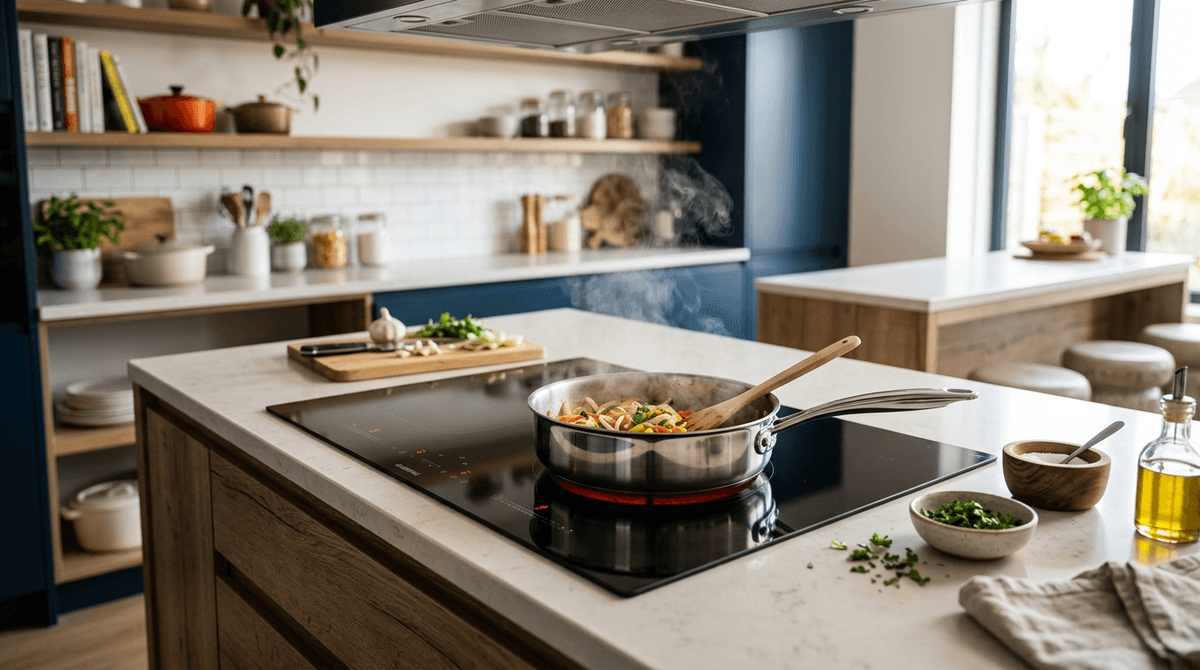
Induction cooktops typically use about 1,200 to 3,700 watts per active burner zone, and whole-unit peak draw can range from around 3,000 to 7,600 watts depending on model size.
For full system planning, use the WattSizing Calculator.
Quick Answer
Induction cooktops typically use about 1,200 to 3,700 watts per active burner zone, and whole-unit peak draw can range from around 3,000 to 7,600 watts depending on model size.
Detailed Explanation
Induction transfers energy directly into compatible cookware, which is one reason it can heat quickly and efficiently. Power draw depends on:
- Number of active cooking zones
- Power level setting
- Pan size and base material
- Whether boost mode is enabled
At low simmer settings, draw can be much lower than nameplate maximum. At boost, one zone may briefly run near its top rating, so simultaneous high-power cooking across multiple zones can push total demand up fast.
Watt Table
| Induction Setup | Typical Running Watts | Typical Peak Watts |
|---|---|---|
| Single portable induction burner | 700 - 1,800 W | 1,800 - 2,000 W |
| 2-burner induction cooktop | 1,200 - 3,000 W | 3,000 - 3,600 W |
| 4-zone 30-inch induction cooktop | 1,800 - 4,500 W | 5,000 - 7,200 W |
| 36-inch induction cooktop | 2,500 - 5,500 W | 6,000 - 7,600 W |
Calculation Example
Example: One induction zone averages 1,900 W for 40 minutes of cooking.
- Run time: 40 / 60 = 0.67 h
- Energy use: (1,900 x 0.67) / 1000 = 1.27 kWh
If you often cook with multiple zones, total demand can approach electric oven levels. For comparison, read How Many Watts Does a Electric Oven Use and How Many Watts Does a Microwave Use.
Tips to Reduce Power Usage
- Use flat, induction-compatible pans for better energy transfer.
- Match pan size to burner zone to avoid wasted heat.
- Start with boost only when needed, then lower to maintain temperature.
- Cook with lids to shorten time to boil and simmer.
FAQs
Does induction always use less electricity than electric coil or radiant?
Often yes for the same cooking task, mainly because heat transfer is more direct. Actual savings depend on cookware, habits, and duration.
Is there a startup surge like a compressor appliance?
Not usually in the same way. Induction is mostly an electronics-driven load, but instantaneous draw can still be high at boost settings.
Can I run an induction cooktop on backup power?
Small portable units are easier. Full-size cooktops often require larger inverter capacity and careful load management.
CTA
Ready to size your setup accurately? Use the WattSizing Calculator to estimate panel, battery, and inverter requirements from your real appliance loads.


