
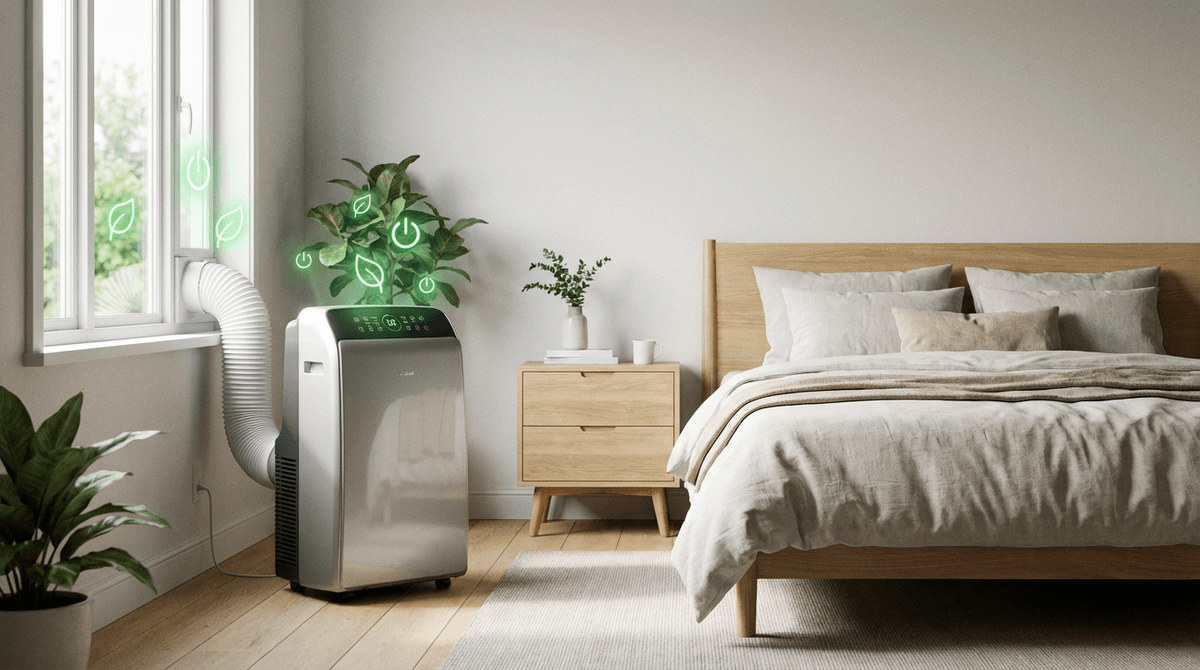
Tiny houses can cool fast, but solar gain through roof and windows can still create sharp afternoon load spikes.
For full system planning, use the WattSizing Calculator.
Quick Answer
In tiny-house setups, portable AC commonly runs around 850 to 1,500 W and uses roughly 3 to 8.5 kWh/day.
Detailed Explanation
Because tiny homes have limited interior volume, cooling response is quick, but envelope quality dominates total energy. Shade, reflective roofing, and targeted room cooling often reduce runtime more than upgrading to a larger AC unit.
For alternatives, compare How Many Watts Does a Mini Split Use in Tiny House and How Many Watts Does a Window Air Conditioner Use in Tiny House.
Watt Table
| Tiny House Context | Typical Running Watts | Typical Daily Energy |
|---|---|---|
| Insulated and shaded | 850 - 1,100 W | 3 - 4.8 kWh/day |
| Average build | 1,000 - 1,300 W | 4.5 - 6.5 kWh/day |
| High sun exposure | 1,200 - 1,500 W | 6.5 - 8.5 kWh/day |
Calculation Example
If portable AC averages 1,050 W for 5 hours/day:
kWh/day = (1,050 x 5) / 1000 = 5.25 kWh/day
Tips
- Shade west-facing windows during afternoon heat.
- Use door curtains or partitions to cool only occupied zones.
- Ventilate naturally at night when outdoor air is cooler.
- Keep unit clear of furniture that blocks airflow.
FAQs
Is portable AC enough for a tiny house?
Often yes for moderate climates and good envelope design.
Should I choose highest BTU possible?
Not always; oversizing can increase cycling and reduce comfort.
Is off-grid use realistic in tiny homes?
Yes, if runtime is managed and the power system is correctly sized.
CTA
Use the WattSizing Calculator to test tiny-house cooling scenarios and pick a right-sized power setup.


