
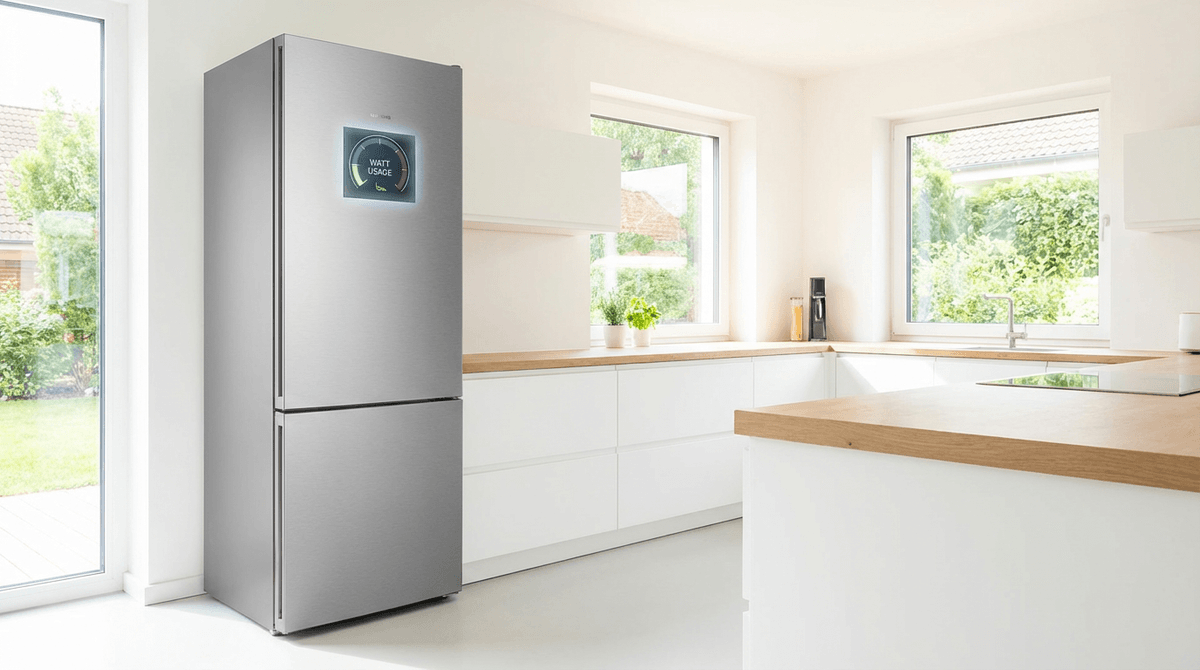
Apartment kitchens often have tighter clearances and warmer ambient conditions, which can increase refrigerator cycling if ventilation is poor.
For full system planning, use the WattSizing Calculator.
Quick Answer
In apartments, refrigerators commonly run around 100 to 230 W and often consume 1.1 to 2.4 kWh/day.
Detailed Explanation
Daily energy depends on apartment temperature, airflow around rear coils, and door-opening frequency. Built-in or tightly enclosed placements can raise compressor runtime compared with open kitchen layouts.
For related context, see How Many Watts Does a Refrigerator Use in Tiny House and How Many Watts Does a Refrigerator Use Per Day.
Watt Table
| Apartment Fridge Context | Typical Running Watts | Typical Daily Energy |
|---|---|---|
| Compact unit, good airflow | 100 - 150 W | 1.1 - 1.6 kWh/day |
| Typical family fridge | 130 - 190 W | 1.5 - 2.0 kWh/day |
| Tight enclosure / warmer kitchen | 170 - 230 W | 1.9 - 2.4 kWh/day |
Calculation Example
If your fridge averages 145 W over 24 hours:
kWh/day = (145 x 24) / 1000 = 3.5 kWh/day (continuous equivalent)
Real metered use is generally lower because compressors cycle.
Tips
- Leave manufacturer-recommended clearance around coils.
- Avoid locating fridge next to stove or dishwasher heat.
- Verify door seals and hinge alignment.
- Keep internal setpoint in recommended safe range only.
FAQs
Why does apartment placement matter so much?
Poor airflow around the condenser increases compressor workload.
Are smaller apartment fridges always lower energy?
Usually, but efficiency rating and usage patterns still matter.
Should I unplug during short trips?
Only if food is removed and appliance can be safely defrosted/dried.
CTA
Use the WattSizing Calculator to estimate apartment base-load energy and include refrigeration accurately.


