
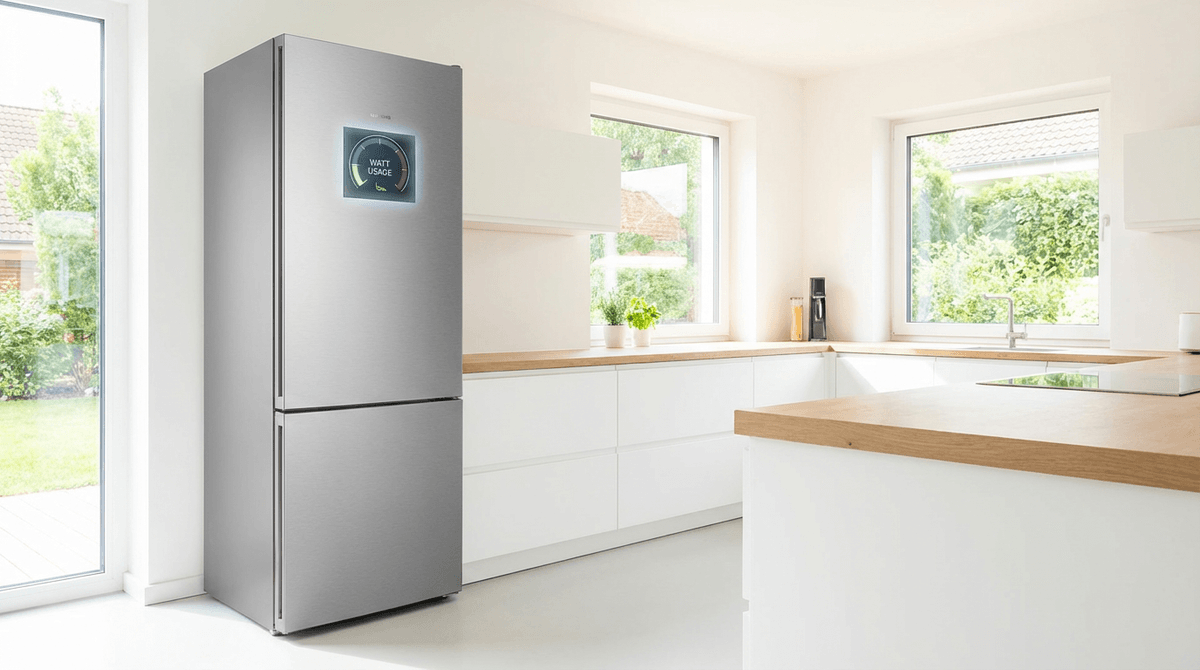
Refrigerators run year-round, but summer conditions usually increase compressor duty cycle due to higher room temperature and more frequent door openings.
For full system planning, use the WattSizing Calculator.
Quick Answer
In summer, most refrigerators draw about 100 to 300 W while running, and many homes see around 1.2 to 3.2 kWh/day.
Detailed Explanation
Running watts are similar across seasons, but total daily energy rises in hot weather because the compressor runs longer to hold internal temperature. Kitchen heat from cooking and direct sunlight can further raise consumption.
For baseline references, see How Many Watts Does a Refrigerator Use and How Many Watts Does a Refrigerator Use Per Day.
Watt Table
| Summer Fridge Context | Typical Running Watts | Typical Daily Energy |
|---|---|---|
| Efficient modern unit | 100 - 180 W | 1.2 - 1.9 kWh/day |
| Typical household unit | 140 - 230 W | 1.7 - 2.5 kWh/day |
| Large or older unit | 180 - 300 W | 2.3 - 3.2 kWh/day |
Calculation Example
If your fridge averages 170 W over 24 hours:
kWh/day = (170 x 24) / 1000 = 4.1 kWh/day (upper-bound continuous equivalent)
In practice, duty cycling usually brings real daily use lower than continuous equivalent.
Tips
- Keep condenser coils clean before hot season peaks.
- Avoid placing hot food inside immediately after cooking.
- Check door gasket seal with a paper test.
- Keep fridge away from oven or direct sun.
FAQs
Why does summer increase fridge electricity usage?
Higher ambient temperature forces longer compressor runtime.
Do newer refrigerators handle summer better?
Usually yes, due to improved compressor and insulation efficiency.
Should I lower thermostat to compensate for heat?
Only slightly; overcooling can waste energy without food-safety benefit.
CTA
Estimate year-round refrigeration energy with the WattSizing Calculator and include seasonal adjustments in your load plan.


