
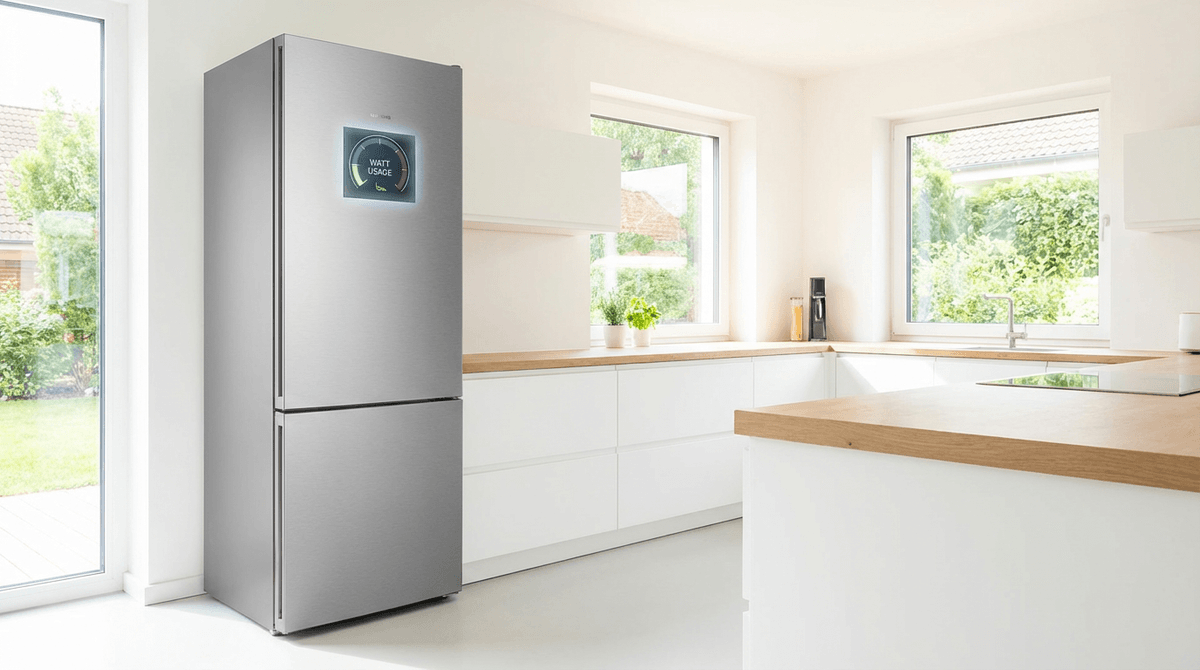
Winter often lowers refrigerator duty cycle because ambient kitchen temperatures are cooler than summer.
For full system planning, use the WattSizing Calculator.
Quick Answer
In winter, refrigerators still run around 90 to 260 W when the compressor is on, with common daily consumption near 0.9 to 2.4 kWh/day.
Detailed Explanation
Compressor wattage itself does not change dramatically, but run-time duration usually drops. Homes with heated kitchens, frequent cooking, or poor door seals may still see moderate usage even in cooler months.
For seasonal comparison, review How Many Watts Does a Refrigerator Use in Summer and How to Calculate Electricity Bill from kWh.
Watt Table
| Winter Fridge Scenario | Typical Running Watts | Typical Daily Energy |
|---|---|---|
| Efficient compact unit | 90 - 150 W | 0.9 - 1.5 kWh/day |
| Standard family fridge | 120 - 210 W | 1.3 - 2.0 kWh/day |
| Large/older model | 170 - 260 W | 1.8 - 2.4 kWh/day |
Calculation Example
If the fridge averages 130 W over 24 hours:
kWh/day = (130 x 24) / 1000 = 3.1 kWh/day (continuous equivalent)
Real measured usage is often lower because compressor operation is intermittent.
Tips
- Keep freezer frost under control for stable efficiency.
- Avoid unnecessary thermostat reductions in cold months.
- Verify door seals to prevent warm-air infiltration.
- Keep airflow clear around rear coils.
FAQs
Why can winter bills still show noticeable fridge use?
Refrigerators run continuously over the full day, even with shorter cycles.
Is garage placement good in winter?
Only if manufacturer temperature limits are respected.
Do smart plugs measure fridge energy accurately?
Yes, they can provide useful daily and monthly trends.
CTA
Use the WattSizing Calculator to model year-round refrigerator demand and improve seasonal accuracy in your estimates.


