
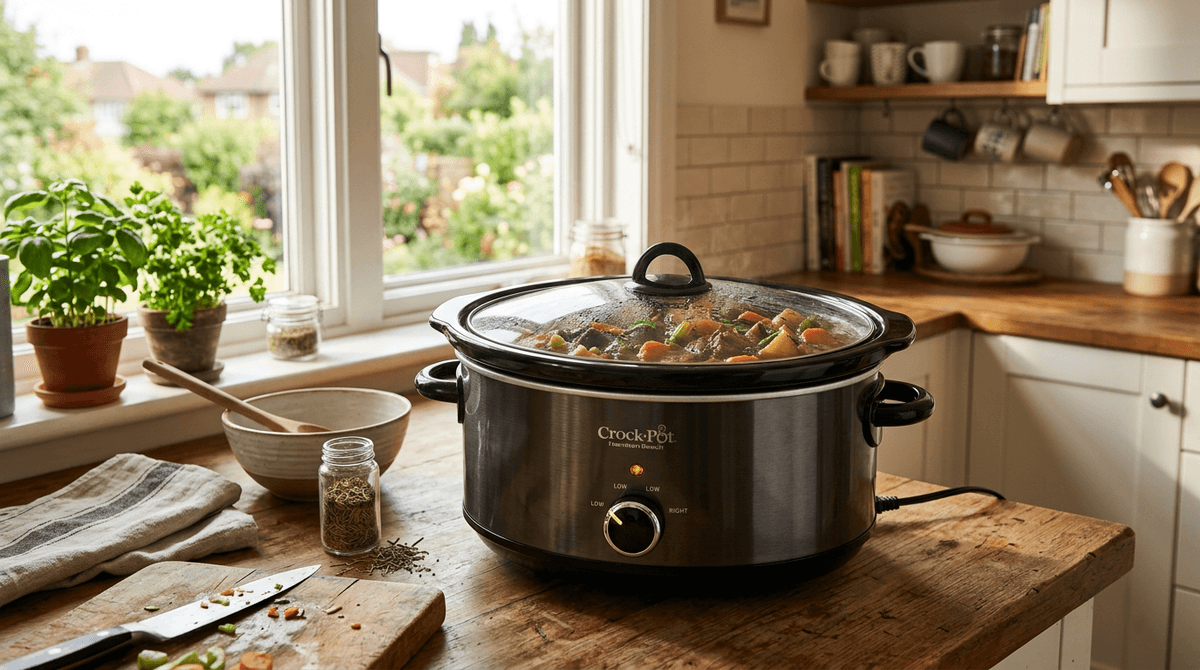
Most slow cookers average roughly 0.6 to 2.5 kWh/day on days you use them, depending on size, temperature setting, and cook time. Instant watts can be higher during warm-up, but average draw usually drops as it cycles.
For full system planning, use the WattSizing Calculator.
Quick Answer
Most slow cookers average roughly 0.6 to 2.5 kWh/day on days you use them, depending on size, setting, and cook time. Average watts are typically lower than the nameplate rating because the heater cycles on and off.
Detailed Explanation
If you multiply “watts x hours,” make sure you’re using average watts, not the maximum label rating. After the slow cooker reaches temperature, it often cycles (on/off) to maintain heat, so the average over a full cook can be significantly lower than the peak.
Daily energy is mostly driven by:
- Cook duration (4–10 hours is typical)
- Pot size (bigger pots often use higher average watts)
- Ambient conditions (cold kitchens increase cycling time)
Watt Table
| Slow Cooker Size / Use | Typical Average Watts | Typical Daily Energy (kWh/day) |
|---|---|---|
| Small (1.5–3 qt), 6 hours | 90 - 140 W | 0.5 - 0.9 kWh/day |
| Medium (4–6 qt), 8 hours | 120 - 220 W | 1.0 - 1.8 kWh/day |
| Large (7–8 qt), 8–10 hours | 160 - 280 W | 1.3 - 2.8 kWh/day |
| Multi-cooker “slow cook,” 6–8 hours | 140 - 300 W | 0.8 - 2.4 kWh/day |
Calculation Example
Example: A slow cooker averages 200 W over an 8-hour cook day.
- kWh/day = (200 x 8) / 1000 = 1.60 kWh/day
- At $0.16/kWh, daily cost is about $0.26
- Monthly cost (if used 12 times/month) is about $3.07
If you’re building a full daily load plan, see How to Calculate Daily Energy Use and compare other long-duration kitchen loads like How Many Watts Does a Rice Cooker Use Per Day and How Many Watts Does a Dishwasher Use Per Day.
Tips to Reduce Power Usage
- Keep the lid closed; every opening can trigger extra heater cycling.
- Avoid starting from frozen ingredients when possible (longer warm-up = more energy).
- Choose the smallest size that fits your batch to reduce heat loss.
- If you need backup power, stagger high-watt appliances (kettle, microwave, toaster) to prevent overload.
FAQs
Why does my slow cooker kWh/day look high?
Long cook times add up. Even “low watt” appliances can use meaningful energy if they run for 8–10 hours.
Is Low always cheaper than High?
Often, yes—but not always by a huge margin for the same recipe because the cooker may run longer on Low. The most accurate way is measuring total kWh with a plug-in meter.
What’s the fastest way to estimate daily energy?
Use: kWh/day = (average watts x hours used) / 1000. If you only know peak watts, treat your estimate as an upper bound.
CTA
Ready to size your setup accurately? Use the WattSizing Calculator to estimate panel, battery, and inverter requirements from your real appliance loads.


