
When cooking off-grid or running a house on a portable generator, the traditional electric oven is your worst enemy. A standard 240-Volt oven draws an apocalyptic 3,000 to 4,000 watts, instantly overloading standard portable generators and destroying small battery banks.
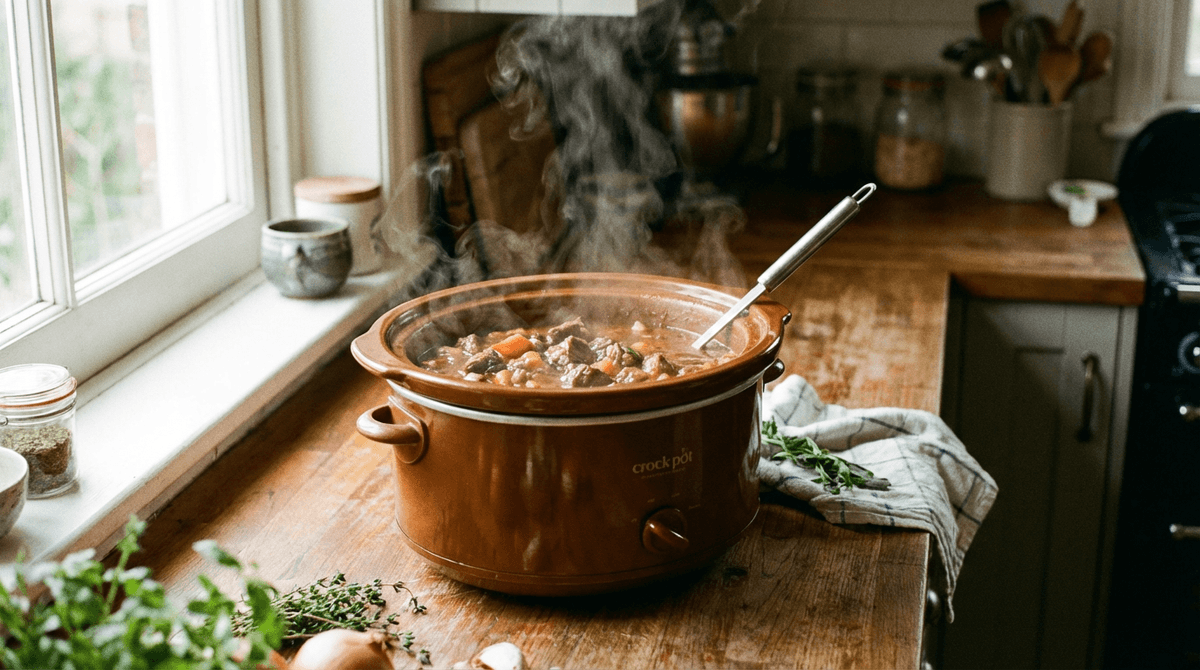
If you want to cook a hot, massive meal during a blackout without stressing your electrical system, there is one appliance that reigns supreme: The Slow Cooker (Crockpot).
Because a slow cooker relies on a heavily insulated ceramic pot and a tiny, low-wattage heating element, it takes hours to cook food. But this "low and slow" approach means its peak power draw is incredibly small. It is the ultimate solar-powered cooking hack.
In this comprehensive guide, we will break down exactly how many watts slow cookers use, calculate their 8-hour battery impact, and show you why they are vastly superior to microwaves and hot plates for off-grid living.
To model your specific slow cooker alongside your other household loads, use our free WattSizing Off-Grid Calculator.
The Quick Answer: Slow Cooker Power Draw
Slow cookers plug into a standard 120-Volt wall outlet. Their power consumption depends on the physical size of the ceramic pot (quarts) and the temperature setting you select.
- Small (1.5 to 3 Quart): Typically draws 70 to 150 running watts.
- Standard (6 to 8 Quart): Typically draws 150 to 300 running watts.
- "Keep Warm" Setting: Drops the wattage down to roughly 50 to 75 watts.
- Starting (Surge) Watts: Because a slow cooker is a pure resistive heating load with no motors, it has zero startup surge. If it draws 250W on high, it will never spike above 250W.
The Thermostat Cycle
It is important to understand that a slow cooker does not pull 250W constantly for 8 hours. Like an oven, it has an internal thermostat. Once the ceramic pot reaches the target temperature, the heating element clicks off (dropping to 0W). It will then cycle on and off every few minutes to maintain the heat. This means the actual average power draw is significantly lower than the peak wattage.
Off-Grid Solar: Cooking on Batteries
Because the peak wattage of a standard 6-Quart slow cooker is only 250W, it is incredibly easy to run on a standard off-grid solar setup or an RV battery bank. You do not need a massive 3,000W inverter to use it. A standard 500W Pure Sine Wave Inverter will run a Crockpot perfectly.
But what about the battery drain?
Calculating Daily Watt-Hours (Wh):
Formula: (Running Watts × Hours Run × Duty Cycle) ÷ 1,000 = Daily kWh
Let's assume you cook a pot roast on the "Low" setting (roughly 150W) for 8 hours. Because the element cycles on and off, we will assume a realistic 60% duty cycle (the element is actively heating for roughly 4.8 hours total).
150W × 4.8 Hours = 720 Wh (0.72 kWh) of total energy.
Sizing the Battery Bank
Using 720 Wh to cook an entire meal for a family of four is incredibly efficient. A single 12V 100Ah Lithium LiFePO4 battery holds 1,280 Wh of energy. You could cook an 8-hour meal and still have nearly half your battery capacity left over to run your TV and lights in the evening.
(By comparison, trying to cook that same pot roast in a 3,000W electric oven for 2 hours would consume roughly 3,000 Wh of energy—completely draining two massive lithium batteries).
What Size Generator Do I Need for a Slow Cooker?
If you are running your kitchen on a gasoline portable generator, the slow cooker is a dream appliance. Because its load is only 200W to 300W, it allows you to cook all day without bogging down the engine or preventing you from using other appliances.
Generator Sizing Guidelines
- Slow Cooker + Refrigerator + TV: A tiny 2,000W Inverter Generator will easily power your refrigerator (which surges to 1,200W), your television, and your slow cooker simultaneously.
- The Multi-Tasking Advantage: If you tried to use a 1,500W Electric Skillet or a 1,500W Microwave on a 2,000W generator, you would have to turn off the refrigerator first to avoid an overload. With a 250W slow cooker, you can safely leave the fridge running and ignore load-balancing entirely.
Slow Cooker vs. Instant Pot (Pressure Cooker)
In the off-grid community, the great debate is between the Slow Cooker and the Instant Pot (Electric Pressure Cooker). Which is better for batteries?
- The Slow Cooker: Draws 250W. Cooks for 8 hours. Total Energy: ~720 Wh.
- The Instant Pot: Draws 1,000W. Cooks for 1 hour. Total Energy: ~500 Wh.
The Verdict: The Instant Pot actually uses less total energy from your battery bank because pressure cooking is so violently fast. However, the Instant Pot requires a massive 1,000W continuous draw while coming up to pressure. If you have a small 500W solar inverter in your van, the Instant Pot will overload it instantly. The Slow Cooker wins purely because its 250W peak draw allows it to run on almost any tiny solar setup or cheap car inverter.
4 Tips for Using a Slow Cooker Off-Grid
- Use the "Low" Setting: If you are trying to conserve battery power, always cook on Low for 8 hours rather than High for 4 hours. The Low setting drastically reduces the peak wattage, making it easier on your solar inverter and battery BMS.
- Do Not Open the Lid: Every time you lift the glass lid to check on the food, you let all the trapped heat escape. The slow cooker will immediately turn its heating element back on to 100% power to recover that lost heat, wasting precious battery capacity. Leave the lid closed.
- Wrap It In a Towel: If you are cooking in a freezing cold off-grid cabin in the winter, the ambient cold air will pull heat out of the ceramic pot, forcing the heating element to run constantly. Wrap the sides of the slow cooker in a heavy towel (leaving the bottom vents clear) to insulate it and save up to 20% on electricity.
- Use It as a Humidifier: In a pinch, if your cabin is incredibly dry, you can fill the slow cooker with water, leave the lid off, and run it on High. It will slowly boil the water, acting as a low-wattage warm mist humidifier for the room.
Frequently Asked Questions
Can I run a slow cooker on a portable power station?
Yes! A mid-sized lithium portable power station (like a Jackery 1000 or EcoFlow Delta 2) is perfect for this. If you have a 1,000 Wh power station, you can safely run a 150W slow cooker for an entire 6-hour cook cycle without needing a solar recharge.
Will a slow cooker trip a 15-Amp breaker?
Never. A standard 15-Amp residential breaker can handle 1,800 Watts. Because a slow cooker maxes out around 300 Watts, it is one of the safest appliances you can plug into an old, crowded kitchen circuit. You can easily run three slow cookers on the same outlet without a problem.
Does a slow cooker use more electricity than a lightbulb?
A modern LED lightbulb uses 10 Watts. A slow cooker uses roughly 200 Watts. So yes, it uses significantly more than a modern bulb. However, compared to an old, traditional 100-Watt incandescent lightbulb, a slow cooker is incredibly similar in power draw.
Conclusion
The Slow Cooker is an absolute masterpiece of energy-efficient cooking. By utilizing a heavily insulated pot and a small 250-watt heating element, it completely bypasses the massive 1,500W surge requirements of modern microwaves and hot plates. If you are building an off-grid solar system or sizing a small portable generator, the Crockpot is the single best appliance you can buy to guarantee a hot meal during an emergency.
Want to accurately size a generator for your off-grid kitchen? Use our free Off-Grid & Backup Load Calculator to enter your exact slow cooker wattage, add your refrigerator and lights, and get a precise runtime recommendation instantly.


