
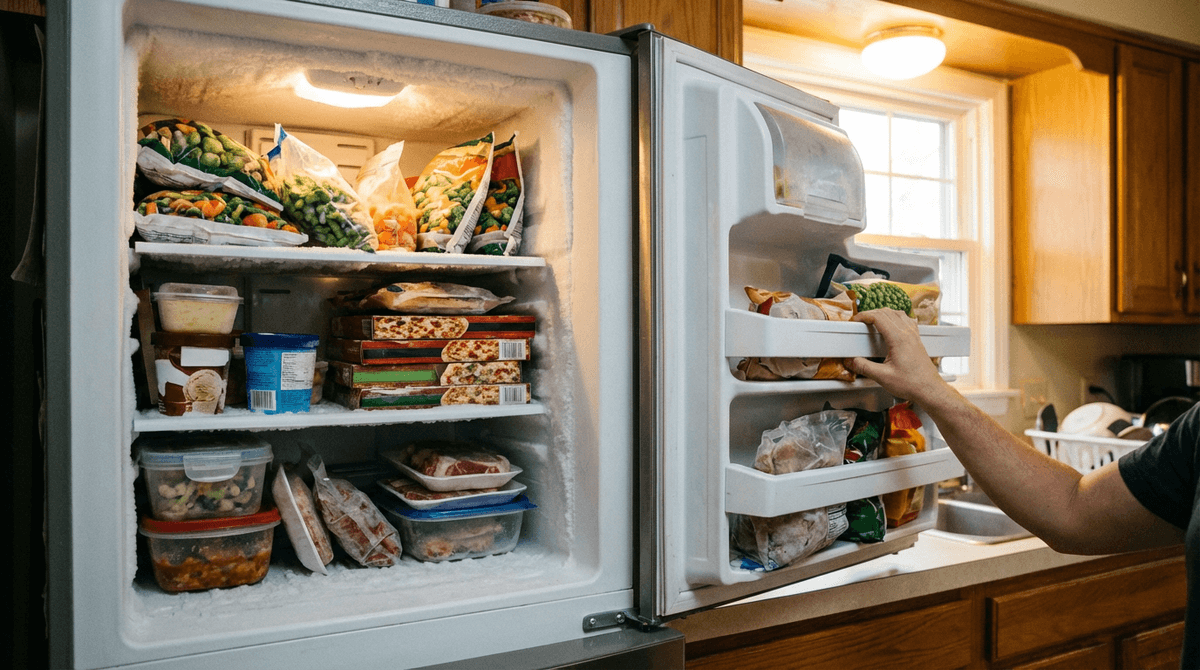
An upright freezer typically runs around 100 to 280 watts during compressor operation, and many households land in the 1.4 to 3.6 kWh/day range.
For full system planning, use the WattSizing Calculator.
Quick Answer
An upright freezer typically runs around 100 to 280 watts during compressor operation, and many households land in the 1.4 to 3.6 kWh/day range.
Detailed Explanation
Compared with chest freezers, upright models can use a bit more energy for the same storage volume because cold air spills out more easily when the door opens. The actual daily total depends on:
- cabinet size and insulation quality
- indoor or garage temperature
- thermostat setting
- how often and how long the door stays open
For planning, it helps to think in three layers: running watts, startup surge, and then kWh/day (the value that hits your bill).
Watt Table
| Device Size / Type | Typical Running Watts | Typical Starting Watts | Typical Daily Energy |
|---|---|---|---|
| 8-10 cu ft upright freezer | 90 - 150 W | 500 - 900 W | 1.0 - 1.9 kWh/day |
| 11-14 cu ft upright freezer | 110 - 190 W | 700 - 1200 W | 1.4 - 2.5 kWh/day |
| 15-18 cu ft upright freezer | 140 - 240 W | 900 - 1500 W | 2.0 - 3.2 kWh/day |
| 19+ cu ft or older model | 180 - 320 W | 1100 - 1900 W | 2.6 - 4.3 kWh/day |
Calculation Example
Example: A 14 cu ft upright freezer averages 120 W across the day.
- kWh/day = (120 x 24) / 1000 = 2.88 kWh/day
- At $0.15/kWh, monthly cost is about $12.96
To convert this into full off-grid sizing, pair this with How Many Batteries for Off-Grid Solar and How Many Solar Panels to Run Appliances.
Tips to Reduce Power Usage
- Keep food organized by shelf to reduce open-door time.
- Check door gaskets for leaks and replace worn seals.
- Leave space around the condenser area for ventilation.
- Avoid setting temperature colder than needed for safe storage.
FAQs
Why do upright freezers often use more kWh/day than chest freezers?
Door openings let dense cold air spill out, so the compressor must run longer to recover.
Should I size backup power with running watts or surge watts?
Both matter. Inverter and generator selection should always include startup surge margin.
What is a practical target for efficient operation?
For modern mid-size units in moderate climates, around 1.5 to 2.5 kWh/day is common.
CTA
Ready to size your setup accurately? Use the WattSizing Calculator to estimate panel, battery, and inverter requirements from your real appliance loads.


