
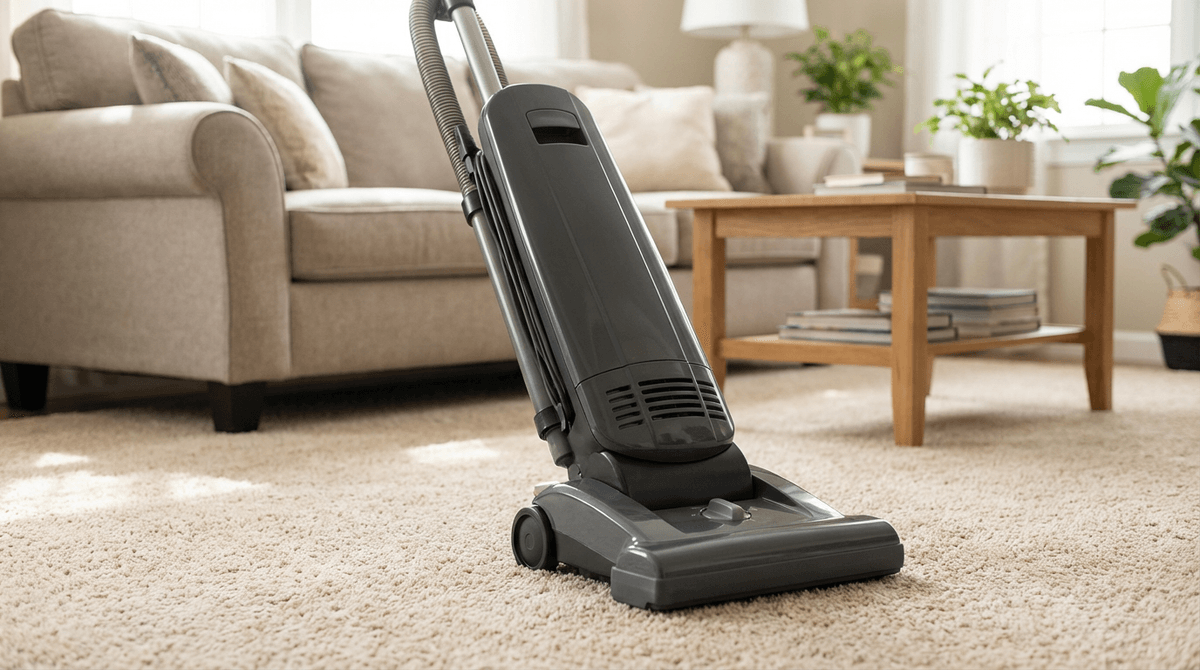
Most corded vacuum cleaners use about 500 to 1,400 watts while running, while cordless stick vacuums are often lower and robot vacuums typically use far less power (but run longer).
For full system planning, use the WattSizing Calculator.
Quick Answer
Most corded uprights and canisters use about 500 to 1,400 running watts. Many cordless sticks land around 100 to 600 watts during charging/use, and robot vacuums typically average 30 to 90 watts while operating.
Detailed Explanation
Vacuum power draw is mostly the suction motor (and sometimes a brush roll motor). Real usage depends on:
- Type: upright/canister vs stick vs robot.
- Power mode: “max” or “boost” modes can increase watts significantly.
- Flooring: deep carpet loads the motor more than hard floors.
For inverter sizing, the key is that vacuums are motor loads, so they can have a brief startup surge above running watts.
Watt Table
| Vacuum Cleaner Type | Typical Running Watts | Typical Starting Watts |
|---|---|---|
| Corded upright | 700 - 1,400 W | 1,000 - 2,000 W |
| Corded canister | 600 - 1,200 W | 900 - 1,700 W |
| Corded stick / lightweight | 500 - 900 W | 800 - 1,400 W |
| Cordless stick (charging / use) | 100 - 600 W | 150 - 800 W |
| Robot vacuum | 30 - 90 W | 50 - 150 W |
Calculation Example
Example: A corded vacuum draws 900 W and you vacuum for 20 minutes/day total.
- Run time in hours: 20 / 60 = 0.33 h
- kWh/day = (900 x 0.33) / 1000 = 0.30 kWh/day
- At $0.16/kWh, monthly cost is about $1.44
If you’re comparing “quick chores” loads, also see How Many Watts Does a Washing Machine Use and How Many Watts Does a Clothes Dryer Use.
Tips to Reduce Power Usage
- Use standard mode for routine cleaning; reserve “boost” for spot jobs.
- Clean filters and check for clogs—restricted airflow can make the motor work harder.
- Vacuum in fewer passes by using the correct head/floor setting.
- If running on backup power, avoid vacuuming while other high-watt loads are on.
FAQs
Is a higher-watt vacuum always better?
Not necessarily. Cleaning performance depends on design, airflow, filtration, and head type—not watts alone.
Do vacuums have startup surge?
Often, yes. Motor start-up can briefly exceed running watts, especially on larger corded models.
Are robot vacuums cheaper to run?
Usually, yes. They draw fewer watts, though they may run longer. Even so, daily kWh is often modest.
CTA
Ready to size your setup accurately? Use the WattSizing Calculator to estimate panel, battery, and inverter requirements from your real appliance loads.


