
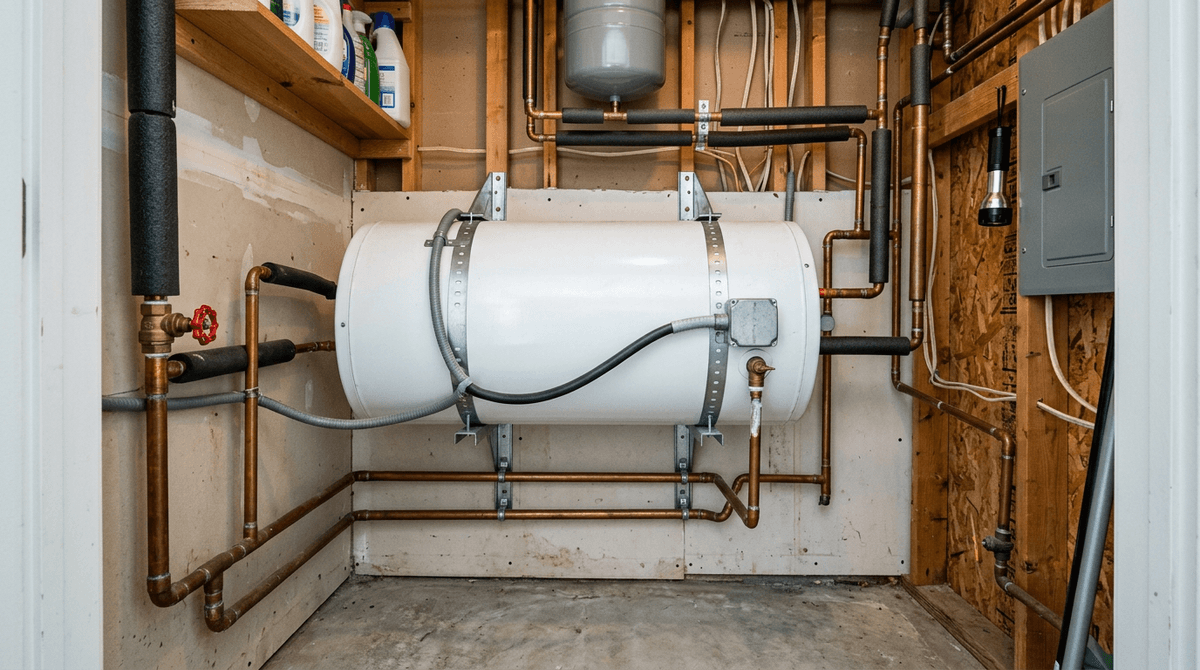
Electric tank water heaters commonly use 3,000 to 5,500 watts per element, while electric tankless units can require far higher power.
For full system planning, use the WattSizing Calculator.
Quick Answer
Electric tank water heaters commonly use 3,000 to 5,500 watts per element, while electric tankless units can require far higher power.
In this context, Apartment living usually means shared circuits, smaller spaces, and stricter noise/time preferences.
Practical Watt Ranges in This Context
| Device Type / Use Case | Typical Running Watts | Typical Peak / Starting Watts |
|---|---|---|
| Small point-of-use tank (120V) | 1200 - 2000 W | 1200 - 2100 W |
| Standard tank (240V, 30-50 gal) | 3000 - 4500 W | 3000 - 4700 W |
| Large tank (240V, 60-80 gal) | 4500 - 5500 W | 4500 - 5800 W |
| Electric tankless (single point) | 3000 - 9000 W | 3000 - 9200 W |
Real-World Usage Examples
Example: A 4,500 W tank heater runs for about 2.5 hours total in a day.
- Runtime in hours: 2.5 h
- Energy used: (4500 x 2.5) / 1000 = 11.25 kWh
In apartment, usage patterns can shift due to timing, climate, and occupancy. Circuit limits and billing structure can make timing and efficiency more important.
For comparison and full-load planning, pair this with How Many Watts Does a Water Heater Use Per Day and How Many Watts Does a Washing Machine Use.
How to Manage Consumption Better
- Run heavy cycles when other large loads are off.
- Use efficient settings first, then increase only when needed.
- Track both watt peaks and daily kWh for accurate sizing.
- Recheck real usage seasonally because behavior changes over time.
FAQs
Does a water heater have motor-like startup surge?
Usually no. It is mostly a high but predictable resistive electrical load.
Why is water heating expensive?
Heating water takes substantial energy, especially with higher setpoints and frequent hot-water use.
Is a full-size water heater practical for off-grid?
Often difficult without a large system. Many off-grid setups use lower-power or alternate heating strategies.
CTA
Need accurate sizing for bills, batteries, or backup? Use the WattSizing Calculator to estimate realistic watts and daily energy from your setup.


