
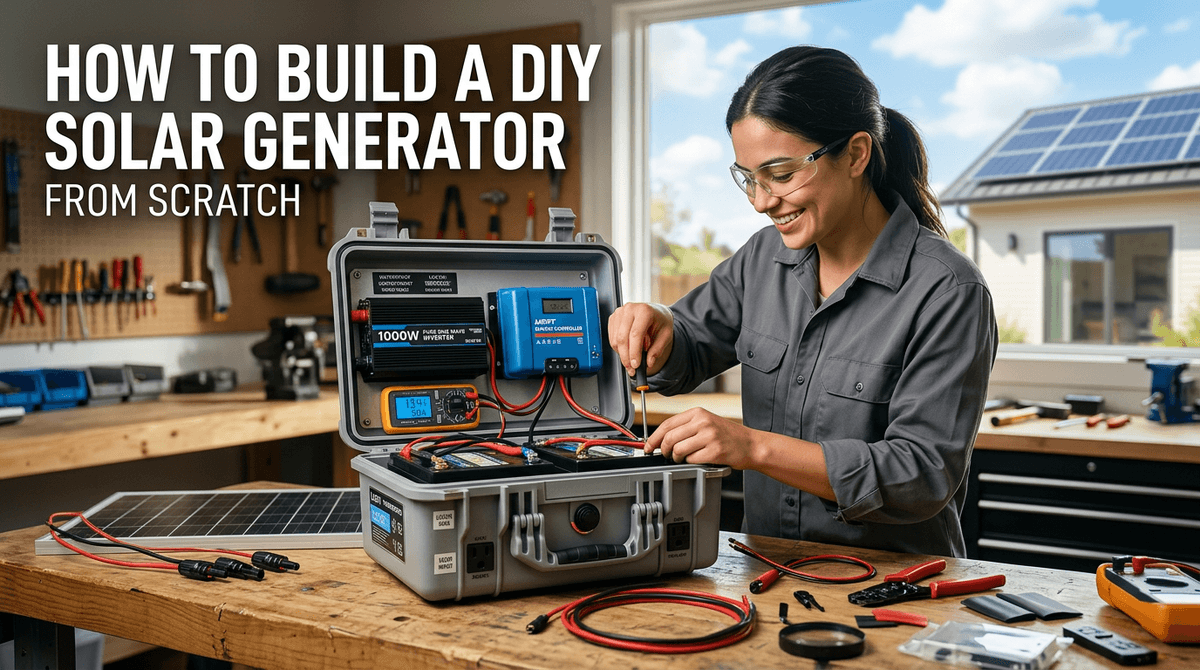
Commercial solar generators (like Jackery, EcoFlow, or Bluetti) are incredibly convenient. You buy them, plug them in, and you have portable power. However, that convenience comes at a steep premium. If you're willing to put in a little elbow grease, building a DIY solar generator from scratch is one of the most rewarding projects you can undertake.
Not only will a DIY build save you hundreds (or even thousands) of dollars, but it also allows you to use higher-quality, modular components. If a part breaks on a commercial unit, the whole thing is often garbage. If a part breaks on your DIY build, you simply replace that specific component.
In this comprehensive guide, we will walk you through exactly how to design, source, and assemble your own custom solar generator. Whether you need backup power for outages, a portable power station for camping, or a robust system for a van build, this guide will get you there. Want to know exactly what size components you need? Use our solar calculator to get started.
Why Build a DIY Solar Generator?
Before we dive into the "how," let's quickly cover the "why."
- Cost Savings: Commercial units often cost $1.00 to $1.50 per Watt-hour (Wh) of battery capacity. A DIY build using Lithium Iron Phosphate (LiFePO4) batteries can bring that cost down to $0.30 to $0.50 per Wh.
- Modularity and Repairability: Every component in a DIY build is separate. You can upgrade your inverter later without buying a whole new battery. If the charge controller fails, it’s a $50 replacement, not a $1,500 total loss.
- Customization: Need massive battery storage but only a small inverter? Or a huge inverter with a smaller battery? Commercial units force you into pre-set ratios. DIY lets you build exactly what you need.
- Learning Experience: Building it yourself teaches you exactly how solar power works, making you self-reliant when troubleshooting off-grid.
The 4 Core Components of a Solar Generator
A "solar generator" is essentially just a battery box with a built-in inverter and charge controller. There are no moving parts (other than cooling fans), and it doesn't actually "generate" power—it stores it.
To build one, you need four main components:
1. The Battery (The Gas Tank)
The battery is the heart of your system. It determines how much energy you can store and how long your devices will run.
- Recommendation: Always use Lithium Iron Phosphate (LiFePO4). They are vastly superior to lead-acid (AGM/Gel) because they are lighter, can be discharged to 100% without damage, and last for 3,000 to 5,000 cycles (compared to 500 cycles for lead-acid).
- Sizing: A 12V 100Ah LiFePO4 battery gives you 1,280 Watt-hours of storage. This is the perfect size for a highly capable, yet portable, DIY generator.
2. The Inverter (The Engine)
The inverter takes the 12V Direct Current (DC) power from your battery and converts it into 120V Alternating Current (AC) power, which is what standard household plugs use.
- Recommendation: You must buy a Pure Sine Wave inverter. Modified sine wave inverters are cheaper but will damage sensitive electronics like laptops, CPAP machines, and TVs.
- Sizing: A 1000W to 1500W inverter is ideal for a 100Ah battery. It can run blenders, small coffee makers, and power tools.
3. The Solar Charge Controller (The Regulator)
This device sits between your solar panels and your battery. It takes the fluctuating voltage from the panels and converts it into the exact voltage profile needed to safely charge your battery without overcharging it.
- Recommendation: Choose an MPPT (Maximum Power Point Tracking) controller over a PWM (Pulse Width Modulation) controller. MPPT is up to 30% more efficient, especially in cloudy conditions.
- Sizing: A 30 Amp or 40 Amp MPPT controller is perfect for a 12V system with up to 400W of solar input.
4. The Enclosure and Wiring (The Chassis)
You need a sturdy box to hold everything, along with the correct gauge wires, fuses, and external ports (USB, 12V cigarette lighter, AC outlets).
- Recommendation: A heavy-duty plastic toolbox (like a Ridgid or Milwaukee packout box from Home Depot) makes an excellent, durable enclosure.
Step-by-Step Build Instructions
Disclaimer: Working with electricity, even 12V DC, carries risks of short circuits and fire. Always use properly sized wires and fuses. If you are unsure, consult a professional.
Step 1: Gather Your Parts and Tools
Here is a standard parts list for a 1,280Wh (100Ah) DIY Solar Generator:
Core Components:
- 1x 12V 100Ah LiFePO4 Battery (e.g., Ampere Time, Chins, or Battle Born)
- 1x 1000W Pure Sine Wave Inverter (e.g., Renogy, Giandel)
- 1x 30A MPPT Charge Controller (e.g., Victron SmartSolar, Renogy Rover)
- 1x Heavy Duty Toolbox (Enclosure)
Wiring and Safety:
- 2 AWG or 4 AWG pure copper wire (for Battery to Inverter)
- 10 AWG pure copper wire (for Solar to Charge Controller)
- 150A Inline ANL Fuse and Fuse Holder (protects the inverter wire)
- 40A Inline Circuit Breaker (protects the charge controller wire)
- Copper wire lugs (ring terminals) and a crimping tool
- Heat shrink tubing
External Ports (Optional but recommended):
- 12V Cigarette Lighter Socket Panel (with USB ports)
- Solar Panel Connectors (MC4 panel mount or Anderson Powerpole)
Step 2: Plan the Layout in the Box
Before drilling any holes or cutting any wires, place your battery, inverter, and charge controller inside the toolbox.
- Ventilation is critical. The inverter will generate heat when running heavy loads. Ensure the inverter's cooling fans have clear airspace. You may need to drill ventilation holes or install small 12V computer fans in the side of the toolbox.
- Keep the wire runs between the battery and the inverter as short as possible to minimize voltage drop.
Step 3: Install External Ports and Connectors
If you want the generator to look professional, you shouldn't have to open the lid to plug things in.
- Drill holes in the side of the toolbox for your 12V/USB socket panel.
- Drill holes for your solar input connectors (Anderson Powerpoles are highly recommended for DIY builds as they are easy to plug/unplug).
- Optional: You can use an extension cord to mount an AC outlet on the outside of the box, plugging the other end directly into the inverter inside.
Step 4: Wire the Charge Controller to the Battery
CRITICAL RULE: Always connect the battery to the charge controller before connecting the solar panels. The controller needs to detect the battery voltage (12V) before it receives solar input.
- Cut two lengths of 10 AWG wire (one red for positive, one black for negative).
- Crimp ring terminals onto one end of each wire (to attach to the battery).
- Strip the other ends to insert into the charge controller's "Battery" terminals.
- Install a 40A circuit breaker on the positive (red) wire between the battery and the controller.
- Connect the wires to the charge controller first, then to the battery terminals. The controller should power on.
Step 5: Wire the Inverter to the Battery
The inverter draws massive amounts of current. A 1000W inverter pulling from a 12V battery will draw over 80 Amps. You must use thick wire (2 AWG or 4 AWG) and a large fuse.
- Cut your thick 2 AWG / 4 AWG cables to length (keep them short!).
- Crimp heavy-duty copper lugs onto all ends.
- Install a 150A ANL fuse on the positive (red) cable, as close to the battery terminal as possible. This prevents a fire if the inverter cable shorts out.
- Connect the negative (black) cable from the inverter to the battery.
- Connect the positive (red) cable from the inverter to the fuse, and then to the battery. Note: You may see a small spark when making the final connection; this is normal as the inverter's internal capacitors charge up.
Step 6: Wire the External Ports
- Run wires from your external 12V/USB socket panel directly to the battery.
- Ensure you put a small inline fuse (e.g., 15A or 20A blade fuse) on the positive wire leading to these sockets to protect your smaller devices.
Step 7: Wire the Solar Input
- Run 10 AWG wire from your external solar connectors (the Anderson or MC4 ports you mounted on the box) to the "PV" or "Solar" input terminals on the charge controller.
- Ensure polarity is correct (Positive to Positive, Negative to Negative).
Testing Your DIY Solar Generator
Before closing the lid and heading into the woods, you need to test the system.
- Test the Inverter: Turn the inverter on. Plug in a household appliance (like a lamp or a fan) and ensure it runs smoothly.
- Test the 12V Ports: Plug your phone into the USB ports to ensure it charges.
- Test the Solar Charging: Take the box outside, plug in your solar panel(s), and check the charge controller screen (or Bluetooth app). You should see the solar wattage coming in and the battery voltage rising.
Expanding Your System
The beauty of this DIY build is that it serves as a foundational blueprint.
- Need more capacity? Wire a second 100Ah battery in parallel (Positive to Positive, Negative to Negative) to double your storage to 200Ah (2,560 Wh).
- Need faster charging? Add more solar panels in series or parallel, provided you don't exceed the maximum voltage and amperage limits of your MPPT charge controller.
- Charging from your vehicle? You can easily add a DC-to-DC battery charger to this exact same box, allowing it to charge from your car's alternator while you drive.
Frequently Asked Questions (FAQ)
How much does it cost to build a DIY solar generator?
A high-quality 1,280Wh (100Ah) DIY build typically costs between $500 and $700. A comparable commercial unit (like a Jackery 1000 or EcoFlow Delta) will cost between $900 and $1,200.
Can I use a car battery for a solar generator?
You can, but you shouldn't. Car batteries are "starter batteries" designed to provide a massive burst of energy for a few seconds. They will quickly degrade and die if you deeply discharge them to run appliances. You must use "Deep Cycle" batteries, preferably Lithium (LiFePO4).
Do I need to ground my DIY solar generator?
For a portable system housed in a plastic box, earth grounding is generally not required or practical. The system is "floating." However, if you are permanently installing this system in an RV or a cabin, you should ground the inverter chassis to the vehicle chassis or an earth ground rod.
Is it safe to put the inverter and battery in the same box?
Yes, provided you are using Lithium (LiFePO4) or sealed AGM batteries. These batteries do not off-gas dangerous hydrogen fumes during normal operation. If you are using flooded lead-acid batteries (which you shouldn't be for a portable build), they must be in a separately vented compartment to prevent explosion risks.
How long will a 100Ah DIY solar generator run a fridge?
A highly efficient 12V portable compressor fridge (like a Dometic or ARB) draws about 30-40 watts when the compressor is running. A 100Ah lithium battery (1,280Wh) can easily run one of these fridges for 2 to 3 days without any solar input.
Conclusion
Building your own DIY solar generator is a fantastic weekend project that yields a powerful, repairable, and highly customized off-grid power station. By carefully selecting a LiFePO4 battery, a pure sine wave inverter, and an MPPT charge controller, you can build a system that outperforms commercial units at a fraction of the cost.
Remember to prioritize safety by using thick enough wire and properly sizing your fuses. Once your build is complete, you'll have reliable backup power for camping, vanlife, or emergency home use.
If you're ready to start sizing the perfect components for your specific power needs, head over to our Off-Grid Solar Calculator to generate your custom parts list!


