
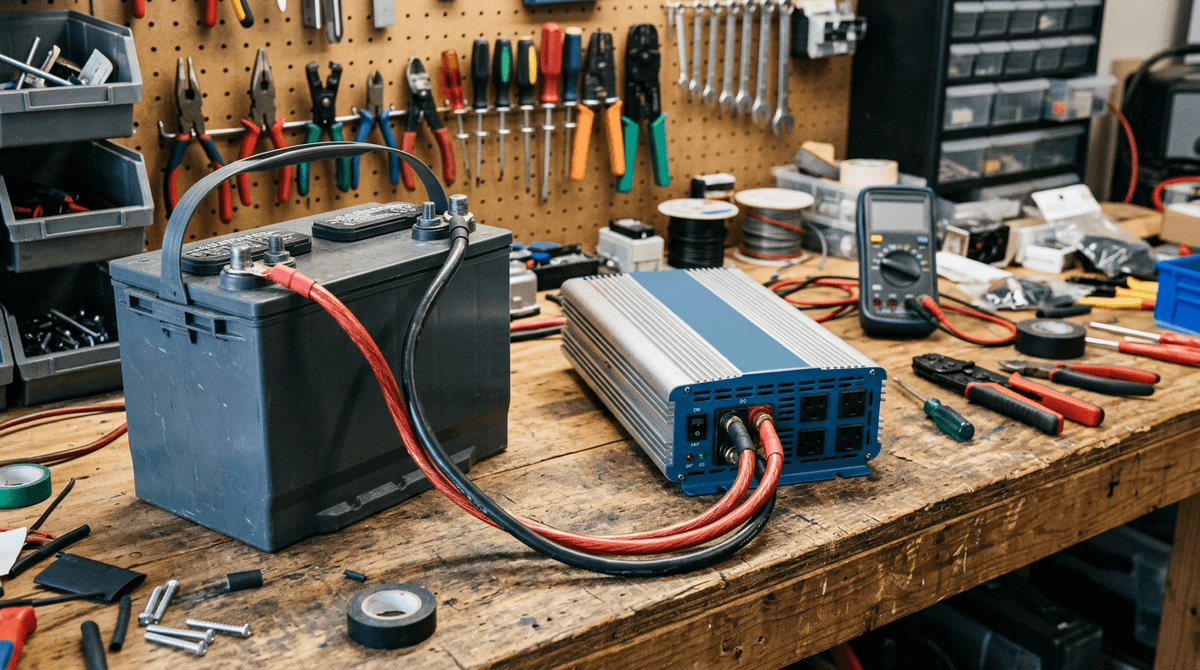
Battery runtime estimates are simple once you use usable watt-hours instead of headline battery numbers. The two biggest errors are ignoring inverter losses and ignoring safe depth of discharge.
For full system planning, use the WattSizing Calculator.
Quick Answer
Use:
Runtime (hours) = Usable battery Wh x inverter efficiency / Appliance watts
Where:
- Usable battery Wh = battery nominal Wh x allowed depth of discharge (DoD)
- Inverter efficiency is typically ~85% to 95%
What to Include for Realistic Runtime
- Battery capacity in Wh (or convert from Ah x V).
- Usable fraction (DoD), especially for lead-acid systems.
- Inverter efficiency losses.
- Average appliance watts, not just peak/startup values.
If you need a refresher on watts and kWh, read How to Calculate kWh from Watts and Hours.
Battery Runtime Reference Table
Assume:
- Battery bank: 12 V x 200 Ah = 2,400 Wh nominal
- Usable DoD: 80% -> 1,920 Wh
- Inverter efficiency: 90%
- Effective usable output:
1,920 x 0.9 = 1,728 Wh
| Appliance Load | Estimated Runtime |
|---|---|
| 60 W router + lights | 28.8 h |
| 120 W fan | 14.4 h |
| 300 W TV + devices | 5.8 h |
| 800 W microwave (intermittent) | 2.2 h |
| 1,200 W heater | 1.4 h |
Worked Example
You have a 24 V 100 Ah LiFePO4 battery and want to run a 150 W laptop/monitor setup.
- Nominal capacity:
24 x 100 = 2,400 Wh - Usable DoD at 90%:
2,400 x 0.9 = 2,160 Wh - Inverter efficiency at 92%:
2,160 x 0.92 = 1,987 Wh - Runtime:
1,987 / 150 = 13.2 hours
Real-world range might be 11.5 to 13 hours depending on conversion losses and load variation.
Quick Conversion Formulas
Wh = V x AhkWh = Wh / 1000Runtime (h) = Effective Wh / W
For multi-appliance scenarios, sum running watts first, then calculate runtime. For surge-sensitive devices, also review Generator Running Watts vs Starting Watts Explained.
Common Runtime Mistakes
- Using 100% of battery nameplate capacity as usable.
- Ignoring inverter idle draw.
- Forgetting that appliance loads fluctuate over time.
- Not checking whether inverter surge rating can start motor loads.
For full off-grid battery sizing, continue with Best Batteries for Off-Grid Solar Comparison and Inverter Sizing for Off-Grid Solar.
FAQs
Is battery runtime linear with load?
Close enough for quick planning, but high loads can reduce effective capacity due to chemistry and thermal effects.
Should I use running watts or starting watts?
Use running watts for runtime. Use starting watts only to confirm inverter surge capability.
Can I run a refrigerator from a small battery overnight?
Sometimes, but you need average cycling watts, startup compatibility, and enough usable Wh margin.
Why is my measured runtime lower than calculated?
Likely causes are higher real load, lower inverter efficiency at that load, battery temperature, or conservative BMS cutoff.
CTA
Want runtime estimates that match your real appliances? Use the WattSizing Calculator to model battery capacity, inverter losses, and daily load profile in one workflow.


