
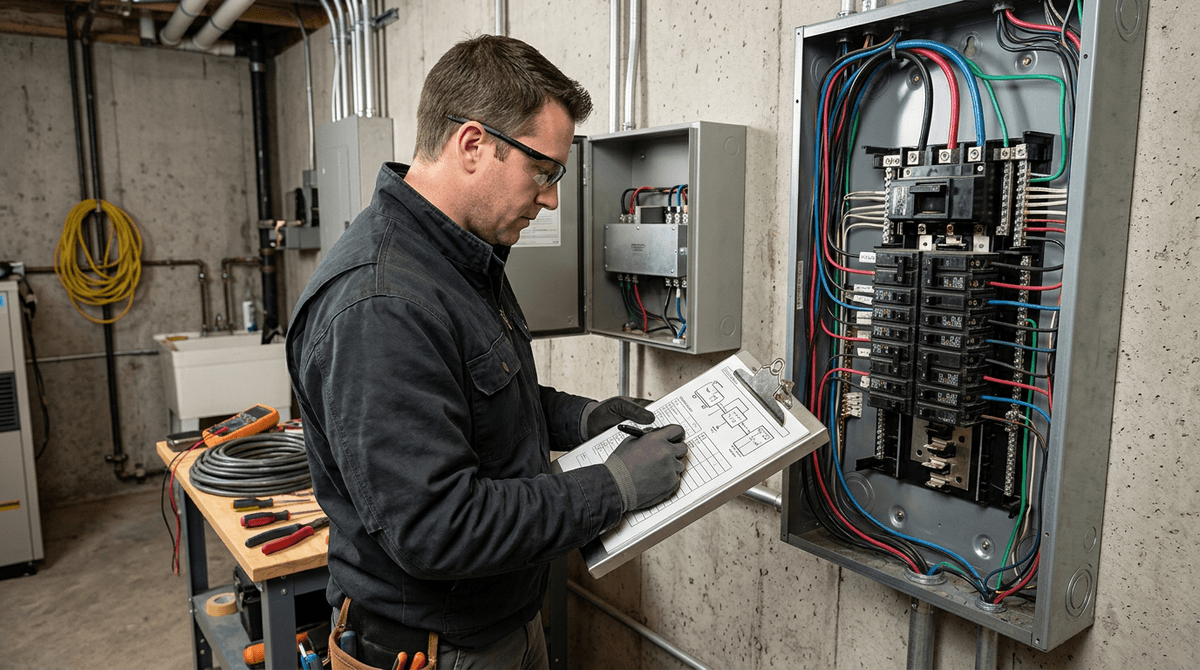
Sizing backup power is not about adding random appliance labels. The accurate method is to separate must-run loads, account for motor startup surges, and apply a realistic simultaneous-use assumption.
Build your final number with the WattSizing Calculator.
Quick Answer
To estimate total home backup load:
- List critical appliances and circuits.
- Add their running watts for expected simultaneous use.
- Identify largest startup events (fridge, pump, AC blower, etc.).
- Size for the higher of running total or surge moment.
- Add a 15% to 25% safety margin.
Why Most Backup Sizing Is Wrong
Many homeowners either oversize aggressively (wasting money) or undersize (tripping breakers and stalling motors). Typical errors:
- Using only nameplate watts and ignoring startup surge.
- Assuming everything runs at the same time.
- Forgetting hidden continuous loads (router, modem, controls, standby).
- Ignoring future additions (freezer, extra circuit, EV charger trickle).
For foundational concepts, see How Many Solar Panels to Run Appliances and How Long Will a 100Ah Battery Last.
Home Backup Load Worksheet
Use this worksheet to estimate your realistic load profile.
| Load / Circuit | Qty | Running Watts (Each) | Running Total (W) | Starting Watts (If Motor) | Simultaneous? |
|---|---|---|---|---|---|
| Refrigerator | 1 | 180 | 180 | 1200 | Yes |
| LED lighting zones | 8 | 12 | 96 | - | Yes |
| Wi-Fi + modem + ONT | 1 set | 40 | 40 | - | Yes |
| TV + streaming box | 1 | 140 | 140 | - | Sometimes |
| Sump pump | 1 | 800 | 800 | 2200 | Rarely with fridge start |
| Microwave | 1 | 1200 | 1200 | - | Intermittent |
Worked Example (Critical Loads Only)
Assume this outage strategy:
- Always on: refrigerator (180W), network (40W), lights (120W), freezer (160W)
- Intermittent: microwave (1200W), sump pump (800W run / 2200W start)
Step 1, continuous running block:
180 + 40 + 120 + 160 = 500W
Step 2, likely peak running moment (microwave active):
500 + 1200 = 1700W
Step 3, worst startup moment (sump pump starts while base loads are on):
500 + 2200 = 2700W
Step 4, add 20% headroom:
2700 x 1.2 = 3240W
Practical recommendation: choose at least a 3.5kW inverter/generator class for this profile.
Practical Safety Margins
| Scenario | Recommended Margin |
|---|---|
| Stable resistive loads only | 10% to 15% |
| Mixed home loads with some motors | 15% to 25% |
| Frequent compressor/pump overlap | 25% to 35% |
If your plan includes air conditioning, review Running Air Conditioner Off-Grid Solar before final sizing.
FAQs
Should I calculate backup load in watts or kWh?
Use both. Watts size inverter/generator power, while kWh estimates runtime and battery capacity.
Do I need to include every appliance in the house?
No. Start with essential circuits, then add optional loads only if your budget allows.
What if two motors start at the same time?
Either design sequencing to prevent overlap, or size for that combined surge event.
Is whole-home backup always better than critical-load backup?
Not always. Critical-load design is usually far cheaper and easier to maintain.
CTA
Ready to size your backup system with fewer assumptions? Use the WattSizing Calculator to estimate realistic running load, surge demand, and required system headroom.


