
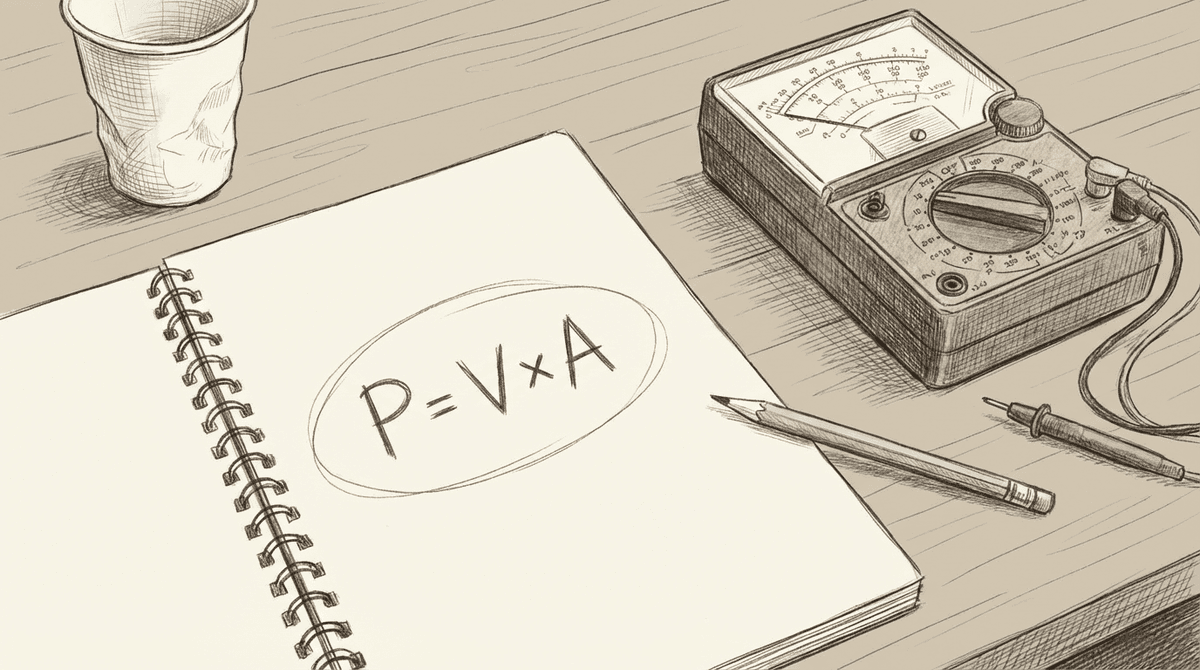
If you know amperage and voltage, you can estimate power quickly and make better decisions for generators, inverters, breakers, and energy usage. The key is using the right formula for your circuit type.
Run instant calculations and full load planning with the WattSizing Calculator.
Quick Answer
The base formula is:
Watts (W) = Volts (V) x Amps (A)
For many DC and simple resistive AC loads, this is enough. For many AC appliances with motors or compressors, include power factor:
Watts (W) = Volts (V) x Amps (A) x Power Factor (PF)
Which Formula to Use
| Circuit Type | Formula | Notes |
|---|---|---|
| DC | W = V x A | Most direct-current systems |
| Single-phase AC (approx) | W = V x A | Works as rough estimate |
| Single-phase AC (more accurate) | W = V x A x PF | Better for motors/compressors |
| Three-phase AC | W = 1.732 x V x A x PF | Uses line voltage |
Worked Examples
Example 1: DC Appliance
A 12V device draws 8A:
W = 12 x 8 = 96 W
So the device uses about 96 watts.
Example 2: Single-Phase AC Resistive Load
A 120V heater draws 10A:
W = 120 x 10 = 1,200 W
Resistive loads are usually close to this value directly.
Example 3: Single-Phase AC Motor Load
A 120V pump draws 9A with PF 0.8:
W = 120 x 9 x 0.8 = 864 W
Without PF, you would overestimate real watts as 1,080W.
Example 4: Three-Phase Load
A 400V three-phase motor draws 12A at PF 0.85:
W = 1.732 x 400 x 12 x 0.85 = 7,065 W (about 7.1 kW)
Quick Conversion Table
| Volts | Amps | Estimated Watts (V x A) |
|---|---|---|
| 120 V | 5 A | 600 W |
| 120 V | 10 A | 1,200 W |
| 120 V | 15 A | 1,800 W |
| 230 V | 5 A | 1,150 W |
| 230 V | 10 A | 2,300 W |
| 12 V | 20 A | 240 W |
Common Mistakes to Avoid
- Mixing up apparent power (VA) and real power (W) for AC motor loads.
- Ignoring power factor on compressor and pump equipment.
- Using nameplate amps without considering operating mode changes.
- Sizing generators with zero margin after calculating watts.
For deeper planning, see How to Calculate Daily Energy Use and Inverter Sizing for Off-Grid Solar.
FAQs
Is watts always just volts times amps?
For DC and many resistive loads, yes. For many AC inductive loads, include power factor for better accuracy.
What is power factor in simple terms?
Power factor is a ratio showing how effectively current is converted into useful work in AC systems.
Can I size a generator from amps and volts alone?
It is a good start, but include startup behavior and safety margin before choosing generator size.
How do I convert watts to kilowatts?
Divide watts by 1,000. Example: 2,400W = 2.4kW.
CTA
Need fast, accurate power sizing without spreadsheet guesswork? Use the WattSizing Calculator to convert loads into practical generator, battery, and inverter recommendations.


