
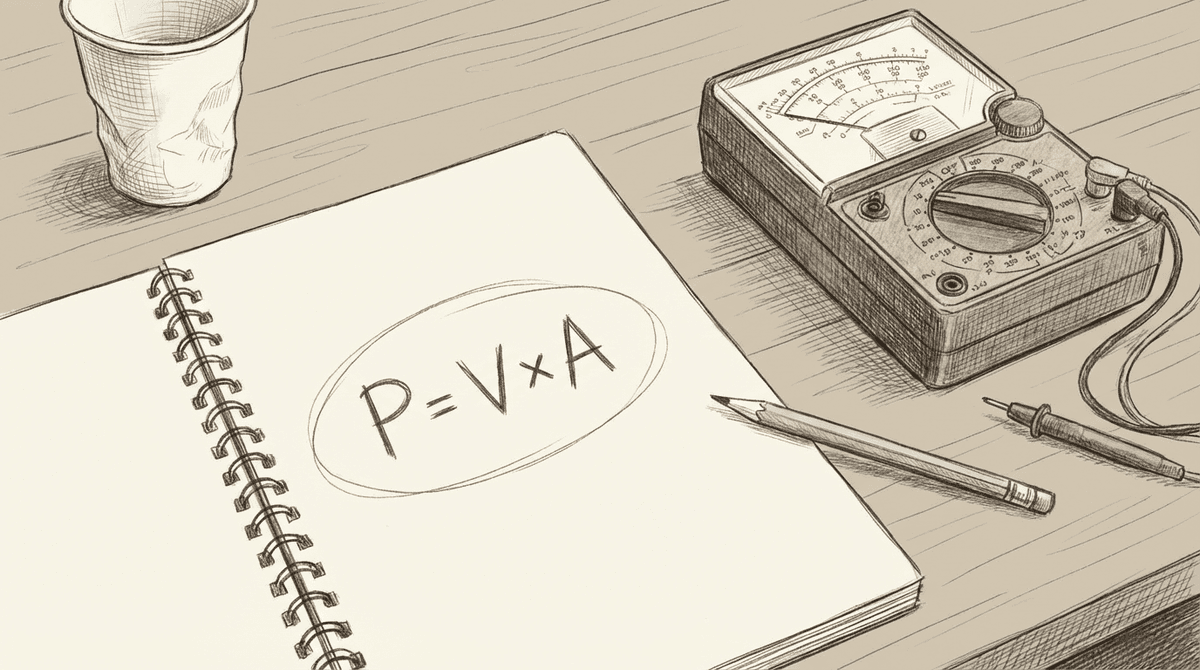
If you know the amperage and voltage of a device, you can estimate its power consumption quickly. This helps you make better decisions for sizing generators, inverters, breakers, and planning your overall energy usage. The key to an accurate calculation is using the right formula for your specific circuit type.
Run instant calculations and full load planning with the WattSizing Calculator.
Quick Answer
To calculate watts, the base formula is Watts (W) = Volts (V) × Amps (A). For direct current (DC) circuits and simple resistive alternating current (AC) loads like heaters, this straightforward multiplication is all you need. However, for AC appliances with motors or compressors (like refrigerators or air conditioners), you must include the power factor (PF) to find the true power: Watts (W) = Volts (V) × Amps (A) × Power Factor (PF).
Understanding the Scope: What Are Watts, Amps, and Volts?
Before diving into the math, it helps to understand what these terms actually measure:
- Volts (V): The electrical pressure pushing the current through the wire. In the US, standard household outlets are 120V, while large appliances use 240V.
- Amps (A): The flow rate or volume of electrical current moving through the circuit.
- Watts (W): The actual power being consumed or produced at a given moment. It is the result of volts and amps working together.
- Power Factor (PF): A ratio (between 0 and 1) that measures how effectively AC electrical power is converted into useful work. Resistive loads have a PF of 1.0, while inductive loads (motors) might have a PF of 0.8.
This guide covers how to calculate real power (Watts) from these metrics. It does not cover calculating energy consumption over time (Kilowatt-hours or kWh), which requires multiplying watts by hours of use.
Which Formula to Use for Your Circuit
The formula you need depends entirely on the type of electrical system you are working with.
| Circuit Type | Formula | Best Used For |
|---|---|---|
| DC (Direct Current) | W = V × A | Car batteries, solar panels, 12V/24V off-grid systems. |
| Single-Phase AC (Resistive) | W = V × A | Incandescent bulbs, space heaters, toasters. |
| Single-Phase AC (Inductive) | W = V × A × PF | Refrigerators, air conditioners, well pumps, power tools. |
| Three-Phase AC | W = 1.732 × V × A × PF | Industrial equipment, large commercial HVAC systems. |
Crucial Details Often Overlooked
When calculating watts for home power planning, many people make simple mistakes that lead to undersized equipment or tripped breakers. Keep these realities in mind:
- Apparent Power (VA) vs. Real Power (W): If you multiply AC Volts by Amps without the power factor, you get Volt-Amps (VA), not Watts. For a heater, VA equals Watts. For a motor, VA will be higher than the actual Watts consumed. Inverters and generators are often rated in VA, so confusing the two can lead to overloading.
- Starting Surge: The formula gives you the running watts. Inductive loads like compressors can draw 2 to 3 times their running amps for a fraction of a second when starting. You must account for this surge when sizing a generator.
- Nameplate vs. Actual Draw: The amps listed on an appliance nameplate are often the maximum safe operating current, not the continuous draw. A device might be rated for 10A but only draw 6A during normal operation.
Illustrative Worked Examples
Here are transparent calculations showing how these formulas apply in the real world. Note: These are illustrative examples; always check your specific equipment's nameplate.
Example 1: Sizing a DC Solar Appliance
You want to run a 12V DC water pump that draws 8 amps.
- Calculation:
12 Volts × 8 Amps = 96 Watts - Result: The pump consumes 96 watts of power.
Example 2: A Simple AC Resistive Load
You plug a space heater into a standard 120V wall outlet, and it draws 12.5 amps. Because it's a resistive heating element, the power factor is 1.0.
- Calculation:
120 Volts × 12.5 Amps = 1,500 Watts - Result: The heater uses exactly 1,500 watts.
Example 3: An AC Motor Load (Where Power Factor Matters)
You have a 120V air compressor that draws 10 amps while running. The motor has a power factor of 0.80.
- Calculation:
120 Volts × 10 Amps × 0.80 PF = 960 Watts - Result: The true power consumption is 960 watts. If you ignored the power factor, you would incorrectly assume it uses 1,200 watts.
Practical Checklist: What to Do Next
If you are calculating watts to size a backup power system or check a circuit, follow these steps:
- Locate the Nameplate: Find the silver or black sticker on the back of your appliance. Note the Volts (V) and Amps (A).
- Identify the Load Type: Is it a heater/bulb (resistive) or a motor/compressor (inductive)?
- Apply the Formula: Multiply V × A. If it's a motor, multiply the result by 0.8 as a safe average power factor if the exact PF isn't listed.
- Account for Surge: If the device has a motor, multiply your final running watts by 2.5 to estimate the starting surge watts.
- Check the Breaker: Ensure the total calculated watts on a single circuit do not exceed 80% of the breaker's capacity for continuous loads (e.g., 1,440W max on a 15A/120V circuit).
For deeper planning on how these watts translate into battery storage, see How to Calculate Daily Energy Use and Inverter Sizing for Off-Grid Solar.
FAQs
Is watts always just volts times amps?
For direct current (DC) systems and simple AC resistive loads (like heaters), yes. However, for AC inductive loads (like motors), you must multiply by the power factor to get the true watts.
What is power factor in simple terms?
Power factor is a ratio showing how effectively electrical current is converted into useful work in AC systems. A power factor of 1.0 means 100% efficiency, while 0.8 means only 80% of the current is doing real work (the rest sustains the magnetic field in the motor).
Can I size a generator from amps and volts alone?
It is a good starting point to find the running watts, but you cannot size a generator on this alone. You must also calculate the starting surge watts of your motor loads and add a 20% safety margin to ensure the generator isn't running at maximum capacity.
How do I convert watts to kilowatts?
Simply divide the total watts by 1,000. For example, 2,400 watts equals 2.4 kilowatts (kW).
What happens if I use the DC formula for an AC motor?
If you multiply V × A for an AC motor without the power factor, you calculate Apparent Power (Volt-Amps or VA), not Real Power (Watts). You will overestimate the actual wattage the device consumes, which could lead you to buy a larger, more expensive inverter than necessary.
How do I find the amperage if I only know the watts and volts?
You can reverse the formula. For DC or resistive AC loads, divide the Watts by the Volts to find the Amps (A = W / V). For example, a 1,200W heater on a 120V circuit draws 10 Amps (1200 / 120 = 10).
Sources
- U.S. Department of Energy - Estimating Appliance and Home Electronic Energy Use
- National Institute of Standards and Technology (NIST) - Electrical Units
CTA
Need fast, accurate power sizing without spreadsheet guesswork? Use the WattSizing Calculator to convert your appliance loads into practical generator, battery, and inverter recommendations.


