
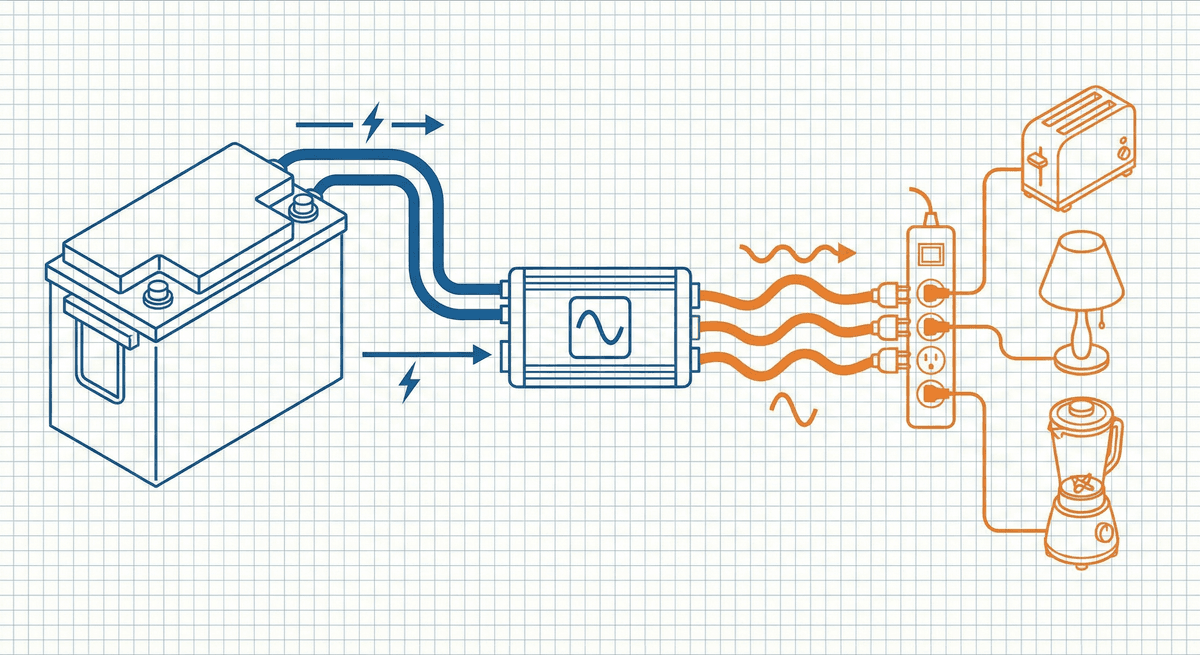
Your inverter turns battery DC into AC for appliances. Undersize it and you’ll trip on overload or surge; oversize it and you spend more than you need. This guide covers continuous watts, surge, and a simple safety margin.
Continuous vs Surge (Peak) Power
- Continuous (rated) watts: What the inverter can deliver all the time. This must be at least the sum of all AC loads that can run together (running watts, not surge).
- Surge (peak) watts: Short burst many inverters can supply for a few seconds. Motors (fridge, pump, compressor) draw 2–5× their running watts at start. Your inverter’s surge must exceed the largest motor surge (or sum if multiple could start together).
Sizing Steps
- List every AC load you’ll run at once. Use running watts from labels or a meter.
- Add them up → that’s your continuous load.
- Find the biggest motor (fridge, pump, etc.). Multiply its running watts by at least 2–3 for surge (check appliance specs if possible).
- Choose an inverter whose continuous rating is ≥ continuous load (plus 10–20% margin) and whose surge rating is ≥ largest surge.
Example: 200 W lights + 50 W fridge (running) + 300 W laptop = 550 W continuous. Fridge surge ~150 W. Inverter: 600 W continuous, 1,000 W+ surge is safe.
Pure Sine vs Modified Sine
- Pure sine wave: Best for sensitive electronics, motors, and medical devices. Preferred for most off-grid AC.
- Modified sine: Cheaper; some motors and electronics run poorly or hotter. OK for basic resistive loads and some tools.
Don’t Forget Efficiency
Inverters waste 5–15% as heat. When you calculate daily energy use, add ~10% to your AC load total so your battery and solar size account for inverter loss. Size the inverter for load; size the battery for energy.
Use the WattSizing calculator to enter loads and get recommended inverter size along with panel and battery.


