
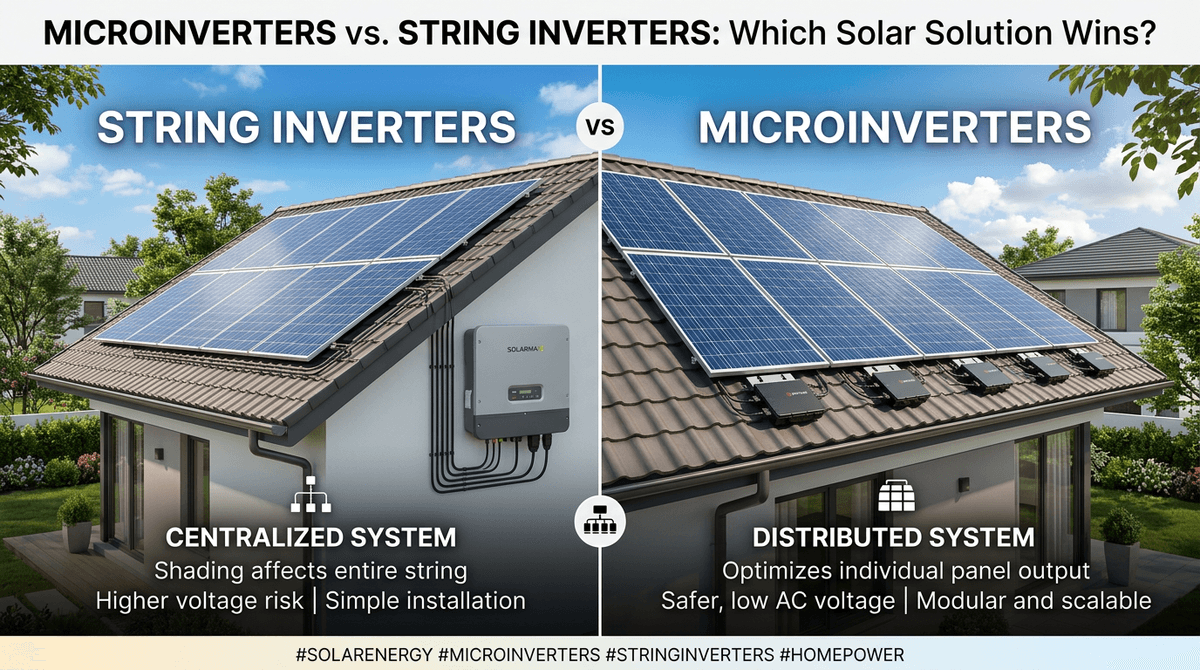
When designing a home solar system, one of the most critical decisions you'll make is choosing the right type of inverter. The inverter is the heart of your solar energy system, responsible for converting the direct current (DC) electricity generated by your solar panels into the alternating current (AC) electricity that powers your home appliances.
Two main technologies dominate the residential solar market today: string inverters and microinverters. While both serve the same fundamental purpose, they operate very differently and offer distinct advantages and disadvantages depending on your specific situation.
In this comprehensive guide, we'll break down the differences between microinverters and string inverters, compare their costs, efficiency, and reliability, and help you determine which is the best fit for your home solar installation. If you're ready to start sizing your system, be sure to check out our solar calculator to get a customized estimate.
What is a Solar Inverter?
Before diving into the differences between the two technologies, it's essential to understand what an inverter does. Solar panels generate DC electricity when exposed to sunlight. However, the electrical grid and the appliances in your home run on AC electricity.
The solar inverter bridges this gap by converting the DC power into usable AC power. Without an inverter, the electricity generated by your solar panels would be completely useless for your home.
The Role of the Inverter
- DC to AC Conversion: The primary function is converting direct current to alternating current.
- Maximum Power Point Tracking (MPPT): Inverters optimize the power output from the solar panels by constantly adjusting the electrical operating point to ensure maximum efficiency.
- Grid Synchronization: For grid-tied systems, the inverter ensures the AC power produced matches the voltage and frequency of the utility grid.
- System Monitoring: Modern inverters provide data on energy production, allowing you to track your system's performance via an app or web portal.
What is a String Inverter?
A string inverter is the traditional and most common type of solar inverter used in residential and commercial installations. In a string inverter system, your solar panels are wired together in a series, creating a "string." This string of panels is then connected to a single central inverter, usually mounted on the side of your house or in your garage.
How String Inverters Work
Imagine a string of old-fashioned Christmas lights. If one bulb goes out or is shaded, the entire string goes dark or dims. A string inverter system operates on a similar principle. The electricity generated by all the panels in the string flows to the central inverter, which then converts the combined DC power into AC power.
Because the panels are wired in series, the performance of the entire string is dictated by the lowest-performing panel. If one panel is shaded by a tree, covered in dirt, or experiencing a technical issue, the output of the entire string drops to match that of the underperforming panel.
Pros of String Inverters
- Lower Initial Cost: String inverters are generally the most cost-effective option upfront. Because you only need one central unit (or perhaps two for larger systems), the equipment and installation costs are lower.
- Proven Technology: String inverters have been around for decades and are a highly mature, reliable technology.
- Easy Maintenance: Since the inverter is typically mounted at ground level (e.g., in a garage or on an exterior wall), it is easily accessible for maintenance, repairs, or replacement. You don't need to climb onto the roof to service it.
- Fewer Points of Failure: With only one central unit, there are fewer electronic components that can fail compared to a system with a microinverter on every panel.
Cons of String Inverters
- Vulnerability to Shading: The biggest drawback is the "Christmas light effect." If a single panel is shaded, the entire string's output is reduced.
- System Expansion is Difficult: Adding more panels to an existing string inverter system can be complicated. You may need to add a second central inverter or ensure the new panels perfectly match the existing ones.
- Shorter Lifespan: String inverters typically have a lifespan of 10 to 15 years, meaning they will likely need to be replaced at least once during the 25-year lifespan of your solar panels.
- Limited Monitoring: String inverters provide aggregate data for the entire string, making it difficult to pinpoint issues with individual panels.
What is a Microinverter?
Microinverters represent a newer, more advanced approach to solar energy conversion. Instead of a single central unit, a microinverter system features a small inverter installed on the back of every single solar panel on your roof.
How Microinverters Work
Because each panel has its own dedicated inverter, the DC to AC conversion happens right on the roof at the panel level. The AC power is then sent down to your home's electrical panel.
This decentralized approach completely eliminates the "Christmas light effect." Each panel operates independently. If one panel is shaded by a chimney or covered in leaves, it only affects the output of that specific panel; the rest of the system continues to operate at maximum capacity.
Pros of Microinverters
- Maximum Energy Production: Microinverters isolate the performance of each panel. This makes them significantly more efficient in situations with partial shading, multiple roof planes, or panels facing different directions.
- Panel-Level Monitoring: Because each panel has its own inverter, you can monitor the performance of every single panel in real-time. This makes it incredibly easy to identify and diagnose issues.
- Easy System Expansion: Expanding a microinverter system is simple. You can add one, two, or ten panels at any time without worrying about matching string sizes or upgrading a central unit.
- Longer Lifespan: Microinverters are designed to last as long as the solar panels themselves—typically 25 years. They usually come with 25-year warranties, compared to the standard 10-12 year warranties for string inverters.
- Enhanced Safety: Microinverters convert high-voltage DC to standard AC right on the roof, eliminating the need to run high-voltage DC wiring through your attic or down the side of your house.
Cons of Microinverters
- Higher Upfront Cost: The primary disadvantage of microinverters is the cost. Purchasing an inverter for every panel is more expensive than buying a single central unit.
- More Difficult Maintenance: If a microinverter fails, a technician must climb onto the roof, remove the solar panel, and replace the unit. This makes labor costs for repairs higher.
- More Points of Failure: A system with 20 panels will have 20 microinverters. This means there are 20 times more electronic components that could potentially fail compared to a single string inverter.
String Inverters with Power Optimizers: The Middle Ground
If you want the benefits of panel-level optimization without the high cost of microinverters, there is a third option: String Inverters with Power Optimizers.
Power optimizers are small devices attached to the back of each solar panel, similar to microinverters. However, instead of converting DC to AC on the roof, they "condition" the DC electricity, fixing the voltage and sending it down to a central string inverter for conversion.
Why Choose Power Optimizers?
- Mitigates Shading Issues: Like microinverters, optimizers isolate each panel, preventing a shaded panel from dragging down the rest of the string.
- Panel-Level Monitoring: Optimizers provide the same granular, panel-level data as microinverters.
- Cost-Effective: They are generally cheaper than a full microinverter system but offer many of the same benefits.
The main downside is that you still have a central inverter that acts as a single point of failure and will likely need replacing after 10-15 years.
Microinverters vs String Inverters: A Head-to-Head Comparison
| Feature | String Inverters | Microinverters | String + Optimizers |
|---|---|---|---|
| Upfront Cost | Lowest | Highest | Medium |
| Shading Tolerance | Poor | Excellent | Excellent |
| Lifespan/Warranty | 10 - 15 Years | 25 Years | Inverter: 12 Yrs / Optimizers: 25 Yrs |
| Monitoring Level | System/String Level | Panel Level | Panel Level |
| Ease of Expansion | Difficult | Very Easy | Moderate |
| Maintenance Access | Easy (Ground Level) | Difficult (On Roof) | Difficult (Optimizers on Roof) |
| Best For... | Unshaded, simple roofs | Shaded, complex roofs | Shaded roofs on a budget |
Which Inverter is Best for Your Home?
The "best" inverter depends entirely on your specific roof, budget, and long-term goals. Here is a breakdown of when to choose each technology.
When to Choose a String Inverter
You should opt for a standard string inverter if:
- Your roof has zero shading: If you have a large, south-facing roof with no trees, chimneys, or dormers casting shadows, a string inverter will perform just as well as microinverters.
- You are on a strict budget: String inverters offer the lowest upfront cost, making solar more accessible.
- You have a simple roof layout: If all your panels are facing the exact same direction and pitch, a string inverter is highly efficient.
When to Choose Microinverters
You should invest in microinverters if:
- Your roof experiences partial shading: If trees, chimneys, or neighboring buildings cast shadows on your roof during the day, microinverters will significantly increase your overall energy production.
- You have a complex roof: If your panels need to be installed across multiple roof planes facing different directions (e.g., some facing south, some facing west), microinverters are essential.
- You plan to expand your system later: If you think you might add more panels in the future (perhaps when you buy an EV), microinverters make expansion incredibly easy.
- You want panel-level monitoring: If you love data and want to track the exact performance of every single panel, microinverters are the way to go.
When to Choose String Inverters with Optimizers
You should consider power optimizers if:
- You have shading but want to save money: Optimizers provide the shading benefits of microinverters but at a slightly lower price point.
- You want panel-level monitoring on a budget: Optimizers give you the granular data without the premium cost of microinverters.
Frequently Asked Questions (FAQ)
1. Do microinverters produce more power than string inverters?
In perfect conditions (no shade, all panels facing the same way), they produce roughly the same amount of power. However, in real-world conditions where partial shading or dirt accumulation occurs, microinverters will produce significantly more overall power because they isolate the underperforming panels.
2. Are microinverters worth the extra cost?
If your roof has any shading issues or multiple angles, yes, they are absolutely worth the extra cost. The increased energy production over the 25-year lifespan of the system will easily pay for the higher upfront price. If your roof is completely unshaded, a string inverter is a more cost-effective choice.
3. What happens if a microinverter fails?
If a microinverter fails, only that specific solar panel stops producing AC power. The rest of your system will continue to operate normally. You will be able to see exactly which unit failed via your monitoring app. A technician will then need to climb onto the roof to replace the faulty unit under warranty.
4. Can I mix string inverters and microinverters?
No, you cannot mix the two technologies on the same solar array. You must choose one system architecture for your installation.
5. How do I size my inverter correctly?
Inverter sizing depends on the total wattage of your solar panel array. Generally, your inverter capacity should be about 80% to 100% of your solar array's DC rating. To get an accurate calculation for your specific needs, use our free solar calculator.
Conclusion
Choosing between microinverters and string inverters is a crucial step in your solar journey. While string inverters offer a reliable, cost-effective solution for simple, unshaded roofs, microinverters provide superior performance, longevity, and flexibility for complex or shaded installations.
Take the time to evaluate your roof's specific conditions, your budget, and your desire for detailed monitoring. By understanding the pros and cons of each technology, you can make an informed decision that will maximize your solar investment for decades to come.
Ready to take the next step? Head over to the WattSizing Calculator to start designing your perfect off-grid or grid-tied solar system today!


