
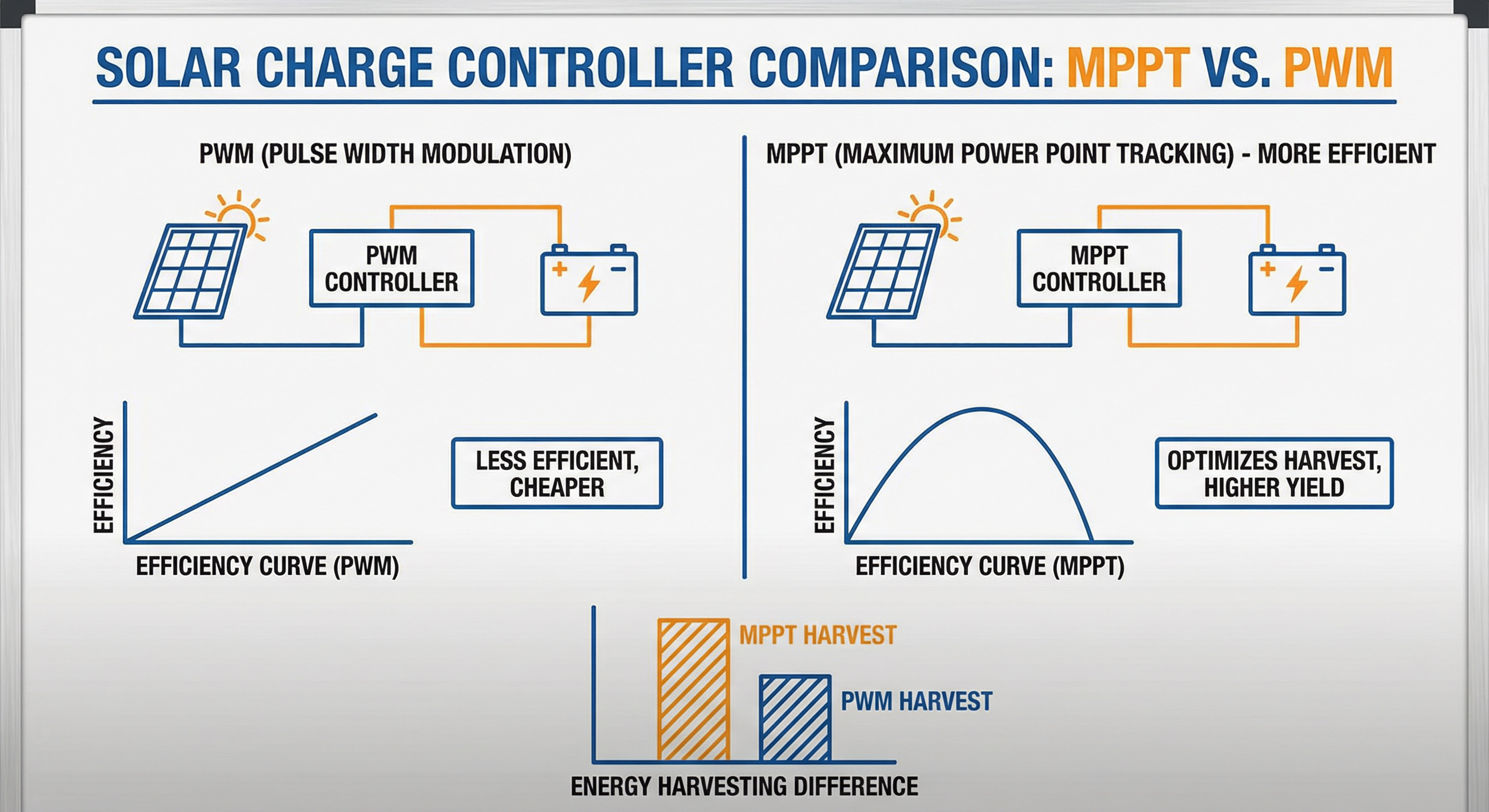
The solar charge controller is the "brain" of your charging system. It sits between your solar panels and your battery bank, ensuring the batteries are charged correctly and not overcharged.
There are two main technologies: PWM (Pulse Width Modulation) and MPPT (Maximum Power Point Tracking).
In 2026, MPPT is the standard for most serious systems, but PWM still has a place. Here is why.
How PWM Works (The "Switch")
Think of a PWM controller as a rapid switch. It connects the solar panels directly to the battery.
- Mechanism: It pulses the connection on and off thousands of times per second to regulate voltage.
- The Catch: Because it connects directly, the solar panel voltage is pulled down to match the battery voltage.
Example: You have a 100W panel (Vmp 18V, Imp 5.5A). You connect it to a 12V battery (actual voltage ~13V). The PWM pulls the panel voltage down to 13V. Power = Volts x Amps 13V x 5.5A = 71.5 Watts.
You lost ~30 Watts (30%) of your potential power!
Pros of PWM
- Cheap: Very inexpensive ($10 - $30).
- Simple: Fewer electronic components to fail.
- Small: Compact size.
Cons of PWM
- Inefficient: Wastes 20-30% of solar energy.
- Voltage Limits: Panel voltage must match battery voltage (e.g., 12V panel for 12V battery). You cannot use high-voltage residential panels.
How MPPT Works (The "DC-DC Converter")
MPPT controllers are smarter. They act as a sophisticated DC-to-DC converter.
- Mechanism: They decouple the panel voltage from the battery voltage. They find the "Maximum Power Point" (Vmp) of the panel and convert the excess voltage into extra current (Amps).
Example: Same 100W panel (Vmp 18V, Imp 5.5A). Battery at 13V. The MPPT keeps the panel at 18V. Input Power: 18V x 5.5A = 99W. Output to Battery: 99W / 13V = 7.6 Amps.
Result: You get nearly the full 100W (minus small conversion losses). You gained ~2.1 Amps of charging current compared to PWM.
Pros of MPPT
- High Efficiency: Up to 98-99% efficient.
- High Voltage Input: You can wire panels in series to get high voltage (e.g., 100V) and step it down to 12V, 24V, or 48V. This allows for thinner wires and longer cable runs.
- Better in Cold/Cloud: Extracts more power in varying conditions.
Cons of MPPT
- Cost: More expensive ($80 - $500+).
- Size: Larger and heavier due to inductors and heatsinks.
When to Use PWM
Use a PWM controller if:
- Small System: < 200W of solar (e.g., a small van fan or gate opener).
- Budget: You have zero budget left.
- Matched Voltage: You are using "12V nominal" panels with a 12V battery.
When to Use MPPT
Use an MPPT controller if:
- System > 200W: The extra energy harvested pays for the controller cost quickly.
- Residential Panels: You are using large 60-cell or 72-cell house panels (which operate at 30V-40V) on a 12V/24V battery. You MUST use MPPT for these.
- Cold Climate: Solar panel voltage rises in cold weather; MPPT captures this extra power.
- Long Wire Runs: High voltage transmission from panels reduces wire cost.
Sizing Your Controller
Controllers are rated by Amps.
- Calculation: Total Solar Wattage / Battery Voltage = Amps.
Example: 800W Solar Array / 24V Battery bank = 33.3 Amps. You need a 40A MPPT Controller.
Note: Always check the Max Input Voltage (Voc) of the controller. If you wire panels in series, the total voltage must not exceed this limit.
Conclusion
In 2026, unless you are building a tiny, ultra-budget system, buy an MPPT controller. The ability to use cheaper, high-voltage residential panels and the 30% efficiency gain make it the obvious choice.
Wiring your panels correctly is crucial for MPPT performance. Read How to Wire Solar Panels: Series vs Parallel to learn more.


