
Charge controllers turn solar panel output into safe charging for your battery. The two main types are PWM (Pulse Width Modulation) and MPPT (Maximum Power Point Tracking). Here’s how they differ and when to use each.
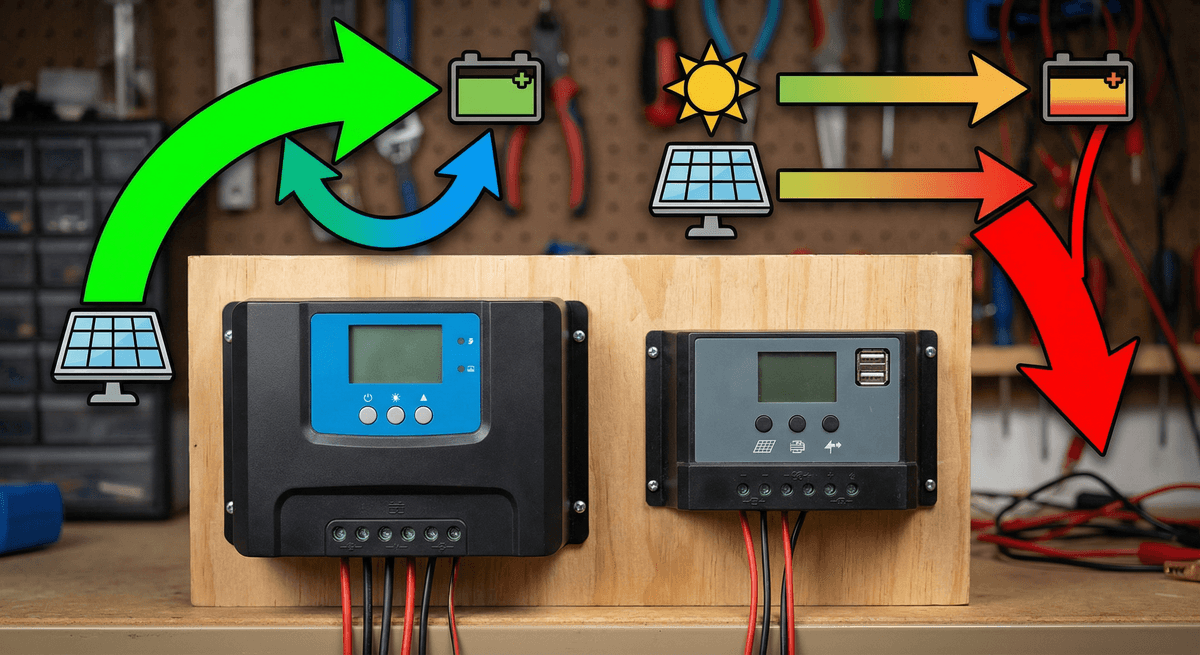
PWM: Simple and Cheap
- How it works: Connects the panel string (at roughly battery voltage) to the battery and “chops” the current on and off to control charging. Panel voltage is pulled down near battery voltage.
- Pros: Inexpensive, simple, reliable. Fine for small 12V systems where panel voltage is close to battery voltage (e.g. one or two 12V panels).
- Cons: When panel voltage is much higher than battery voltage (e.g. 2–3 panels in series, or cold weather), extra voltage is wasted. You get less energy into the battery than the panels could produce.
MPPT: Efficient and Flexible
- How it works: Tracks the panel’s maximum power point (best voltage/current combination) and converts that to the right voltage and current for the battery. Lets you use higher-voltage panel strings.
- Pros: Higher harvest, especially in cloudy or cold conditions. You can have more panels in series (lower current, thinner cables). See how to size an MPPT.
- Cons: More expensive and slightly more complex than PWM.
When to Choose Which
- PWM: Single or two 12V panels, tight budget, panel Vmp close to battery voltage. OK for tiny setups (e.g. shed, small boat).
- MPPT: Multiple panels, 24V/48V systems, or when you want to maximize energy from the array. Standard choice for most off-grid systems beyond the smallest.
For most new builds, MPPT is the better investment. Use the WattSizing calculator to get recommended array size; then match an MPPT or PWM to that array and your battery voltage.


