
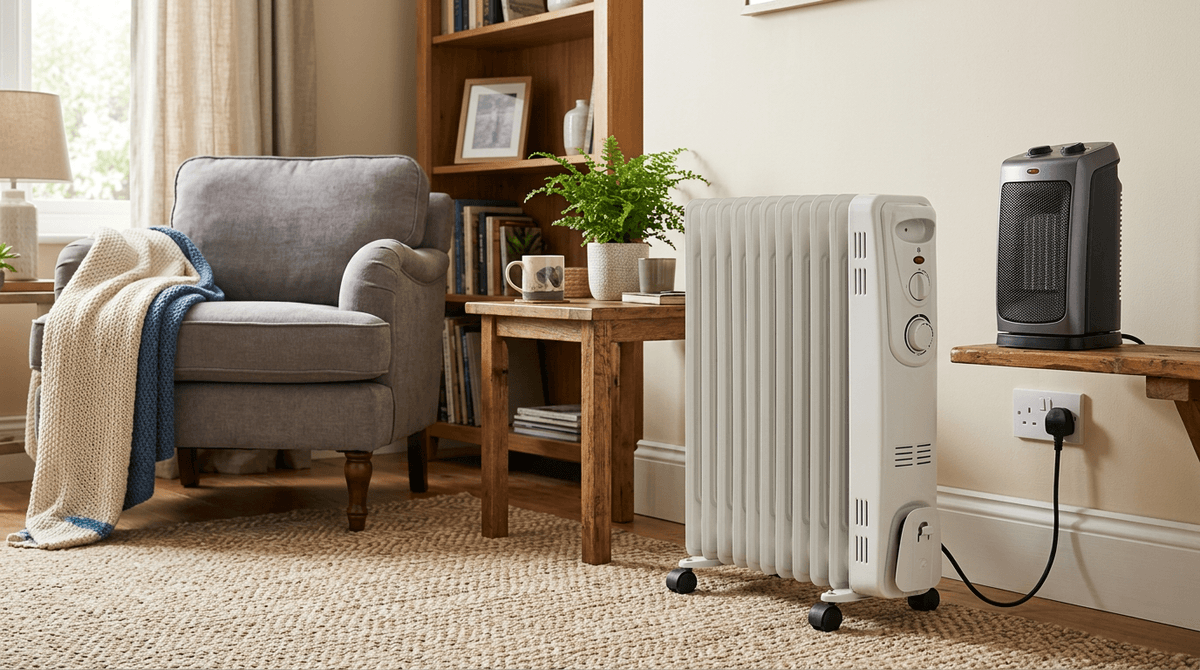
Most portable electric heaters and oil radiators have similar rated wattage, but real-world electricity use differs because of thermostat behavior and heat retention.
For room-by-room heating estimates, use the WattSizing Calculator.
Quick Answer
Both types are commonly rated around 1,200 to 1,500 watts on high settings. In practice, an oil radiator may cycle less frequently in stable rooms, while fan heaters often deliver faster warm-up.
Portable Heater vs Oil Radiator: Power Table
| Heater Type | Typical Rated Power | Typical Runtime Pattern | Typical Daily Use (kWh/day) |
|---|---|---|---|
| Ceramic/fan portable heater | 1,200 - 1,500 W | Short bursts, frequent cycling | 3.0 - 12.0 |
| Oil-filled radiator | 1,200 - 1,500 W | Slower warm-up, steadier cycling | 2.5 - 10.5 |
| Low setting (either type) | 600 - 900 W | Longer runtime | 2.4 - 8.1 |
At maximum output, both consume similar power per hour. Control strategy and insulation drive total cost.
Monthly Cost Comparison
Assume electricity is $0.18/kWh.
| Scenario | Daily kWh | Monthly kWh (30 days) | Estimated Monthly Cost |
|---|---|---|---|
| Fan heater at 1,500 W for 4 h/day equivalent | 6.0 | 180 | $32.40 |
| Oil radiator at 1,500 W for 3.3 h/day equivalent | 5.0 | 150 | $27.00 |
| Either heater at 900 W for 5 h/day | 4.5 | 135 | $24.30 |
Small runtime differences can matter more than heater type.
Realistic Scenarios
Scenario 1: Quick Morning Warm-Up
- Small bedroom
- 1,500W fan heater
- 45 minutes morning + 45 minutes evening
Daily energy:
1.5 x 1.5 h = 2.25 kWh/day
A fan heater is often preferred when fast heat is the goal.
Scenario 2: Home Office All Day
- 1,500W oil radiator with thermostat
- Cycles to about 40% duty over 8 hours
Daily energy:
1.5 x 8 x 0.4 = 4.8 kWh/day
The radiator can maintain comfort with fewer sharp temperature swings.
Scenario 3: Poorly Insulated Room
Both heater types may run near continuously:
- Effective runtime near 80% over 6 hours at 1,500W
- Daily use:
1.5 x 6 x 0.8 = 7.2 kWh/day
In this case, weatherproofing and insulation upgrades usually save more than switching heater types.
Efficiency Tips That Actually Lower Cost
- Heat only occupied rooms and close doors.
- Use thermostat settings instead of constant max heat.
- Seal drafts around windows and doors.
- Pre-heat briefly, then reduce to maintenance level.
- Use ceiling fans on low reverse mode to improve heat distribution.
Related reading:
FAQs
Which uses more electricity: fan heater or oil radiator?
At the same wattage and runtime, electricity use is nearly the same. Actual cost depends on cycling behavior and how long each runs.
Is an oil radiator more efficient?
Not in conversion efficiency. Both electric resistance heaters are close to 100% at point of use; comfort and control differences affect runtime.
Can I run either heater on a small inverter?
Many small inverters are undersized for 1,200 to 1,500W heaters. Check continuous watt rating and circuit limits.
Are these heaters expensive to run?
They can be, especially in cold climates with long runtime. Monitoring kWh is the best way to control cost.
CTA
Want to compare heating cost by room, schedule, and local utility rate? Use the WattSizing Calculator to estimate daily and monthly heater electricity use.


