
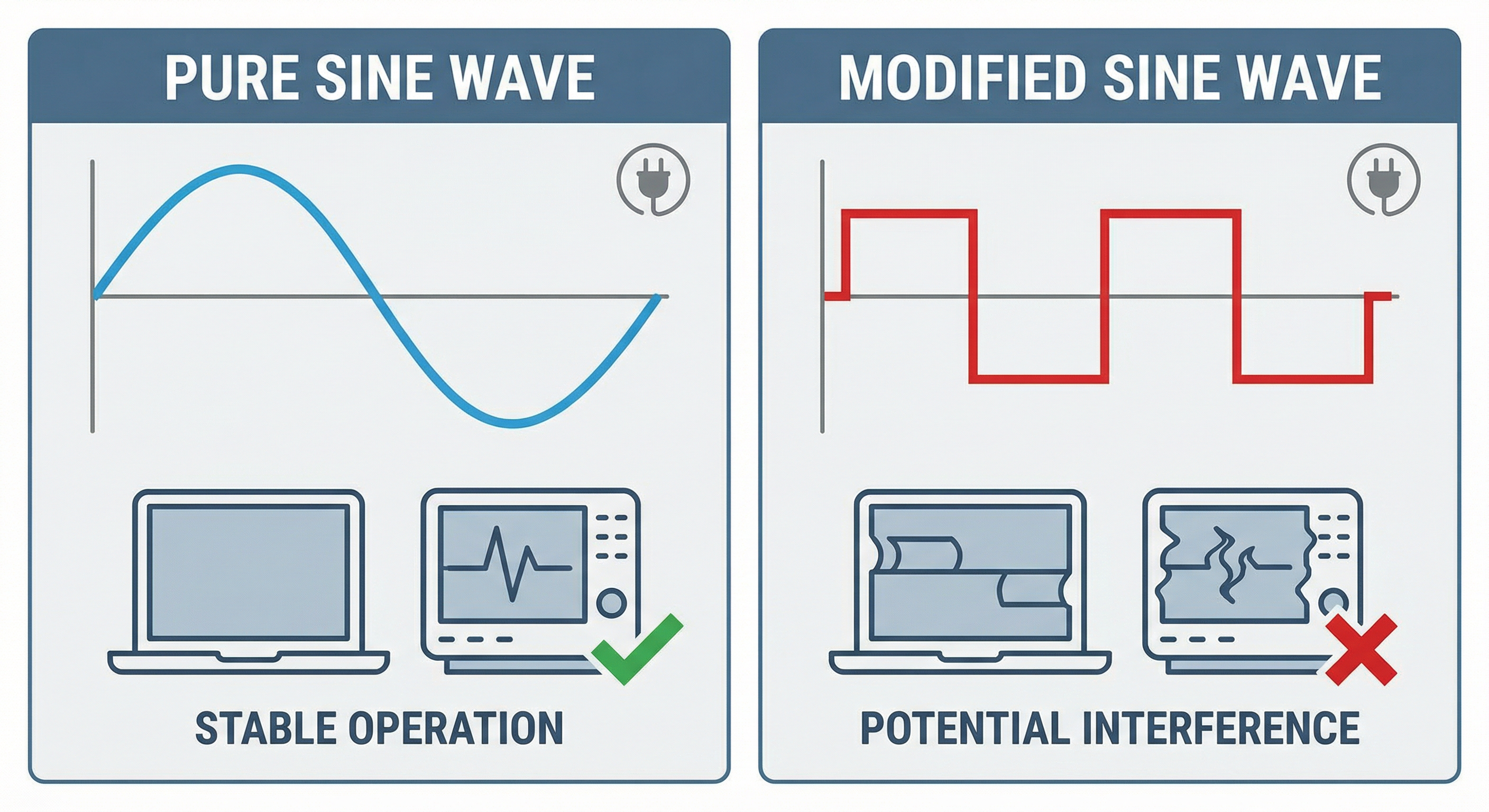
When shopping for an inverter to convert your battery's DC power into household AC power, you'll see two main types: Pure Sine Wave (PSW) and Modified Sine Wave (MSW).
The price difference can be significant. A 2000W MSW inverter might cost $150, while a 2000W PSW inverter might cost $300+. Is the extra cost worth it?
In 2026: Yes, absolutely.
The Waveform Difference
Pure Sine Wave
The electricity from the utility grid is a smooth, oscillating wave. It curves up and down 60 times a second (60Hz). A Pure Sine Wave inverter replicates this smooth curve almost perfectly. It produces "clean" power.
Modified Sine Wave
A Modified Sine Wave inverter produces a blocky, stair-step wave. It tries to mimic the curve by jumping straight up, holding, jumping down, holding, etc. It is "dirty" power with high harmonic distortion.
Why It Matters: Appliance Compatibility
Appliances that HATE Modified Sine Wave
Running these on a cheap MSW inverter can cause damage, overheating, or failure:
- AC Motors: Fridges, pumps, fans, compressors. The "blocky" wave causes motors to run hotter and less efficiently (buzzing sound). It can shorten their lifespan significantly.
- Medical Equipment: CPAP machines, oxygen concentrators. Never run these on MSW; it can be dangerous.
- Sensitive Electronics: Laser printers, some laptops, digital clocks (they will lose time), smart home devices.
- Audio/Video: TVs and stereos will likely have a noticeable "hum" or buzz in the audio/picture.
- Induction Cooktops: Often won't work at all.
- Battery Chargers: Tool chargers (DeWalt, Milwaukee) can overheat and burn out.
Appliances that are OK with Modified Sine Wave
Simple, resistive loads usually don't care:
- Old-school incandescent light bulbs.
- Simple heating elements (toasters, kettles) - though they might buzz.
- Old tube TVs.
The Efficiency Factor
Pure Sine Wave inverters are generally more efficient (90-95%) than older MSW models. Because motors run cooler on PSW, your fridge will actually use less energy from your battery bank on a PSW inverter than on an MSW one.
The Verdict for 2026
Ten years ago, PSW inverters were incredibly expensive ($1000+), so MSW was a necessary evil. Today, the price gap has narrowed drastically. You can get a reliable 2000W Pure Sine Wave inverter for under $300.
Recommendation:
- Always buy Pure Sine Wave for a home, cabin, RV, or van. It protects your expensive appliances and ensures everything works.
- Only buy Modified Sine Wave for a cheap, emergency backup inverter that will only run a few lights or a simple heater for a few hours a year.
Sizing Your Inverter
Once you've chosen Pure Sine Wave, you need to pick the size (Watts).
- Continuous Watts: What it can run all day.
- Surge Watts: What it can handle for a few seconds (starting a motor).
Make sure your inverter is grounded properly for safety. See Grounding Your Off-Grid Solar System.


