
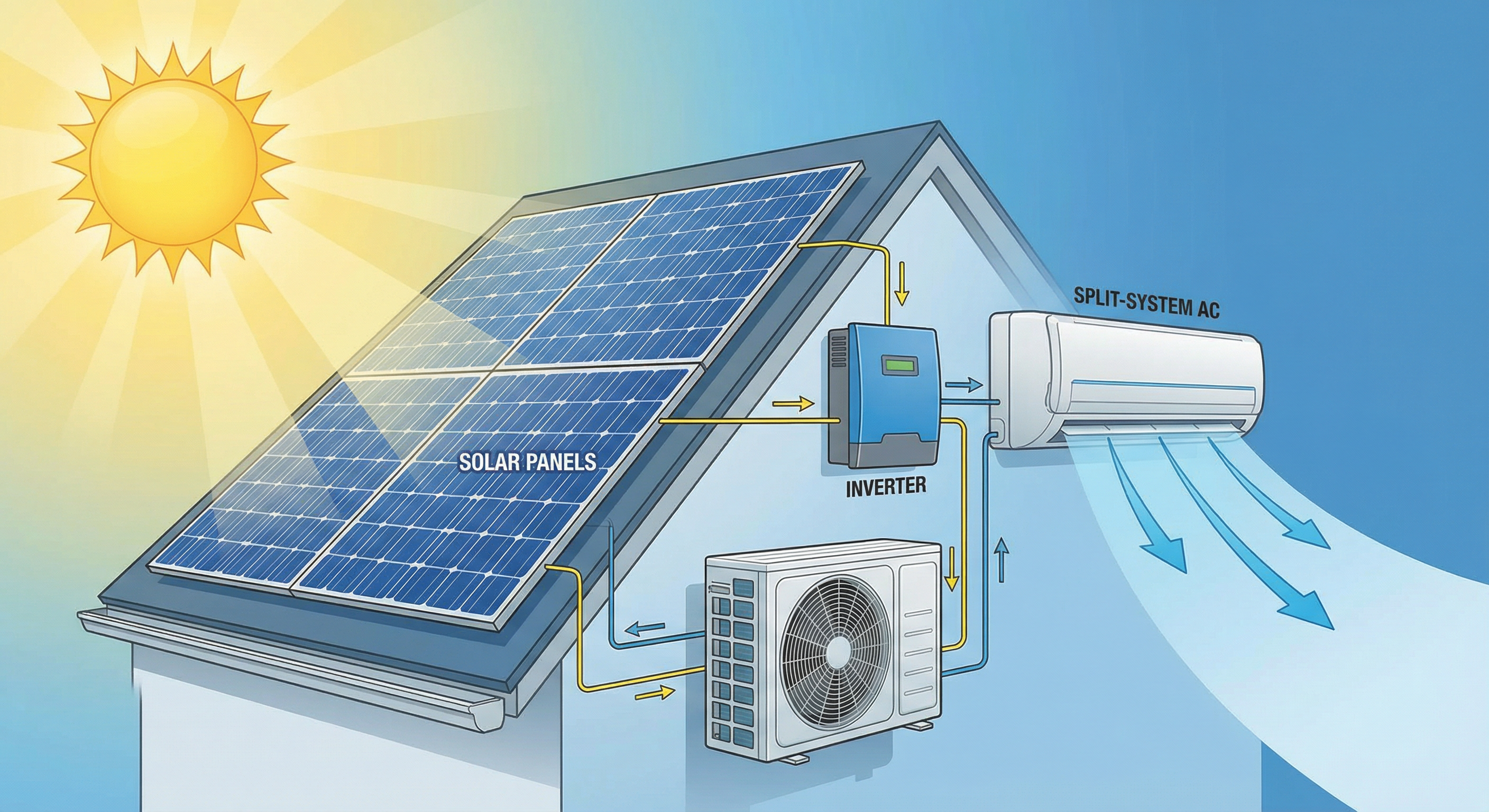
The "Holy Grail" of off-grid living is often climate control. Heating is usually handled by wood or propane, but cooling? That requires electricity. A lot of it.
A common question we get is: "Can I run my air conditioner off solar panels?"
The short answer is YES. The long answer is: Yes, but it will likely be the most expensive part of your system.
Here is how to make it work in 2026.
The Problem: Surge vs. Running Watts
Air conditioners are inductive loads. They have motors (compressors).
- Running Watts: The power the AC uses while it's humming along cooling the room.
- Surge Watts (Inrush Current): The massive spike of power needed for a split second to start the compressor. This can be 3-5 times the running watts.
Example: A typical 13,500 BTU RV air conditioner might run at 1500W but require a 3500W+ surge to start. If your inverter can't handle that 3500W spike, the system will trip and shut down, even if you have enough battery for the running watts.
The Solution: Inverter Technology & Soft Starters
1. Mini-Splits (The Gold Standard)
If you are building a cabin, tiny house, or retrofitting a home, install a Mini-Split.
- Inverter Technology: Modern mini-splits use variable-speed compressors. They don't "slam" on and off. They ramp up slowly. This eliminates the massive surge spike almost entirely.
- Efficiency: They are incredibly efficient (high SEER ratings). A 12,000 BTU mini-split might only draw 300-400W once the room is cool, compared to 1200W for a window unit.
2. Soft Starters
If you have an existing roof AC (like on an RV) or a standard window unit, you can install a Soft Start device (like Micro-Air). This device smooths out the power inrush, reducing the startup surge by up to 70%. This allows a smaller inverter (and generator) to start the AC.
Sizing the Solar System for AC
To run an AC, you need to calculate the energy "budget."
Scenario: You want to run a 12,000 BTU Mini-Split for 8 hours a day (mostly during the sunniest part of the day).
- Average Draw: Let's be conservative and say 600W average (it fluctuates).
- Total Energy: 600W x 8 hours = 4800Wh (4.8kWh).
This 4.8kWh is just for the AC. You still need power for lights, fridge, etc.
Solar Panel Requirement
To generate 4.8kWh in a day with 5 peak sun hours: 4800Wh / 5h = 960W. Accounting for efficiency losses (divide by 0.75): 960W / 0.75 = ~1280W of solar panels.
So, you need roughly 1300W of solar dedicated solely to the air conditioner.
Battery Requirement
If you only run the AC while the sun is shining, you don't need a massive battery bank. But if you want to run it at night (sleeping):
- Night run time: 8 hours (10pm - 6am).
- Load: 4.8kWh.
- Battery needed (LiFePO4): 4.8kWh / 0.8 (DoD) = 6kWh battery bank.
DC Air Conditioners
There are specialized DC Air Conditioners that run directly off 48V batteries, bypassing the inverter entirely.
- Pros: More efficient (no DC-to-AC conversion loss).
- Cons: More expensive, harder to find parts for, requires heavy DC cabling.
- Verdict: For most people, a high-efficiency 240V or 120V AC mini-split is better because standard appliances are cheaper and easier to replace.
Tips for Success
- Insulation is Key: The best way to save solar power is to stop the heat from getting in. Insulate your roof, walls, and windows. Shade your windows from the outside.
- Cool the Person, Not the Room: Use fans. A ceiling fan uses 50W. An AC uses 1000W.
- Dump Loads: Set up your system so the AC only runs hard when the batteries are full and the sun is shining ("opportunity load").
- Voltage: Use a 48V system. Running high-draw appliances on 12V requires massive cables and creates heat/efficiency loss.
Conclusion
Yes, you can run A/C on solar.
- Best Path: High-SEER Mini-Split + 48V System + LiFePO4 Batteries.
- Hard Path: Old window unit + 12V Lead Acid System (Don't do this).
Before you buy your AC, make sure you understand your inverter capabilities. Check out Pure Sine Wave vs Modified Sine Wave Inverters.


