
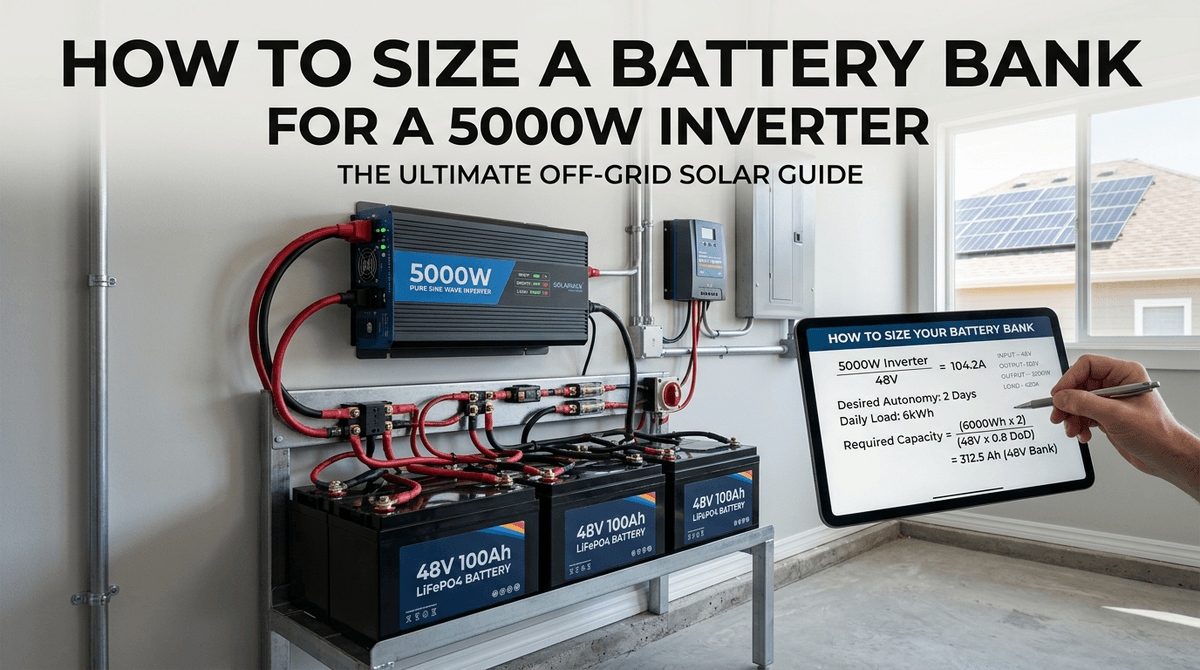
A 5000-watt (5kW) inverter is a serious piece of equipment. It's capable of running almost any household appliance, from air conditioners and well pumps to power tools and electric ovens. However, an inverter is only as good as the battery bank supplying its power. If you pair a massive 5000W inverter with a tiny battery bank, the system will shut down almost immediately under a heavy load.
So, how do you size a battery bank for a 5000W inverter?
The answer depends on three crucial factors: the voltage of your battery bank (12V, 24V, or 48V), the chemistry of your batteries (Lead-Acid vs. Lithium), and how long you plan to run your appliances at maximum capacity.
In this comprehensive guide, we will walk you through the math step-by-step to ensure you build a battery bank that can handle the massive power draw of a 5kW inverter safely and efficiently. If you want to skip the math, use our free solar calculator to size your entire system instantly.
Step 1: Determine Your Battery Bank Voltage (12V, 24V, or 48V)
The first and most critical decision you must make when sizing a battery bank for a 5000W inverter is choosing the system voltage.
While 12-volt systems are common for small RVs and vans, you should never use a 12V battery bank with a 5000W inverter. Here's why:
The Problem with 12V Systems at 5000W
To calculate the amperage your inverter will pull from the batteries, you divide the wattage by the voltage (Watts / Volts = Amps).
If you run a 5000W inverter at full capacity on a 12V battery bank: 5000W / 12V = 416 Amps
Pulling 416 amps continuously is incredibly dangerous. It requires massive, expensive, and difficult-to-work-with 4/0 AWG cables to prevent the wires from melting or catching fire.
Why 48V is the Standard for 5000W Inverters
To reduce the amperage (and therefore the required wire size), you must increase the voltage.
If you use a 48V battery bank: 5000W / 48V = 104 Amps
At 104 amps, you can safely use much thinner, cheaper, and more manageable wiring (like 2 AWG or 1/0 AWG). For a 5000W inverter, a 48V battery bank is highly recommended, though a 24V system (pulling ~208 amps) is acceptable if wired very carefully.
Step 2: Calculate the Maximum Amp Draw
Now that we've established that a 48V system is best, we need to calculate the absolute maximum amperage the inverter will pull from the batteries.
Inverters are not 100% efficient. Some energy is lost as heat during the DC-to-AC conversion process. Most high-quality pure sine wave inverters are about 85% to 90% efficient.
To calculate the true maximum draw, we must factor in this inefficiency:
- Maximum Continuous Load: 5000 Watts
- System Voltage: 48 Volts
- Inverter Efficiency: 85% (0.85)
Formula: (Watts / Volts) / Efficiency = Maximum Amps (5000W / 48V) / 0.85 = 122.5 Amps
Your battery bank must be capable of safely discharging 123 Amps continuously without overheating or damaging the cells.
Step 3: Choose Your Battery Chemistry (Lithium vs. Lead-Acid)
The type of battery you choose drastically affects how large your battery bank needs to be. The two main options are deep-cycle Lead-Acid (AGM/Gel/Flooded) and Lithium Iron Phosphate (LiFePO4).
Depth of Discharge (DoD)
The most critical difference between the two chemistries is their Depth of Discharge (DoD). This is the percentage of the battery's total capacity that you can safely use before it needs to be recharged.
- Lead-Acid Batteries: You should never discharge a lead-acid battery below 50% capacity. Doing so permanently damages the battery and drastically reduces its lifespan. Therefore, a 100Ah lead-acid battery only provides 50Ah of usable power.
- Lithium (LiFePO4) Batteries: Lithium batteries can safely be discharged to 80%, 90%, or even 100% of their capacity without damage. A 100Ah lithium battery provides 80Ah to 100Ah of usable power.
The "C-Rate" (Discharge Rate)
The C-Rate dictates how fast a battery can be discharged safely.
- Lead-Acid: Discharging lead-acid batteries too quickly (e.g., pulling 100 amps from a 100Ah battery) causes the voltage to plummet and significantly reduces the total usable capacity (known as the Peukert Effect). They prefer a slow, steady discharge (0.1C to 0.2C).
- Lithium: Lithium batteries can easily handle high discharge rates (often 1C, meaning pulling 100 amps from a 100Ah battery) without significant voltage drop or capacity loss.
The Verdict: For a high-draw 5000W inverter, Lithium (LiFePO4) batteries are vastly superior. They are lighter, last 5-10 times longer, and can handle the massive amp draw without voltage sag.
Step 4: Calculate the Required Battery Capacity (Amp-Hours)
Now we need to determine how many Amp-Hours (Ah) your battery bank needs to be. This depends entirely on how long you want to run the 5000W load.
Let's assume you want to be able to run the inverter at its absolute maximum capacity (5000W) for 2 continuous hours before the batteries are dead.
Scenario A: Sizing a 48V Lithium (LiFePO4) Battery Bank
- Max Continuous Draw: 123 Amps (calculated in Step 2)
- Desired Run Time: 2 Hours
- Total Amp-Hours Needed: 123 Amps x 2 Hours = 246 Ah
- Factor in Depth of Discharge (80% DoD): 246 Ah / 0.80 = 307.5 Ah
To run a 5000W load for 2 hours on a 48V system, you need a 48V Lithium battery bank rated for at least 310 Ah. (This is a massive amount of energy—roughly 15 kWh).
Scenario B: Sizing a 48V Lead-Acid Battery Bank
- Max Continuous Draw: 123 Amps
- Desired Run Time: 2 Hours
- Total Amp-Hours Needed: 123 Amps x 2 Hours = 246 Ah
- Factor in Depth of Discharge (50% DoD): 246 Ah / 0.50 = 492 Ah
- Factor in the Peukert Effect: Because you are discharging lead-acid batteries very quickly, you lose roughly 20% of their rated capacity. 492 Ah / 0.80 = 615 Ah
To run the exact same 5000W load for 2 hours, you would need a 48V Lead-Acid battery bank rated for at least 615 Ah. This would require dozens of incredibly heavy batteries and take up a massive amount of space.
Real-World Sizing: You Won't Run 5000W Continuously
The calculations above assume you are maxing out the inverter for 2 hours straight. In the real world, this almost never happens.
A 5000W inverter allows you to run high-surge appliances (like an AC unit starting up) while simultaneously running smaller loads (lights, a TV, a fridge). Your average continuous load will likely be much lower—perhaps 1000W to 2000W.
How to Size for Real-World Usage
Instead of sizing the battery bank based on the inverter's maximum capacity, you should size it based on your actual daily energy consumption (measured in Watt-hours or kWh).
- List all the appliances you plan to run.
- Multiply their wattage by the hours they run per day to find the daily Watt-hours (Wh).
- Divide the total daily Wh by your battery voltage to find the required Amp-hours (Ah).
For example, if your cabin uses 10,000 Wh (10 kWh) per day:
- 10,000 Wh / 48V = 208 Ah per day.
- For a Lithium bank (80% DoD), you need: 208 Ah / 0.80 = 260 Ah at 48V.
To make this process effortless, use our Off-Grid Solar Calculator to input your specific appliances and get an exact battery bank size recommendation.
The Importance of the Battery Management System (BMS)
If you choose Lithium batteries (which you should for a 5000W inverter), you must pay close attention to the Battery Management System (BMS) rating.
Every "drop-in" lithium battery has an internal BMS that protects the cells from overcharging, over-discharging, and overheating. The BMS also limits the maximum continuous discharge current.
Many cheaper 100Ah lithium batteries have a BMS limited to 100 Amps continuous discharge.
If you wire four 12V 100Ah batteries in series to create a 48V 100Ah battery bank, the maximum continuous discharge for the entire bank is still limited by the BMS of a single battery—100 Amps.
As we calculated in Step 2, a 5000W inverter on a 48V system pulls 123 Amps. If you try to pull 5000W from that battery bank, the BMS will instantly shut the batteries down to protect them.
The Solution: You must ensure that the combined BMS continuous discharge rating of your battery bank exceeds 123 Amps. This usually means wiring multiple 48V server rack batteries in parallel (e.g., two 48V 100Ah batteries in parallel gives you 200Ah of capacity and 200 Amps of continuous discharge capability).
Frequently Asked Questions (FAQ)
1. Can I run a 5000W inverter on a 12V battery bank?
Technically yes, but it is highly discouraged and potentially dangerous. A 5000W inverter will pull over 400 amps from a 12V battery bank. This requires massive, expensive 4/0 AWG wiring and generates a tremendous amount of heat. A 48V system is the standard for 5000W inverters.
2. How many 100Ah batteries do I need for a 5000W inverter?
If you are building a 48V system using 12V 100Ah Lithium batteries, you need a minimum of four batteries wired in series to reach 48V. However, because a 5000W inverter pulls ~123 amps, a single string of 100Ah batteries may trip their internal BMS. You likely need eight 12V 100Ah batteries (two parallel strings of four in series) to safely handle the amp draw, giving you a 48V 200Ah bank.
3. What size wire do I need between the battery and a 5000W inverter?
For a 48V system pulling ~123 amps, you should use 2 AWG or 1/0 AWG pure copper welding cable, keeping the distance between the batteries and the inverter as short as possible (under 5 feet). For a 24V system pulling ~246 amps, you must use massive 4/0 AWG cable.
4. What size fuse do I need for a 5000W inverter?
To size the fuse, take the maximum continuous amp draw and multiply by 1.25 (a 25% safety margin). For a 48V system (123 amps max draw): 123A x 1.25 = 153A. You should use a 150A or 175A Class T fuse or ANL fuse.
5. How long will a 5000W inverter run on two 100Ah batteries?
Assuming you have two 12V 100Ah Lithium batteries wired in series (creating a 24V 100Ah bank), you have 2,400 Watt-hours of total energy. If you run the inverter at its maximum 5000W capacity, the batteries will be dead in roughly 25 minutes (and the massive amp draw will likely trip the BMS instantly).
Conclusion
Sizing a battery bank for a 5000W inverter is not a place to cut corners. Because of the massive power potential, you must prioritize safety, proper voltage selection, and adequate capacity.
For a 5000W inverter, you should almost exclusively look at building a 48V Lithium (LiFePO4) battery bank. Lithium batteries provide the high discharge rates necessary to power the inverter without voltage sag, and a 48V system keeps the amperage low enough to use safe, manageable wiring.
Always calculate your required Amp-hours based on your actual daily energy consumption, not just the maximum capacity of the inverter. And most importantly, ensure the BMS discharge rating of your lithium batteries exceeds the maximum amp draw of the inverter.
Ready to design your high-powered off-grid system? Head over to the WattSizing Calculator to instantly size your battery bank, solar array, and wiring for your 5000W setup.


