
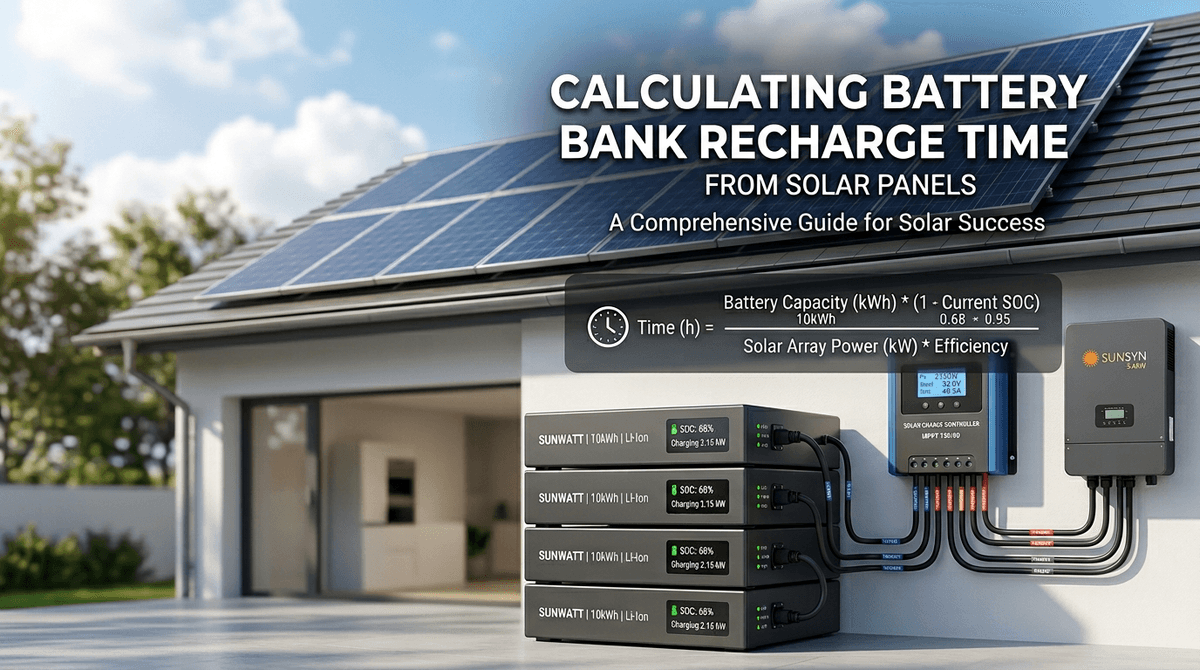
One of the most common questions we get from off-grid solar enthusiasts is, "How long will it take my solar panels to recharge my battery bank?"
Whether you are boondocking in an RV, living in an off-grid cabin, or relying on a solar generator during a power outage, knowing your solar battery recharge time is critical. If your panels can't replenish the energy you use each day, your batteries will eventually die, leaving you in the dark.
In this comprehensive guide, we will break down the exact formula to calculate your recharge time, explain the hidden efficiency losses you must account for, and show you how to size your solar array perfectly.
If you want to skip the math, you can always use our free WattSizing Solar Calculator to instantly determine your ideal system size!
The Basic Formula for Solar Recharge Time
At its core, calculating recharge time is a simple math equation: you divide the amount of energy you need to replace by the amount of power your solar panels can generate per hour.
The Basic Formula:
Recharge Time (Hours) = Energy Needed (Watt-hours) / Solar Panel Output (Watts)
However, this basic formula assumes 100% efficiency, which is impossible in the real world. To get an accurate number, we need to break this down into three detailed steps:
- Calculate the energy needed to refill the battery (in Watt-hours).
- Calculate the actual output of your solar panels (accounting for losses).
- Divide the energy needed by the actual output.
Let's walk through each step in detail.
Step 1: Calculate the Energy Needed to Refill Your Battery
Before you can calculate how long it takes to charge a battery, you need to know how much energy it takes to fill it up.
Batteries are usually rated in Amp-hours (Ah) and Volts (V). To find the total energy capacity in Watt-hours (Wh), simply multiply them:
Battery Capacity (Wh) = Amp-hours (Ah) x Volts (V)
Example: A 12V, 100Ah battery holds 1,200 Watt-hours of energy (12 x 100 = 1200).
Accounting for Depth of Discharge (DoD)
You rarely (if ever) drain a battery from 100% down to 0%. Different battery chemistries have different safe "Depth of Discharge" (DoD) limits:
- Lead-Acid (AGM, Gel, Flooded): Should only be discharged to 50% to maximize lifespan.
- Lithium Iron Phosphate (LiFePO4): Can safely be discharged to 80% or even 100%.
If you have a 12V 100Ah Lead-Acid battery (1200Wh) and you discharge it to its safe 50% limit, you only need to replace 600 Watt-hours of energy.
If you have a 12V 100Ah Lithium battery (1200Wh) and you discharge it to 80%, you need to replace 960 Watt-hours of energy.
Step 2: Calculate the Actual Output of Your Solar Panels
This is where most people make a mistake. If you have a 100W solar panel, it will almost never produce exactly 100 watts of power.
Solar panels are rated under perfect laboratory conditions (Standard Test Conditions, or STC). In the real world, you must account for several efficiency losses:
- Temperature: Solar panels lose efficiency as they get hotter.
- Angle and Shading: Panels rarely face the sun at a perfect 90-degree angle all day, and even minor shading can drastically reduce output.
- Wiring and Connections: Energy is lost as heat as it travels through wires.
- Charge Controller Efficiency: PWM controllers are only about 70-80% efficient, while MPPT controllers are 95-98% efficient.
- Battery Charging Efficiency: Lead-acid batteries lose about 15% of the energy pushed into them as heat during charging. Lithium batteries are much more efficient (around 99%).
The Real-World Efficiency Rule of Thumb
To account for all these losses, solar engineers use a standard derating factor.
- For MPPT Charge Controllers: Multiply your total solar panel wattage by 0.85 (85% efficiency).
- For PWM Charge Controllers: Multiply your total solar panel wattage by 0.75 (75% efficiency).
Example: If you have two 100W panels (200W total) and an MPPT controller, your real-world output is roughly 170 Watts per hour of direct sunlight (200 x 0.85 = 170).
Step 3: Calculate the Final Recharge Time
Now that we have the real numbers, we can use the final, accurate formula:
Accurate Formula:
Recharge Time (Hours) = Energy Needed to Refill (Wh) / Real-World Solar Output (W)
Example Calculation: The RV Weekend Warrior
Let's say you have a camper van with the following setup:
- Battery: One 12V, 200Ah AGM Battery (Discharged to 50%)
- Solar Panels: Three 100W Panels (300W total)
- Charge Controller: MPPT
1. Energy Needed: Total Capacity = 12V x 200Ah = 2400Wh. Since it's AGM, we only discharge to 50%. Energy Needed = 2400Wh x 0.5 = 1200Wh.
2. Real-World Solar Output: Total Solar = 300W. Using an MPPT controller (85% efficiency). Real Output = 300W x 0.85 = 255W.
3. Recharge Time: 1200Wh / 255W = 4.7 Hours of direct sunlight.
The Importance of Peak Sun Hours
In the example above, the battery will recharge in 4.7 hours. However, this means 4.7 hours of direct, overhead sunlight.
The sun is not equally strong all day. A solar panel produces very little power at 8:00 AM compared to 12:00 PM. To calculate if your panels can recharge your battery in a single day, you must use Peak Sun Hours.
A Peak Sun Hour is equivalent to one hour of sunlight at an intensity of 1,000 watts per square meter. Depending on your location and the season, you might get anywhere from 2 to 6 Peak Sun Hours per day.
- Arizona in Summer: ~6.5 Peak Sun Hours
- Seattle in Winter: ~1.5 Peak Sun Hours
If you need 4.7 hours to recharge your battery, but you live in Seattle in the winter, your 300W solar array will not be able to recharge your battery in a single day. You would need to add more solar panels.
How to Decrease Your Recharge Time
If your calculations show that your recharge time is too long, you have a few options to speed things up:
- Add More Solar Panels: This is the easiest and most effective solution. Doubling your solar wattage will cut your recharge time in half.
- Upgrade to an MPPT Charge Controller: If you are currently using a cheaper PWM controller, upgrading to an MPPT can instantly boost your solar yield by up to 30%.
- Switch to Lithium Batteries: Because lithium batteries charge much more efficiently than lead-acid (and can accept a higher charge current), they will recharge significantly faster, even with the exact same solar panels.
- Use a Generator or Alternator: For days with poor weather, having a secondary charging source like a DC-to-DC alternator charger or a gas generator is crucial for off-grid reliability.
Conclusion
Calculating your solar battery recharge time doesn't have to be complicated, but it does require realistic expectations about efficiency losses and available sunlight. By using the formulas above, you can ensure your off-grid system is perfectly balanced and never leaves you without power.
Ready to take the guesswork out of sizing your system? Use our comprehensive WattSizing Calculator to instantly find the perfect ratio of solar panels to battery capacity for your specific location and energy needs!
Frequently Asked Questions (FAQ)
Can I charge a 100Ah battery with a 100W solar panel?
Yes, but it will take a long time. A 100Ah 12V battery holds 1200Wh. A 100W panel produces about 85W in the real world. If the battery is 50% discharged (needs 600Wh), it will take about 7 hours of direct, peak sunlight to recharge. In many locations, this will take more than one day.
Why is my solar panel not charging my battery fast enough?
There are several reasons: poor sun angle, shading (even a tiny shadow on one corner of a panel can cut output by 50%), hot temperatures reducing panel efficiency, using a low-efficiency PWM charge controller, or simply not having enough total solar wattage for your battery bank size.
Does a larger battery charge faster?
No. A larger battery bank takes longer to charge if your solar array remains the same size, because there is more total energy (Watt-hours) to replace. To charge a larger battery in the same amount of time, you must add more solar panels.


