
You've purchased high-efficiency solar panels, a top-of-the-line MPPT charge controller, and premium lithium batteries. You wire everything up, wait for a sunny day, and check your monitoring app—only to find that your system is producing 10% to 15% less power than it should be.
Where did that energy go? It didn't vanish into thin air; it was lost as heat in your wiring due to a phenomenon known as voltage drop.
Voltage drop is the silent killer of solar system efficiency. If ignored, it will not only rob you of the power you paid for, but it can also cause your charge controller to chronically undercharge your batteries, leading to premature battery failure.
In this comprehensive guide, we will explain exactly what voltage drop is, why it happens, how to calculate it, and most importantly, how to eliminate it. If you want to skip the manual math, you can use our free solar calculator to automatically size your wires for minimal voltage drop.
What is Voltage Drop?
To understand voltage drop, it helps to think of electricity like water flowing through a hose.
- Voltage is the water pressure.
- Amperage (Current) is the volume of water flowing.
- The Wire is the hose itself.
No wire is a perfect conductor; all wires have a certain amount of internal resistance. As electricity travels down the wire, it has to fight against this resistance. The longer the wire, and the thinner the wire, the more resistance the electricity encounters.
As the electricity fights through this resistance, some of the "pressure" (Voltage) is lost as heat. Therefore, the voltage measured at the end of the wire will always be lower than the voltage measured at the beginning of the wire. This difference is the voltage drop.
Why is Voltage Drop a Problem in Solar?
- Lost Power (Watts): Power (Watts) is calculated by multiplying Voltage by Amps (W = V x A). If your voltage drops, your total wattage drops. You are literally throwing away the solar energy you generated, turning it into useless heat in your cables.
- Improper Battery Charging: This is the most severe consequence. A charge controller relies on precise voltage readings to know when a battery is full. If there is a high voltage drop between the controller and the battery, the controller will read a higher voltage than the battery is actually receiving. It will prematurely switch to "Float" mode, leaving your batteries chronically undercharged. Over time, this destroys lead-acid batteries through sulfation.
- Inverter Shutdowns: Inverters have a low-voltage disconnect (LVD) feature to protect batteries. If the voltage drop between the battery and the inverter is too high, the inverter will sense a low voltage and shut down, even if the battery is fully charged.
The Golden Rules of Solar Voltage Drop
In the solar industry, there are strict guidelines for acceptable voltage drop percentages to ensure maximum efficiency and equipment safety.
1. Solar Panels to Charge Controller: Max 2% to 3%
The wire run from your roof (or ground mount) to your charge controller is usually the longest in the system. Because modern MPPT charge controllers can handle high voltages, you have a little more leeway here. You should aim for a maximum voltage drop of 2%, though up to 3% is acceptable for very long runs.
2. Charge Controller to Battery Bank: Max 1%
This is the most critical wire run for battery health. Because the charge controller needs exact voltage readings to charge the batteries properly, the voltage drop here must be kept to an absolute minimum. Aim for less than 1% voltage drop. This is achieved by keeping the charge controller as physically close to the batteries as possible (ideally under 3 feet).
3. Battery Bank to Inverter: Max 1% to 2%
Inverters pull massive amounts of current (Amps). High current exacerbates voltage drop significantly. To prevent the inverter from shutting down under heavy loads, keep the voltage drop between the battery and inverter under 2% (ideally under 1%). This requires very thick, short cables.
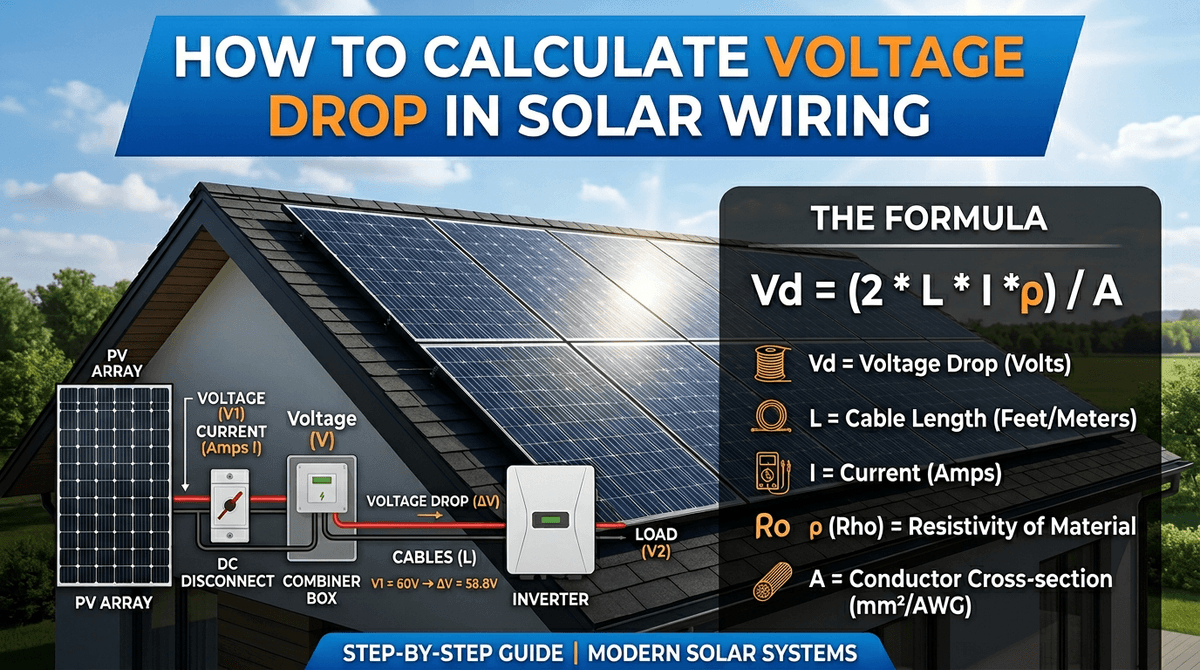
How to Calculate Voltage Drop (The Formula)
Calculating voltage drop manually requires knowing four variables:
- Current (Amps): The maximum amps flowing through the wire.
- Length of the Wire (Feet): The one-way distance of the wire run.
- System Voltage: The operating voltage (e.g., 12V, 24V, 48V, or the Vmp of your solar array).
- Wire Resistance: The resistance of the specific wire gauge (AWG) per 1000 feet (found in NEC Chapter 9, Table 8).
The Voltage Drop Formula:
Voltage Drop = (2 x Length x Current x Resistance per 1000ft) / 1000
The Percentage Formula:
Voltage Drop % = (Voltage Drop / System Voltage) x 100
Real-World Example Calculation
Let's say you have a 12V solar system. Your solar array produces 20 Amps at 18 Volts (Vmp). The panels are located 50 feet away from your charge controller. You are using standard 10 AWG wire.
- Step 1: Find the resistance. According to NEC tables, stranded 10 AWG copper wire has a resistance of roughly 1.24 ohms per 1000 feet.
- Step 2: Apply the formula. Voltage Drop = (2 x 50ft x 20A x 1.24) / 1000 Voltage Drop = (2480) / 1000 Voltage Drop = 2.48 Volts
- Step 3: Calculate the percentage. Voltage Drop % = (2.48V / 18V) x 100 Voltage Drop % = 13.7%
The Result: A 13.7% voltage drop is catastrophic. You are losing nearly 14% of your solar energy to heat in the wires. To fix this, you must upsize the wire.
If we run the same calculation using much thicker 4 AWG wire (resistance of 0.25 ohms per 1000ft):
- Voltage Drop = (2 x 50 x 20 x 0.25) / 1000 = 0.5 Volts.
- Percentage = (0.5V / 18V) x 100 = 2.7%.
By upsizing from 10 AWG to 4 AWG, we brought the voltage drop down to an acceptable level.
3 Ways to Reduce Voltage Drop in Your Solar System
If your calculations show an unacceptable voltage drop, you have three primary ways to fix the problem.
1. Upsize the Wire (Decrease AWG)
As demonstrated in the example above, the most common way to reduce voltage drop is to use a thicker wire. Thicker wires have less internal resistance. If a 10 AWG wire gives you a 10% drop, moving to an 8 AWG, 6 AWG, or 4 AWG wire will progressively lower that percentage.
Pros: Simple, easy to understand. Cons: Thick copper wire is very expensive and can be difficult to physically bend and fit into the terminals of your equipment.
2. Shorten the Wire Run
Voltage drop is directly proportional to the length of the wire. If you cut the distance in half, you cut the voltage drop in half.
Pros: Saves money on wire costs. Cons: Not always physically possible. You can't usually move your roof closer to your garage. However, you can ensure your charge controller, batteries, and inverter are mounted right next to each other on the same wall.
3. Increase the System Voltage (The Best Solution)
This is the secret weapon of professional solar designers. Because Power = Volts x Amps, if you increase the voltage, the amperage drops proportionally for the same amount of power. Lower amperage means significantly less voltage drop.
How to do it:
- For the Solar Array: Instead of wiring all your solar panels in parallel (which keeps voltage low and pushes amperage high), wire them in series. Wiring panels in series adds their voltage together while keeping the amperage low. A high-voltage array (e.g., 100V to 150V) can push power through hundreds of feet of standard 10 AWG wire with almost zero voltage drop. (Note: You must use an MPPT charge controller to do this).
- For the Battery Bank: Instead of building a 12V battery bank, build a 24V or 48V battery bank. A 2000W inverter pulls ~166 Amps at 12V, but only ~41 Amps at 48V. This massive reduction in amperage virtually eliminates voltage drop issues between the battery and inverter, allowing you to use much cheaper, thinner cables.
Frequently Asked Questions (FAQ)
1. Does voltage drop happen on AC wiring too?
Yes. Voltage drop occurs on both DC (Direct Current) and AC (Alternating Current) wiring. However, because the AC power coming out of your inverter is high voltage (120V or 240V) and relatively low amperage, voltage drop is rarely an issue for standard household wire runs. It is primarily a major concern on the low-voltage, high-amperage DC side of your solar system.
2. Can voltage drop cause a fire?
Extreme voltage drop means the wire is acting as a resistor and generating heat. While the voltage drop itself won't start a fire, the heat generated by pushing too many amps through a wire with high resistance absolutely can melt insulation and cause electrical fires. This is why proper wire sizing and fusing are mandatory.
3. Why does my inverter beep and shut off when I run the microwave?
This is a classic symptom of voltage drop between the battery and the inverter. When the microwave starts, it pulls a massive surge of amps. If your battery cables are too thin or too long, that surge creates a severe, instantaneous voltage drop. The inverter's internal sensors read this low voltage, assume the battery is dead, and shut down to protect the system. Upsizing your battery cables will usually fix this.
4. Are the voltage drop calculators online accurate?
Yes, most online calculators use the standard NEC formulas and are highly accurate. However, they are only as accurate as the data you input. You must ensure you are using the correct maximum amperage and the correct one-way wire distance. For a calculator specifically designed for solar applications, use the WattSizing Calculator.
Conclusion
Voltage drop is an unavoidable law of physics, but it doesn't have to ruin your solar system's performance. By understanding the relationship between wire length, thickness, amperage, and voltage, you can design a system that minimizes resistance and maximizes power delivery.
Always aim for less than a 2% drop from your panels to your controller, and less than a 1% drop between your controller, batteries, and inverter. When in doubt, wire your solar panels in series to increase voltage, build a 24V or 48V battery bank, and never hesitate to upsize your copper wiring.
Ready to perfectly size your wires without doing the math yourself? Head over to the WattSizing Calculator to get instant, accurate wire gauge recommendations for your entire off-grid or grid-tied solar system!


