
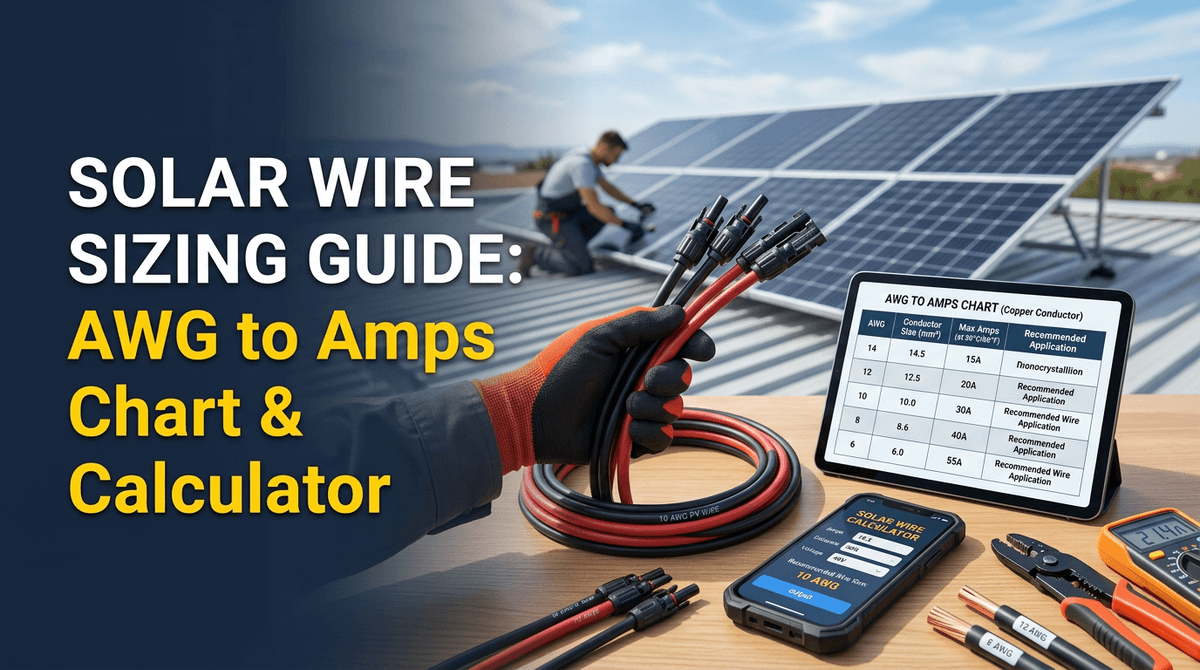
When designing a solar energy system, one of the most critical—yet frequently misunderstood—components is the wiring. Using the wrong size wire between your solar panels, charge controller, batteries, and inverter isn't just inefficient; it's a massive fire hazard.
In the solar industry, wire size is measured in American Wire Gauge (AWG). The smaller the AWG number, the thicker the wire. Thicker wires can safely carry more electrical current (Amps) without overheating.
In this comprehensive guide, we will explain exactly how to size the wires for every part of your solar system. We've included an easy-to-use AWG to Amps chart, explained the critical concept of "ampacity," and detailed how voltage drop affects your wire choices. If you want to automatically calculate the exact wire size for your specific setup, use our free solar calculator.
What is Ampacity?
Before looking at the chart, you must understand ampacity.
Ampacity is the maximum amount of electrical current (Amps) a conductor can carry continuously under the conditions of use without exceeding its temperature rating. If you push more amps through a wire than its ampacity rating allows, the wire will heat up. Eventually, the insulation will melt, and the wire could catch fire.
When sizing solar wires, your goal is to ensure the ampacity of the wire is always higher than the maximum current that will flow through it.
The Solar Wire Sizing Rule: The 125% Safety Factor
The National Electrical Code (NEC) requires a safety factor when sizing wires for continuous loads (like solar panels producing power for hours at a time).
You should never size a wire to run at 100% of its maximum ampacity. Instead, you must multiply the maximum expected current by 1.25 (a 125% safety factor) to determine the required wire ampacity.
Example Calculation:
- Maximum Current: Your solar array produces a maximum of 20 Amps.
- Apply Safety Factor: 20 Amps x 1.25 = 25 Amps.
- Required Wire: You must choose a wire that has an ampacity rating of at least 25 Amps.
Solar Wire Sizing Chart (AWG to Amps)
The following chart shows the standard ampacity ratings for copper wire with 90°C (194°F) insulation, which is the standard for most modern solar installations (like THWN-2 or PV wire).
Note: This chart assumes no more than 3 current-carrying conductors in a conduit and an ambient temperature of 30°C (86°F).
| Wire Gauge (AWG) | Maximum Ampacity (Amps) | Common Solar Application |
|---|---|---|
| 14 AWG | 15 Amps | Small, single-panel setups (under 100W) |
| 12 AWG | 20 Amps | Standard single panels, small parallel arrays |
| 10 AWG | 30 Amps | Standard PV wire from roof array to combiner box |
| 8 AWG | 55 Amps | Combiner box to charge controller (short runs) |
| 6 AWG | 75 Amps | Charge controller to battery bank |
| 4 AWG | 95 Amps | Small inverter to battery bank (1000W) |
| 2 AWG | 130 Amps | Medium inverter to battery bank (2000W) |
| 1/0 AWG | 170 Amps | Large inverter to battery bank (3000W) |
| 2/0 AWG | 195 Amps | Very large inverter to battery bank (4000W) |
| 4/0 AWG | 260 Amps | Massive inverter to battery bank (5000W+) |
Sizing Wires for Each Component of Your System
A solar energy system has three distinct wiring "runs," and each requires a different calculation.
1. Solar Panels to Charge Controller
This run carries the high-voltage DC power generated by your panels down to the charge controller.
- Calculation: Find the Short Circuit Current (Isc) rating on your solar panel's specification sticker. Multiply this number by the number of panels wired in parallel. (Panels wired in series increase voltage, not amperage).
- Safety Factor: Multiply the total parallel Isc by 1.56 (The NEC requires a 1.25 multiplier for continuous sunlight, plus another 1.25 multiplier for the wire ampacity: 1.25 x 1.25 = 1.56).
- Example: You have two 10A panels wired in parallel. Total Isc = 20A. 20A x 1.56 = 31.2A. You need a wire rated for at least 31.2 Amps (8 AWG).
- Standard Wire: Most modern solar panels come with 10 AWG PV wire pre-installed, which is rated for 30 Amps.
2. Charge Controller to Battery Bank
This run carries the regulated DC power from the charge controller into the batteries.
- Calculation: Look at the maximum output rating of your charge controller (e.g., a 60 Amp MPPT controller).
- Safety Factor: Multiply the controller's max output by 1.25.
- Example: 60A controller x 1.25 = 75 Amps. You need a wire rated for at least 75 Amps (6 AWG).
- Crucial Rule: This wire run should be as short as physically possible (under 5 feet) to minimize voltage drop.
3. Battery Bank to Inverter
This is the most critical and dangerous wire run in your entire system. Inverters pull massive amounts of low-voltage DC power, resulting in extremely high amperage.
- Calculation: Divide the inverter's maximum continuous wattage by the battery bank voltage. Then divide by the inverter's efficiency (usually 0.85).
- Safety Factor: Multiply the result by 1.25.
- Example: A 2000W inverter on a 12V battery bank.
- (2000W / 12V) / 0.85 = 196 Amps.
- 196 Amps x 1.25 = 245 Amps.
- Required Wire: You need a wire rated for at least 245 Amps (4/0 AWG).
The Silent Killer: Voltage Drop
Even if you select a wire that can safely handle the amperage (based on the chart above), you might still need to use a thicker wire due to voltage drop.
Voltage drop occurs when electrical current travels through a wire. The longer the wire, the more resistance it has. This resistance causes the voltage at the end of the wire to be lower than the voltage at the beginning.
Why Voltage Drop Matters
- Efficiency Loss: If you lose 10% of your voltage between the panels and the charge controller, you are losing 10% of your solar energy as heat.
- Equipment Failure: Inverters and charge controllers require a specific voltage to operate. If the voltage drops too low, the equipment will shut down or fail to charge the batteries properly.
The Voltage Drop Rule of Thumb
As a general rule in solar design, you should aim for:
- Less than 2% voltage drop between the panels and the charge controller.
- Less than 1% voltage drop between the charge controller, batteries, and inverter.
How to Fix Voltage Drop
If your wire run is very long (e.g., your panels are 100 feet away from your house), the standard AWG from the ampacity chart will result in unacceptable voltage drop.
To fix this, you must "upsize" the wire. By using a thicker wire (a lower AWG number), you decrease the resistance and reduce the voltage drop.
Example: A 10 AWG wire can safely carry 30 Amps. However, if you run 30 Amps through 100 feet of 10 AWG wire on a 12V system, the voltage drop will be massive (over 15%). To get the voltage drop under 2%, you would need to upsize to incredibly thick 2/0 AWG wire.
To calculate the exact voltage drop for your specific wire length and amperage, use our solar calculator.
Copper vs. Aluminum Wire
When shopping for thick wires (like 1/0 or 4/0 AWG) for your battery bank, you will notice that Aluminum wire is significantly cheaper than Copper wire.
Do not use Aluminum wire for your battery or inverter connections.
While aluminum is an acceptable conductor, it has higher resistance than copper. This means an aluminum wire must be significantly thicker than a copper wire to carry the same amount of current. Furthermore, aluminum expands and contracts more than copper when heated, which can cause connections to loosen over time, creating a severe fire hazard.
Always use pure stranded copper wire for your solar installations. For battery and inverter connections, highly flexible "welding cable" is the easiest to work with.
Frequently Asked Questions (FAQ)
1. What happens if I use a wire that is too small?
If the wire is too small for the amperage, it will act like a resistor. It will heat up, melting the insulation and potentially causing an electrical fire. Even if it doesn't catch fire, the severe voltage drop will cause your inverter to shut down and your batteries to chronically undercharge.
2. Can I use a wire that is too large?
Electrically, no. Using a thicker wire than necessary (e.g., using 4 AWG when 10 AWG is required) is perfectly safe and will actually improve your system's efficiency by reducing voltage drop to near zero. The only downsides are cost and physical difficulty (thick wire is hard to bend and may not fit into the terminals of your equipment).
3. What is PV Wire?
Photovoltaic (PV) wire is a specific type of single-conductor wire designed specifically for connecting solar panels. It has extra-thick, UV-resistant, and weather-resistant insulation designed to withstand decades of exposure to harsh sunlight, rain, and extreme temperatures on a roof.
4. Do I need to fuse my wires?
Yes, absolutely. Every wire run in your system should be protected by a fuse or circuit breaker. The fuse must be sized to protect the wire, not the equipment. If a wire is rated for 100 Amps, the fuse should be no larger than 100 Amps. If a short circuit occurs, the fuse will blow before the wire melts.
5. Does the insulation temperature rating matter?
Yes. The ampacity chart above assumes 90°C (194°F) insulation. If you use cheap wire with 60°C insulation, it cannot safely carry as many amps because the insulation will melt at a lower temperature. Always check the temperature rating printed on the wire jacket.
Conclusion
Proper wire sizing is not a suggestion; it is a critical safety requirement for any solar installation. By understanding ampacity, applying the 125% safety factor, and accounting for voltage drop over long distances, you can design a system that operates efficiently and safely for decades.
Always remember: when in doubt, upsize the wire. A thicker wire will never hurt your system, but a wire that is too thin can cause catastrophic failure.
Ready to take the guesswork out of your solar design? Head over to the WattSizing Calculator to instantly determine the exact AWG wire size, fuse size, and voltage drop for your specific off-grid or grid-tied solar project.


